Showing posts with label Getting tipsy. Show all posts

Wednesday, August 24, 2011

Drunk guys say the sweetest things

On Saturday, I attended the Bend Brewfest. It’s a three-day event featuring more than 80 fine beers from craft breweries across the region.

In other words, a great place to get sloshed.

Not that this was my goal. While it’s true I enjoyed my share of delectable adult beverages, I always find it more entertaining to watch other people get hammered.

I hadn’t been there more than twenty minutes when I found myself ravenously hungry. I wandered over to the food court and selected a tasty gourmet sausage made with curry and lemongrass. They served it to me on a stick, so I carried my treat back to the common area to search for my friends.

Within seconds, a strange man in a stained blue t-shirt staggered up with a glazed expression and a mug he struggled to hold upright.

“You know you’re driving every guy here totally crazy,” he slurred.

I looked behind him to see if there was an angry mob forming. I didn’t see one, nor could I recall having done anything to impact the gentleman’s sanity.

I looked back at him. “Come again?”

He closed his eyes and groaned. “Yeah.”

He opened his eyes and nodded at my snack. “You with that sausage. You’re so f**king hot.”

It finally occurred to me what he was getting at, and I tried to discretely wipe sausage juice off my hand to avoid additional comment.

“Sure,” I said as I backed away. “I’m sure it’s especially hot the way I just bit the end off and chewed it into a million little pieces.”

He laughed like that was the funniest thing he’d ever heard. Then he fell over in the grass.

I continued on with my evening, consuming a whole lot of good food and beer and watching as everyone began looking a lot more glassy-eyed. I excused myself at one point to visit the porta-potties. After making use of the facilities, I emerged to discover the hand-washing station had run out of water and paper towels.

Naturally, I didn’t discover this until after I’d soaped up my hands.

A guy beside me made the same discovery, and looked at me with a tipsy grin. He held up his hands for my inspection. “Can I dry them on your shirt?”

“No thanks,” I replied as I focused on pumping a few meager tablespoons of water from the portable sink.

Undeterred, the guy grinned wider. “You want to dry your hands on my pants?”

And just in case I hadn’t understood the offer, he thrust his pelvis at me.

“That’s very kind of you,” I said, backing away. “How about you wipe your hands on your own pants?”

He looked down, probably assessing whether that was an acceptable substitution. “Hey, my fly’s down.”

“Yes, it is,” I agreed. “I hear that’s what all the ladies find charming.”

“No shit?”

I wandered away and returned to my evening of excellent beer and food. Still, none of it impressed me quite as much as the creativity of those alcohol-saturated Romeos. Though I doubt either gentleman remembers his romantic gesture, they can rest assured I do.

What’s the funniest thing you’ve ever heard a drunk person say? For that matter, has someone ever informed you of some pearl of wisdom you’ve offered up after a few too many? Please share.

I’ll be over here deciding whether my dinner sausage would be best accompanied by Pumpkin Ale or Pineapple Wheat Beer.

Thursday, April 7, 2011

The wine between my legs

I can be a bit of a wine snob.

I’m also a cheapskate, which you’d think wouldn’t mesh with the wine thing. In truth, it just means I’m skilled at finding bargains on good stuff.

When it comes to red wine, I’m a big believer in decanting – pouring wine from its bottle into a receptacle that allows it to breathe. For older wines, it’s a good way to separate out sediment. For younger wines, the act of mixing the wine with oxygen brings out its best characteristics.

I see the non-wine drinkers among you yawning, so I’ll get on with the story.

If I’m bringing a wine to dinner party and I know it will be served early in the evening, I’m faced with a dilemma. It makes sense to pour the wine in my decanter and drive slowly to my destination with the receptacle anchored between my legs.

But like most states, Oregon has an open container law. I’ve read the law, and I don’t disagree with its intent. I’m as eager as the next person to reduce the number of folks swigging from bottles of Mad Dog as they cruise the streets looking for transvestite hookers.

I also know I’m not going to be drinking straight from my decanter. Aside from the physical impossibility of it, it’s unlikely anyone would be refined enough to bother decanting a wine but gauche enough to guzzle it behind the wheel of a moving vehicle.

Let’s all pause here for a moment while we finish laughing at the fact that I just implied I’m refined.

Nevertheless, the open container issue is something I’ve considered. If a police officer pulls me over, I’m technically in violation of the law. I recognize that, but can’t help but wonder if a cop would be a little understanding. It’s not like I’m slurping it through a twisty straw, and I really can’t throw the decanter in the trunk to roll around with my spare tire. I'm also a stickler for making sure I don't drive home later in the evening if I've had more than a few sips.

In truth, I don’t spend a ton of time worrying about this. I usually just opt for wines that don’t require decanting, or make sure the wine I bring won’t be served until later in the evening. Problem solved.

But I do think about this in the context of writing rules and when it’s OK to break them.

In romance writing, there are plenty of subjects and situations authors have avoided over the years. While the implied rules have loosened and plenty of authors break them, it's still risky.

For instance, in a love story where the hero and heroine will end up pledging eternal devotion to one another, it's tough to include earlier scenes where either character is bumping uglies with a different person. There are plenty of reasons for doing it, but it takes a careful hand and an acceptance of the risk that some readers might lose sympathy or question the central relationship.

But some authors can smash the rules so beautifully you forget they're there at all. I’ve been re-reading Jennifer Crusie’s FAST WOMEN for the millionth time, enjoying the humorous look at divorce and relationships. 

The fact that Crusie can write a funny book about divorce is one of many reasons I worship at her altar. Another reason is that the book includes a glorious scene in which the heroine sleeps with the hero’s best friend, cousin, and business partner (that’s all the same guy – it’s a fling, not a gang-bang).

The scene is there for a lot of good reasons, and it moves the character development in ways that couldn’t have happened without it.

But talk about risky.

I’ve reread the scene a lot, not just because it’s hot, but because it’s a good study in how to get away with something most authors wouldn’t touch with a ten foot pole.

While I don’t know that it’ll help me much if a cop pulls me over with a decanter of wine and a transvestite hooker in my car, I do think it’ll help me the next time I decide to break an implied writing rule.

Are there times you’ve found yourself breaking rules for a good reason? When is it justifiable and when are you just being bratty? Please share!

Tuesday, January 4, 2011

Happily ever after…or something like that

I am not big fan of television. There’s a TV in my home, but the closest I can come to operating it is staring at the remote like a monkey doing algebra.

Despite this, I must confess that I watch The Bachelor.

Not only that, I’ve watched The Bachelorette.

It started innocently enough a couple years ago. A girlfriend invited me over to share a bottle of wine while her husband was scratching himself in a bar watching Monday Night Football. Soon I was hanging out on her sofa every Monday evening.

While we sucked down Chianti, we got sucked into a show that – let's be honest – kind of sucks.

Or does it?

In case you’ve never watched, the format is simple: one eligible bachelor or bachelorette is presented with a pool of 25-30 potential marriage candidates. One by one, the suitors are eliminated after a series of dates and challenges. In the end, the bachelor or bachelorette chooses a mate and the happy couple enjoys wedded bliss for all of eternity.

Theoretically, anyway.

Out of 14 seasons of The Bachelor and six of The Bachelorette, there’s only been one actual marriage between the final couple. Not great odds.

And yet…we want to believe it can work.

Or maybe we just want to play drinking games that involve taking a slug of Sangiovese each time someone utters the phrase soulmates, falling for you, or amazing connection.

I’m hesitant to draw a parallel between cheesy reality TV and the romance genre, but I can’t pretend there isn’t one. We’ve all heard statistics about how 40-50% of all marriages end in divorce. We know relationships are messy and difficult and likely to involve as much time spent picking up your spouse’s socks as making love in a field of daffodils while sparrows sing “Endless Love.”

Still, we want to believe the fairy tale. In the happily ever after. In the idea that two people can meet and fall in love and sustain their passion even after ABC halts the flow of all-expense-paid dates.

Or maybe we just appreciate the entertainment value of watching people make asses of themselves in the name of love. There's no shame in that.

Do you have any guilty pleasures when it comes to love, lust, and cheesy entertainment? What keeps you tuning in or turning pages? Please share.

I’ll be over here filling out my application to be the next Bachelorette. They take married chicks, right?

Wednesday, November 10, 2010

On cheap wine and editor taste

What’s it like to get a bunch of wine snobs together with a bunch of cheapskates when it just so happens they’re the same people?

That’s what yesterday evening was like for me.

I love good wine, and I love a good bargain. Those two things sometimes coexist at the Grocery Outlet (a surplus retailer with 130 stores in 6 western states offering discounted prices on everything from toothbrushes to lobster tails).

The wine section at the Grocery Outlet is a bit like going to Vegas. Sometimes you toss in a few coins and come out with a lovely little gem of Italian Sangiovese with just the right notes of strawberry and oak.

Other times you check the label to see if you accidentally purchased oven cleaner.

The gamble is worth it, since most wines are under $10, with plenty of bargains to be found in the $2.99-$3.99 range.

A few times a year, they offer 20% off all their wines. Cheapskate wine snobs look forward to these events because if we can just figure out which wines are the real gems, we can buy entire cases for pennies on the dollar.

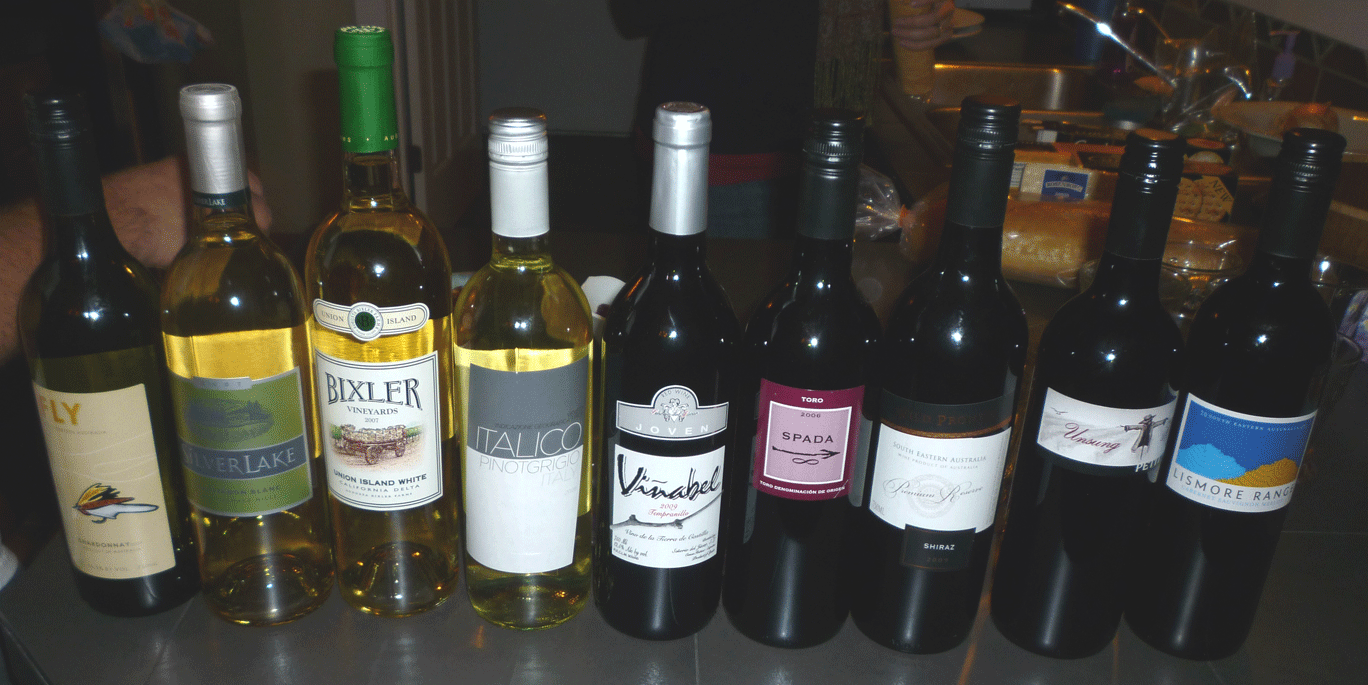
This was the thought behind a dinner party at a friend’s house last night. Seven of us gathered with nine bottles of recently purchased Grocery Outlet wine and a plan to find the best ones in the bunch.

We intended to determine the best bargains and race back at 7 a.m. the next morning to fight the other cheapskate wine snobs for the good stuff.

But here’s the funny thing – none of us agreed on which wine was “the good stuff.”

I was fond of the 2008 Unsung Heroes Petite Verdot from South Australia. My friend Larie fell hard for a quirky little white blend from California with a ghetto label. Pythagoras – who isn’t generally a wine fan – loved an Italian Pinot Grigio that didn’t have a word of English printed on the bottle.

And while the two Spanish reds I expected to adore fell flat in my opinion, they drew great praise from several members of the group.
It reminds me of an analogy someone shared when I first started submitting my writing to editors and agents.

“Don’t think of it as the editor rejecting you because it’s bad,” she urged. “Think of it more like you’re around a big dinner table with a bunch of editors, and the one next to you passes on your green bean casserole because she doesn’t particularly care for green beans, but the editor at the other end of the table happens to love them.”

It put things into perspective for me. Yes, there are always things we can do to grow and improve as writers, but rejection doesn’t always mean you suck. Sometimes, it just means you offered the editor a spicy Shiraz when she happened to want a citrusy Sauvignon Blanc.

We all have different tastes – even editors and agents. This is a subjective business. The trick is to keep that in mind, and remember that somewhere out there is the person who will love every last drop of whatever you’re pouring.

On that note, I must go practice my kung-fu moves. If the other cheapskate wine snobs think they’re getting their hands on that Petit Verdot, they’ve got another think coming.

Monday, September 13, 2010

My hole got plugged so my jugs aren't full

Before we get started on this fine Monday morning, thank you SO MUCH to everyone who offered blog organization tips in response to Friday's post.

I asked Joelle Anthony, author of RESTORING HARMONY, to choose one lucky commenter to receive the autographed copy of her book. After a complicated selection process that involved calculating the square root of pi and sacrificing several small mammals, Joelle chose blog commenter ~ M (also known as Mary Alongi). Congratulations, Mary! Email me with your address and I'll get the book to you ASAP!

Now, back to our regularly scheduled blog post.

I traveled to Salem, OR this past weekend to take part in the 20th Annual Grape Stomp Competition at Willamette Valley Vineyards.

Participants compete in pairs with the "stomper" using bare feet to crush grapes, and the "swabber" using a dipstick-like device to keep the drain clear and the juice flowing into the milk jugs.

I stomped. My dad swabbed.

We sucked.

Something went awry with our drain tube, and despite my dad's best efforts, we couldn't get it clear. On top of that, the teenager I asked to take video of the five-minute event manged to record exactly one second of footage of me stepping out of the barrel.

But this is exactly what I wanted. A learning experience.

Though it's possible I'd do this event even if I didn't have an ulterior motive, I do have one. The third book in my contract, LET IT BREATHE, takes place in the Oregon wine industry. Though it won't be released until August 2012, it's never to early to look for interesting promotional opportunities.

I don't know yet if the 2012 Grape Stomp might be a good place for a book signing, or if my time might be better spent lighting my hair on fire and screaming "buy my book!" as I fling grape pulp at the competitors.

But I do know how the event works now. I know that next time, I'll watch the earlier heats to see which barrels have trouble draining. I know I'll spend more time finding someone to take video. I know I'll poke holes in the bottom of the other competitors' jugs so all their juice drains out I'll wear my hair up next time so it stays out of my face.

It's a bit like writing, no? Even if some of your earliest efforts are abysmal failures in terms of publication or feedback, they aren't wasted efforts. You learn from those efforts, and those lessons will serve you well with future books.

What are some learning experiences you've had so far in your writing? Please share.

And speaking of sharing, here are some of the lovely photos my mother took on Saturday. Enjoy!

A plethora of grapes await stomping.
Dad scopes out the barrels before the competition.
A little pre-competition beverage.
Sizing up the competition before the whistle blows.
Stomping...
More stomping...
Wow, this stomping is lasting on a long time.

Yay, team! Oh, wait – we sucked.
My grape stomping machines.
Getting cleaned up afterward.
Standing in line to get our juice strained and measured.
Hanging with my parents!

Monday, August 30, 2010

Why I love being a trophy wife

On Friday night, I had a hot date with a guy who’s not my husband.

He’s a handsome, sophisticated, dashing older gentleman, and we enjoyed a fine evening of gourmet food and wine.

The fact that he’s my dad doesn’t make it any less scandalous. On the contrary, I saw several sets of raised eyebrows.

You see, my dad is a retired teacher who spent 30 years at the same school. Pretty much anywhere he goes in Salem, Oregon, there's a chance he'll run into a former student, parent, or colleague.

Since my mom prefers her wine to include the word “cooler,” it’s one of those things my dad and I enjoy together. We enjoy it best of all at the Celebration Oregon, an annual event that includes wines from 50+ wineries and food from 15 chefs.
Taking wine notes.

We’ve been attending for years, and without fail, we always run into someone who knows my dad.

On Saturday night, it was a perky 20-something pouring for one of the wineries.

“Mr. Fenske!” she called. “Hi, Mr. Fenske! Remember me?”

As always, there was a long pause. I could see the wheels turning in my dad’s head. I could see him trying hard to place her – maybe in the back of the classroom in 1999? No, no, maybe third seat from the front the last semester of 1997– did she have braces then?

“It’s Jane,” she announced. “You were my English and Social Studies teacher. I thought you were the best!”

As my dad continued to study her and wait for recognition to dawn, I watched the girl steal a look at me. That’s when I saw the wheels start to turn in her head:

Wait – that’s not his wife. I know that’s not his wife, he had a picture on his desk. Is she the mistress? Oh, man. Maybe I’m not supposed to see this. Or maybe his wife died and he got a younger one. Wow, that’s so sad, but good for him. I mean, a guy deserves to be happy, right?

If I were a nicer person, I’d step in every time this happens and clear the whole thing up by introducing myself as Mr. Fenske’s daughter.

But the fact is, I enjoy this. For all those times my dad went out of his way to embarrass me in middle school by calling me by my nickname in front of my classmates (Buzzard Snot, if you must know) this is payback.

Eventually, we wandered off with our wineglasses in hand. I was already scanning the crowd for the next former student. Just for fun, I reached up with my napkin to dab some barbecue sauce from my dad’s chin.

I’m a considerate sort of trophy wife.

Did you have parents who liked to embarrass you? Has the tide shifted now that you’re older, or are they still yelling across public places to ask if you need to use the bathroom? Please share in the comments.

I’ll be deciding whether my mom has something coming in return for all those early curfews.
Is he my dad, or is he my sugar daddy?

Friday, August 27, 2010

My book club got NUMB from something besides wine

I've been part of the same book club for over 10 years.

We've read some incredible books, and have had the opportunity to talk with a number of authors whose books we've chosen. Sometimes, the author joins us in person (as was the case with Diane Hammond, author of HANNAH'S DREAM) but usually we cluster tipsily around a speakerphone, giddy with excitement at getting to talk with a real, live author.

The author making us giddy last night was Sean Ferrell, debut author of NUMB. According to him, he phoned us from the floor of a bus station and wasn't wearing any pants.

According to us, we're all Swedish swimsuit models dressed for the occasion in fur bikinis with lion tails sewn to the back.

It's possible some of us were lying. Certainly Sean has a talent for storytelling, if NUMB is any indication.

Here's what the book is about:
Numb, a man who feels no pain and has no memory of how he came to be this way, travels to New York City after a short stint in the circus to search for the answers to his past. But when word of his condition spreads – sparked by the attention he attracts from letting people nail his hands to bars for money – he quickly finds himself hounded on all sides by those who would use his unique ability in their own pursuits of fame and fortune. There's the best friend who doesn't quite know how to handle Numb's newfound celebrity, the savvy talent agent who may or may not have Numb's best interests in mind, the sadistic supermodel whose idea of a good time involves lion claws and can openers, and the blind girlfriend who might actually see something in Numb others don't. As Numb navigates this strange world, and as he continues to search for clues from his past, he is forced to confront one of life's toughest questions: Who am I?

We loved it (and I'm not just saying that because Sean threatened to beat me up – dude, I could totally take him). The book was sweet, funny, thought-provoking, touching, and – at times – uncomfortable to read.

That was one of the things I loved best about it.

Several book club members brought lists of questions to ask Sean. What did you mean by this? How did you come up with that? What was the inspiration for this character? Have you spent significant time in an insane asylum?

And though he answered all of our questions cleverly and engagingly, he was quick to point out that the book is less about his intent as the writer and more about our experience as readers.

As the only writer in the bunch, that struck a chord with me. Weren't we just talking on this blog about the importance of getting outside perspectives on your writing? This is why that matters so much. When people pick up a book and start reading it, they filter everything through their own life experiences and viewpoints. How one person chooses to read something might be totally different from another reader's take on it.

At one point in the discussion last night, I asked Sean about the contents of a video in the story (I'm not saying more because I don't want to give anything away).

"Do you know what was in the video?" I asked.

"Yes," Sean answered.

"You're not going to tell us, are you?"

Nope. Not even if we held him down and tickled him until he peed (which we totally would have done if we'd found a good flight from Central Oregon to New York at 8 p.m. on a Thursday night).

But I get his point. It matters more what we think might be in the video then what Sean – in his warped twisted brilliant mind actually intended.

Oh, and if you're part of a book club and would like to talk with Sean about NUMB, I have it on good authority he's willing to do this again (though obviously he loves us best and all other book clubs will pale in comparison). You can contact Sean on his website to set it up, and you can buy the book here.

So what are your thoughts on the balance between what an author intends and how readers interpret things? Have you ever had the pleasure of talking with the author about his/her book? What was that like? Please share in the comments.

For now, I leave you with this lovely image of our book club after we changed out of the fur bikinis.

Thursday, June 3, 2010

3 tips I won’t share with writers’ groups

Lately, I’ve been getting a lot of requests to speak to writers’ groups, something I find both flattering and surprising.

I’ve been brainstorming with event organizers to determine what participants might want me to talk about. Writing tips and discussions on craft are popular, while discussions on toenail fungus are not.

It got me thinking about what’s appropriate. If you’re reading this blog, you’re unlikely to be offended by tales of fake car sex and phallic wine stoppers. If you’re offended, you’ll stop reading. Writers’ group attendees won’t have that option (though they will have the option of pelting me with rotten fruit).

In the interest of (a) not offending anyone, and (b) not coming off as a drunken pervert with kleptomaniac tendencies, there are a few tips I’m unlikely to share in my talks.

But it’s a shame for them to go to waste, so allow me to share them with you now:

TIP 1: Drink. I’ve seen a quote attributed to Ernest Hemmingway, and while I’m not sure he really said it, I agree with the concept: “write drunk, edit sober.”

You’d be a pretty crappy writer if you could only perform with a fifth of Jack in your system, but there’s a benefit to occasionally subduing your internal editor. I can spend an entire day producing a handful of polished pages, but my output quintuples that evening if I sit down with a glass of wine. Why? Because I let the words flow. Because I’m not stopping every five seconds to mull whether “licked” or “laved” is the better word.

Even if the sentences you produce are mostly gibberish, it gives you a skeleton to use for the prose you’ll produce when you stop guzzling bourbon.

TIP 2: Steal ruthlessly.
If I find myself hopelessly stuck in a manuscript, I’m not ashamed to pick the brains of loved ones and steal their good ideas. When I hit the middle of my debut novel MAKING WAVES, I was still struggling to figure out what made my heroine tick. I lamented this one evening at a dinner party. “I can’t even decide what she does for a living,” I whined to a friend. He began listing random careers, and something clicked in my brain. “Oh – not one of those things, but all.” And that’s how my quirky, job-hopping heroine started to come together in my mind. (No, not that kind of “come together” – that doesn’t happen until later in the book).

TIP 3: Thou shalt lust. I write romance, so it’s my sworn duty to ogle as many men as I can. It’s research, right? And if I find myself staring at a picture of a scruffy looking Daniel Craig and pondering how beard burn would feel against my stomach, it’s possible those thoughts will find their way into my manuscript. You do what you’ve gotta do to infuse your writing with the right amount of sexual tension (unless what you’ve gotta do is chain Daniel Craig in your basement as your personal sex muse, in which case you might want to check with your spouse first).

So there you have it. The inappropriate writing advice you won’t hear me share with any writers’ group.

Got any tips of your own to share? Leave it in the comments. I have to go check on Daniel refill my tea.

Friday, May 28, 2010

Defending pink wine and bodice rippers

The other night, I went to a dinner party with a 2004 Jardiniére Rosé Willamette Valley Pinot Noir.

That’s a complicated way of saying I brought a bottle of pink wine. A damn good wine, but pink nonetheless.

There’s a stereotype associated with pink wines, and it’s not a good one. People think of the sickly-sweet rotgut sold in gallon jugs as “white zinfandel” and think pink=cheap. Unless you’re a starving college student, cheap is not a good thing in wine.

I was recently at Firesteed doing research for LET IT BREATHE, and the tasting room associate lamented this as he poured their fabulous 2008 Pinot Noir Rosé.
A most excellent Rosé.
“Wine critics love it, but the public is reluctant,” he explained. “People see pink and turn up their noses.”

It’s not hard for me to draw a parallel between that and the romance genre.

I’ll proudly tell anyone from my grandma to the paperboy that I write romance. Though most are supportive, I’d be delusional if I said I didn’t see the occasional sneer. It’s a look that suggests I’m either a sexual deviant, an inferior writer, or some combination of the two.

My instinct is to stammer something about how I write quirky romantic comedies that are way different from the stereotypical bodice rippers with Fabio on the cover.

And then I get mad at myself, because so damn what if I wrote bodice rippers? Is there something wrong with that?

Statistically speaking, the romance genre generated $1.37 billion in sales in 2008, and remained the largest share of the consumer market at 13.5 percent (thanks RWA for those stats).

And yet, as the creators of Smart Bitches, Trashy Books noted in their hysterical book BEYOND HEAVING BOSOMS, “romance is easily the most well-hidden literary habit in America. Millions of dollars are spent on romance novels, yet few will admit to reading them.”

I’m not sure what’s behind that. Is it the desire to be seen as intellectual who would never read escapist tripe? Is it the fear of being branded a sexual deviant along with the author?

Or is it something else?

As the recipient of a degree in English Lit, I am qualified not only to serve Happy Meals, but to point out that romance is part of nearly every great work of literature. The Illiad, Hamlet, Don Quixote, Anna Karenina…frankly, you’d have a shorter list if you just tallied up the books without romance (and then skipped them entirely, because really, who wants to read anything without nookie in it?)

While most modern romance novels probably won’t find their way into the literary canon anytime soon, that doesn’t make them any less worthy of respect and admiration. The romance genre is popular, it’s enjoyable, and it’s nothing to be ashamed of – for readers or for writers.

So on that note, I lift my glass of pink wine in a toast to everyone who loves romance. Cheers to all of you – the sexual deviants, the good and bad writers, and anyone who just craves a damn good love story.

Monday, April 26, 2010

Research tip of the day: learn when to shut up

I spent three days last week visiting my parents in the heart of Oregon wine country.

It was a great chance to round out last month’s research for LET IT BREATHE by peppering wine industry experts with questions I neglected when I was too busy snickering over phrases like “bung hole” and “node pushing” and “head suckers.”

I’ve blogged before about my fondness for research, both the legitimate sort and the kind that requires my husband to have fake sex with me on the bathroom counter.

But there’s one tip I want to share with anyone doing field research for a book: learn when to shut up.

I know I’ve suggested formulating a list of questions and conducting interviews in a professional manner. But sometimes in the course of research, you’ll encounter someone so passionate about your subject that they’ll grab hold of the conversation and take off running in direction you didn’t anticipate.

And when that happens, be prepared to shut up and write. Fast. On the back of your notepad or your hand if you run out of blank pages.

Forrest Schaad explains dirt to my dad.
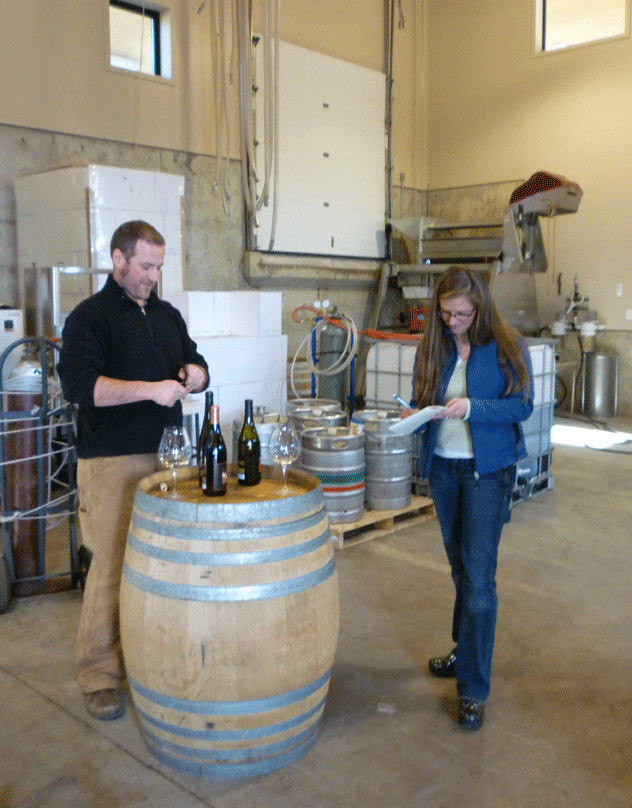
This happened to me during my visit to Sokol Blosser Vineyard and Winery in Dundee. I called ahead to arrange what was supposed to be a 20-minute tour and wine tasting.

It lasted over two hours.

Cellar Hand/Tasting Room Associate Forrest Schaad was like a walking wine industry encyclopedia. I learned what a “Sasquatch Harvest” is and how weather conditions in 2006 created one. And I learned how the wine produced then differed from 2007.

I learned how to use insects and bluebirds and feral cats to control vineyard pests. And I learned that Oregon’s state soil is called jory.

Seriously – a state soil. Can you name yours?

We strolled the vineyards and cellars and tasted wines in the precise spots Forrest insisted would bring out each wine’s best characteristics. As we stood beside the vines with a cover crop of clover and sweet pea under our shoes and the smell of damp soil and spring onion in the air and the wine swirling in our glasses, I had to admit – it did taste different.

By the end of our tour, my head was brimming with ideas, my writing hand was cramping, and I’d discovered ways to fix every issue critique partner Cynthia Reese flagged in last week’s read-through of my first three chapters.

After explaining the environmental importance of soy-based ink on wine labels, Forrest smiled a little sheepishly. “That’s probably a lot more information than you wanted.”

I shook my head in vehement denial. “I could suck your brain dry all day – you have so much great information.”

(As a side-note, I don’t recommend beginning a sentence with those four words when speaking with a man you’ve just met. Judging from the look of alarm on his face – followed by relief when he realized what I was actually saying – I probably could have found a better way to express myself).

So I guess the take home message (aside from not accidentally propositioning strange men) is that research is about more than just gathering information. It’s about unearthing the passion and the personalities in the world you’re trying to capture in your novel.

And with that, I’m off to write about mealworms.
Forrest shows us the bottling process at Sokol Blosser.

Wednesday, March 31, 2010

Why you shouldn’t request phalluses from strangers

The other day I blogged about people who lack social filters, and how those awkward conversations are a goldmine for authors.

Now I must confess that I’ve been known to make the occasional joke that turns out to be mildly inappropriate.

Shocking, isn’t it?

The problem when you write humor is that there’s sometimes a fine line between “funny” and “what the hell?”

Case in point, my debut novel MAKING WAVES has a scene in which the hero and heroine are on the balcony of a hotel overhearing the world’s most awkward tryst on the beach below. I was going for a combination of humor and “this shouldn’t be a turn-on but kinda is.”

It was apparent from my agent’s reaction that I’d missed my mark.

“I don’t even know what this phrase is supposed to mean,” she emailed.

“That’s the point – it’s funny, you know?”

Um, no. Apparently it was funny for a few lines. Not for a few pages. The scene got trimmed, and rightfully so.

I’d like to say I only do this in writing and would never have my humor fall flat in real life, but then I’d be both a liar and a pervert.

About a month ago, I was at a friend’s party with several strangers. A gentleman struck up a conversation with me about his friend who makes beautiful, hand-carved wine bottle stoppers, and asked what shape I thought would be most marketable.

“A penis,” I told him for reasons I can no longer recall that probably seemed funny at the time.

There was some discussion about length and girth, and at one point the party’s hostess joined in and we all had a good laugh about it.

A few weeks later, the hostess called. “Remember that guy who was talking to us about the wine bottle stoppers?”

“Um, vaguely.”

“I have something for you.”

Yes indeed, this stranger took it upon himself to go to his artist friend and request a hand-carved wooden phallus for my wine bottles. And the artist didn’t stop at merely carving. As you can see, he hand-stitched this lovely leather scrotum, complete with two disturbingly lifelike testicles.

The creator was very proud of his work, and though I hadn’t actually planned to purchase such fine custom artwork in the immediate future, I was compelled to cough up the cash and admit that my joke had fallen a bit flat.

So now I have a wine stopper that spends most of its time hidden in a drawer, and a more finely-tuned appreciation for my need to think twice when I think I’m being funny.

How about you? Ever made a joke that’s fallen flat? Or one that’s forced you to purchase a hand-carved wooden phallus? Please share in the comments.

Wednesday, March 24, 2010

Bung holes and book research

Michael Lundeen, Winemaker for Illahe Vineyards,
tries to pretend I'm not the most immature
person he's ever met as I snicker about
bung holes.
I arrived home late yesterday after three days of touring the Willamette Valley drinking wine and taking such copious notes that I required more wine to ease my aching hand.


I know I’ve blathered before about my great passion for book research, but this trip reminded me why there’s no substitute for getting up close and personal with the subject of your novel.

Sure, I could have opened a bottle of my favorite Sineann wine at home and jotted my impressions about the flavors and aromas.

But I would have missed seeing owner/winemaker Peter Rosback’s face light up as he discussed 100-year-old Zin vines and glass corks and the feeling of rain slithering down his neck in the crush bed.

I could have perused online photos determine that Van Duzer Vineyards comes closest to my mental picture of the setting for LET IT BREATHE.

But I wouldn’t have heard the squawk of Canadian Geese and the thrum of rain on the roof as tasting room guru Danielle Blanchette kept my glass filled and viticulturist Rebecca Sweet explained the delicate balance involved in combating vineyard threats like powdery mildew while remaining Salmon Safe and LIVE Certified.

I could have learned wine terminology by reading a book on winemaking.

But I would have missed watching Illahe Vineyards winemaker Michael Lundeen struggle to keep a straight face as he showed me how to remove the “bung” from the “bung hole” on a barrel so he could use his “wine thief” to sample an aging Pinot Noir.

More importantly, I would have missed sampling said Pinot Noir.

Now that I’m home, I have a pile of notes covered in wine-stains and hair that smells faintly of fermenting grapes.

I also have a renewed appreciation for a passage I highlighted in Steve Roberts’ WINETRAILS OF OREGON before we embarked on this trip:

“Most people don’t realize that winemaking involves hundreds of decisions: when to pick the grapes, what equipment to use, what strain of yeast to inoculate with, when to rack, and when to bottle.”

It’s true for both winemaking and writing.

Some of an author’s decisions are small – what color is my heroine’s hair? What is her house like?

Some decisions are bigger – who are her family members and how does she relate to them? What challenges are they facing in their vineyard and how do they impact her life?

I’ll figure it out as I go, but I know this is a part of the process non-writers don’t really appreciate. To be a good writer, you not only have to arm yourself with research, but use that research to make a million little decisions each time you sit down at the keyboard.

For now at least, I feel well-armed. I’ve got pages of notes, hundreds of photos, and 12 bottles of excellent wine.

That should hold me for at least a couple days.
Heading into the tasting room at Van Duzer Vineyards.

Monday, March 22, 2010

Living the dirty dream

I'll be doing a lot of this for a few days.
I’ve held down a full-time job since I was 18. Even in college I washed dogs, sold donuts, and wrote newspaper articles to keep a roof over my head and Chianti on the table.

If at any point in my adult life you had asked me what my dream job would be, I’d probably snort and give you a semi-smartass, semi-serious answer:

Well, I’d like to get paid to travel, hang out with my pets, drink wine, and write about it all.


So I’m a little stunned to realize that for a few days anyway, I get to do just that.

Pythagoras and I are currently traveling through Oregon wine country doing research for the third novel in my three-book contract with Sourcebooks, Inc.

I’ll be visiting some of my favorite wineries and vineyards including Illahe, Adelsheim, and Sineann to learn the ins and outs of what they do and how they do it.

And yeah, I might have a glass of wine. Or twelve.

Since LET IT BREATHE is already under contract, that technically means I’m being paid to do this research and write this book. Pretty mind-blowing, considering I’ve spent the last eight years researching and writing with only the faint hope that my books would eventually be read by someone besides my mom and my agent.

I’ll be back to blogging on Wednesday – and back to bills, back to reality, back to the knowledge that I have to write a helluva lot more books for this to be anything close to a livable wage.

Or maybe I’ll sell a kidney on the black market.

But for a little while anyway, I’m living the dream.

Wednesday, February 24, 2010

Why titles are a bitch

I’ve been thinking a lot about book titles lately.

This is probably because I’ve had to come up with a buttload of them in recent weeks, some for books I haven’t even written yet. I think this may be my agent’s attempt to kill me.

Because the truth is that I hate coming up with book titles. I’d honestly rather take a carrot peeler to my forearm and spritz the wounds with grapefruit juice.

In my mind, every book I ever write or consider writing is titled by combining some element of the book’s theme and the word “bitch.” It’s quite simple. The book I sold to Silhouette Bombshell staring a ski patroller was “Snowbitch.” The follow-up starring a heroine competing in the Iditarod was “Sledbitch.”

My most recent projects include “Psychicbitch” (BELIEVE IT OR NOT) and “Dumpbitch” (GETTING DUMPED). I think it startled my agent the first time I accidentally referred to one of my manuscripts this way, but she now shares my habit of forgetting a manuscript’s actual title in favor of the simplified bitch-version.

Unfortunately, my bitch-titles don’t work in the real world.

Fortunately, I’m very lucky to have some excellent tools at my disposal for developing real-world titles. By “tools” I mean friends and family (not that I’m calling you guys tools, but hey – some of you kind of are).

My loved ones have been amazing contributors to the process, sometimes offering terrific ideas and sometimes offering abysmally bad ones that morph into ideas that are actually quite decent.

When my agent asked me recently to conduct a quick poll of friends and family and their feelings about a list of potential titles, I was stunned to have nearly everyone – about 30 people in all – reply within a matter of hours. I was also a little stunned by some of their preferences, which indicate that in addition to the tools, I know a surprising a number of perverts. Apparently several of them feel it’s vital to my writing career that my name someday appear on the cover of a book with the word “booty” in the title.

Another secret weapon in my arsenal of titling strategies is the winestorm. The winestorm is pretty much like a brainstorm except for the obvious distinction of including wine. Lots of it. I have a handful of friends who will gleefully participate in a winestorm regardless of whether they have any notion what the book is about. Or whether they’re literate. Past winestorms have yielded some terrific ideas for book titles, as well as a number of titles that will be useful if I ever decide to enter the adult film industry.

But probably my most treasured resource in the titling warefare is my friend, JJ, a woman known to me as Her Royal Majesty the Title Queen. JJ isn’t a writer. She actually works in the technology field, and to my knowledge, has no aspirations to write a book. But I can give JJ a one-paragraph synopsis of any book and she’ll come back to me with half-a-dozen potential titles that are roughly 1,597-times better than anything I could possibly come up with on my own. When I made the switch from writing women’s action/adventure for Bombshell to writing quirky comedy, I wasn’t certain JJ would still be up to the task. To my delight, she kicks ass at quirky comedy even more than she kicked ass at kickass action/adventure. (And yes, for those of you paying attention, I did in fact name the heroine in GETTING DUMPED for her).

The funny thing is, as much effort as we put into coming up with titles for my books, it’s a fact that publishers will often scrap an author’s title in favor of something they’ve come up with on their own. I know this to be true, which is why I try not to get attached to any of my titles. Even so, it’s crucial for an author to put her best foot forward. No sense giving an editor reason to reject a book based solely on a title that makes her want to beat her forehead with a shoe.

So bottom line, I do my best with titles. And since my best tends to suck, I do my best to absorb the combined wisdom of my friends, family, and all the tools and perverts I know. Isn’t that what writing’s all about?

Wednesday, February 3, 2010

My drinking club has a book problem

For more than a decade now, I’ve been a member of a book club.

OK, if you want to split hairs, it’s probably more of a wine club that loves to read. Nevertheless, we’ve been together an awfully long time, sharing our mutual fondness for reading, eating, and drinking (not always in that order).

We get together once a month and read selections ranging from classic literature to bestsellers to poetry to smut. We’re proudly devouring an Emma Holly erotica title for Valentine’s month, which will be followed in March by Kathryn Stockett’s critically acclaimed novel THE HELP.

Eclectic tastes, to say the least.

Over the years, we’ve eaten a lot of great food, consumed oceans of wine, and have watched our membership fluctuate between six and 20+. There’s a 25-year age difference between our eldest member and our youngest, and our group includes women with wildly different lifestyles, political views, and beverage preferences.

It goes without saying that we often have vastly different perspectives on the books we read. That’s the whole point, really.

Last August, we read Tiffanie DeBartolo’s HOW TO KILL A ROCK STAR, an amazing novel released in 2005 from Sourcebooks. If you haven’t read it, go buy it right now.

Our discussion became heated when one member dared to suggest she didn’t particularly care for the narrator. In a room full of readers who had developed a sisterly love for this character over the course of 352 pages, this was akin to calling the sister a skank. I had to remove the wine bottles from the table in case a fight broke out.

For the most part though, it was a fun discussion, and a good reminder of one of the key mantras of the publishing industry:

It’s all subjective.


What one reader, editor, or agent hates, another may fall in love with. We all want to believe there’s a magic bullet in publishing – a “right way” or a “wrong way” to read a book or to write one. Believe me, I’ve seen plenty of feedback from editors and it never ceases to amaze me how varied it can be. These are smart, accomplished, professional editors with extensive careers in publishing. They certainly don’t all agree on what makes a good book or a bad one. Why should we?

So I’ve learned not to take it personally when an editor rejects my masterpiece, or a book club member hates a book I picked, or when my brilliant and talented agent sends me back to the drawing board to rewrite the marketing hooks I was so certain were perfect.

Just don’t question my taste in wine, OK? Thems fightin’ words.