Showing posts with label Tips and advice. Show all posts

Wednesday, January 20, 2016

Why you REALLY don't want publishing advice from me

Something weird happens every January.

I mean besides the fact that my bathroom scale malfunctions, because clearly I didn't eat that many bacon-wrapped dates for Christmas.

Each January, I see a flood of emails, tweets, private Facebook messages, and the occasional note scrawled on the bathroom wall asking me for advice on getting published. "I've vowed to write a book this year!" they often begin, or even, "I've just finished my first novel!" And then comes the big ask: "You seem like you're doing well, so can you tell me how to get it published?"

The simple answer is no.

I'm not saying that to be a bitch. There are plenty of other ways I elect to be a bitch on a daily basis, but I'm generally pretty kind when it comes to encouraging my fellow writers.

I suck at giving publishing advice almost as much as I
suck at making a hairbrush look like a lightsaber instead
of like a dildo. You're welcome for that visual.
But here's the thing: If you see an author who's published a dozen or so books in the last 5-10 years, odds are good that person would give you horrible advice on the process of getting published. In fact, the advice they give might end up discouraging, confusing, or completely misdirecting you. Why? Because the publishing industry has changed at the speed of a roadrunner careening down an Astroglide-coated Slip-and-Slide. The knowledge we operated with at the start of our careers is now so laughably antiquated, we might as well tell you your best path to publication is chiseling your manuscript into a cave wall.

I made my first attempt at writing fiction in 2002. Back then, most publishers and agents still wanted snail-mailed queries. It could take a year to hear back from them, and if you did, they might ask you to print out the whole manuscript and lug that 987-pound mofo down to the post office. We'd heard of self-publishing, but it was that thing you did if you couldn't get an agent or a "real" book deal. Twitter was the sound the aforementioned roadrunner might make if he fell off the Slip-and-Slide, and Google sounded like something dirty you might do to yourself under the covers (on second thought, it still sounds like that). Aspiring authors longed to see our books on the shelves at Borders, because obviously everyone wants books in paperback and not those ridiculous newfangled eReader thingies.

You see where I'm going with this? None of that is true anymore, and as far as most of it's concerned, good riddance to bad rubbish.

But if you look at authors who've been cranking out books for a few years, odds are good that was their starting point. And after they slowly, painstakingly crawled their way out of the slush pile and worked their way toward royalty checks that allow them to buy both the cup of coffee and the donut, they crammed their brains full of new knowledge applicable to a different stage in their careers. Contract negotiations, social media marketing, branding, how to be a hybrid author, how to convince the IRS a sex toy collection is a write-off – these are the things we learn after we've been at it a while and reached some modicum of success. While it's useful knowledge after you have a few published books under your belt, you'll make yourself batshit crazy if you start fretting about those things when you're standing there with that shiny first novel in your hand and stars in your eyes.

Any advice I could give you on how to get a book published is either woefully outdated or completely useless to you unless you're at a point in your career where your agent can sell your next book based on the letters "TBD" (yes, that really happened, and yes, I'm eternally grateful Wolfson Literary pulled off that feat and then didn't bat an eyelash when I said, "I think this will be a romantic comedy about death and grief," though I suspect we both breathed a sigh of relief when my editor approved and the book continued on its publication journey for release September 2016. But that's a story for another time. Also, if I'd attempted something like that ten years ago, I would have been laughed out of the publishing biz quicker than you can say, "gofuckyourself, newbie.")

So what can I give you? I mean besides a pat on the butt and hearty congratulations on a major milestone. Seriously, completing that first novel is HUGE. Like go-ahead-and-drink-the-whole-bottle-of-Chianti huge.

Well, I can steer you to the FAQ page of my website, where you'll find a few links and tidbits of advice that may or may not be helpful. I can tell you that while there are wildly differing views on whether authors do or do not need an agent, I would sooner hack off my own nipples with a rusty spoon than operate without Wolfson Literary in my corner, and if you think you might also need an agent, agentquery.com is a good place to start. If the idea of writing a query in the first place is kinda daunting, visit Query Shark and start reading. Don't pause for food or potty breaks until you've been at it for at least eight hours (and preferably eight days).

Don't get discouraged. It's rough out there, and sometimes searching too hard for the magic secret to publication will suck all the joy out of your writing process.

Above all, keep writing. Let me repeat that: KEEP WRITING. It's the one thing you can do to guarantee you'll continue to improve your skills as an author and your odds of eventually landing that book deal.

But don't listen to me. I'm still back here setting up that Slip-and-Slide. Anyone know where I can find a roadrunner?

Thursday, July 5, 2012

Push it real good

Raise your hand if you're a child of the '80s and the title of this post has the Salt-N-Pepa tune humming through your brain right now.
OK, I'm putting my hand down now because that makes it kinda hard to type. And typing is what I wanted to talk about today.

Well, not just typing, though sometimes writing a novel does feel like an exercise in typing random, disconnected words with only a dim hope you're forming coherent sentences.

One of the most common questions I field when I run out of things to discuss at cocktail parties and confess I'm a published author is, "how long does it take you to write a book?"

It's a question I hate for several reasons.

My cocky answer is "about three months," which is technically true. I wrote Making Waves in that amount of time, and Believe it or Not took just a week or two more than that. Factor in another couple weeks for revisions from critique partners and beta readers, and a few more for back-and-forth edits with my publisher once both novels sold as part of my three-book deal. Still, it's true I completed pretty solid drafts of two novels in 12-14 weeks apiece.

But the reason I say that's cocky is the same reason I hate the question – who the hell can live up to that?

Not most writers, and I'm sorry to say, not me.

Because while I can claim I did it in the past, I'm not so sure I can do it now. The last novel I completed took over a year, and it still has some issues. Admittedly, that year was filled with a lot of life drama like divorce and the chaotic publicity of an impending book release, but it's still clear to me I'm slower than I used to be.

That's hard to swallow (snicker).

A headline caught my eye the other day when I was trolling the internet to procrastinate doing real work conducting important online research.  The headline was 4 myths about your ideal weight, and I clicked on it for the same reason I'd click on a headline about lesbian Eskimo porn (morbid curiosity, general perversion, boredom...take your pick).

One part of the article jumped out at me:

That seems like sound advice whether you're discussing weight or writing. People change, lifestyles change, brain/body chemistry changes. You'll go nuts if you spend your life trying to live up to some impossible standard set by your younger self or by someone else.

And yet...part of me still wants to try.

Not the weight thing, since I was living in Venezuela with an intestinal parasite after college graduation, and my freakishly low weight and equally freakish boobs made me look like a toothpick spearing a pair of olives. I'm quite fine looking the way I look now with fifteen years and 20 extra pounds on my frame, thankyouverymuch.

But part of me wants to push it (and push it real good) on the writing front. Part of me wants to see if I still have it in me to write at my old pace.

I sat down a few weeks ago to map out my word count goals for a new novel. It's something I used to do back in my speedy heyday as a newer writer, so I thought I should revisit the habit. I determined the date I needed to complete the novel, and marked 85,000 words on that day to remind myself what my final goal will be.

Then I worked backward from there, marking each Monday (the day I consider the end of my writing week) with the word count I want to achieve by the time I switch off my computer that day.

At the end of the exercise, the pace I'd set for myself was 7,000 words a week. I stared at the numbers for awhile, trying to figure out if it was a realistic goal or an are-you-out-of-your-mind-idiot?! goal.

Then I decided to stop thinking about it and just give it a shot. That was two weeks ago. So far, I've managed to meet my goal both weeks. I may have done it by the skin of my teeth, and I can assure you many of the words I've written would make you cover your eyes in horror and rock back and forth humming Warrant's "She's My Cherry Pie" until the memory of those words disappears from your brain.

But I can't tell you how good it feels to switch off the computer at the end of the day and realize I've met my goal.

Can I keep it up? (snicker). Time will tell. I have my doubts, since the next few months of my life will include a fairly aggressive book tour schedule, some speaking engagements, my 20-year high school reunion, and a complete household move for myself, my gentleman friend, and our assorted pets and kids. Oh, and did I mention we still have no idea when or where we're moving?

But still, I want to try. There's a satisfying balance in learning to celebrate when you meet a seemingly unachievable goal, and learning to cut yourself some slack when you don't. I'm still figuring out that balance.

And there's something rewarding in making a conscious decision to replace, "I can't possibly," with "what the hell, I'll give it a shot."

For what it's worth though, pushing it real good feels damn nice sometimes. Just like the song says.

What's your take on this? Do you tend to set stretch goals and forgive yourself if you don't quite meet them, or do you prefer to keep goals more achievable to ensure the satisfaction of meeting them? Please share!

Oh, and I can promise you'll have that song stuck in your head all day. You're welcome.


Monday, June 18, 2012

Stuff I'll tell you if you buy me lunch

I've gotten a lot of email from strangers lately, and not just the ones encouraging me to enlarge my penis so I can meet a horny housewife and acquire a low-rate mortgage.

They're messages from newer writers asking how to get published, and inquiring whether I ever mentor other authors. The thought of me mentoring anyone at anything is frankly, a little disturbing. I respond to all such messages with a few links and tidbits, and I'm happy to blather for an hour for those who live close enough to take me out for lunch. But regrettably, I don't have time to craft detailed career plans for everyone who asks.

What I can offer is a pretty big backlog of blog posts dispensing tips and information on writing and publication. While some of you come here just to read stories about my housemates or my socially awkward tendencies, I've also shared quite a bit of advice in the two years and four months I've been blogging.

If you look in the sidebar on the lower right, you'll see an eloquently-phrased header that says, "Stuff I've blogged about." Most of the posts I've written in 24 months have been tagged with at least one keyword ranging from "blogging" to "query letters" to "rejections and setbacks." That's a good place to start if you're interested in a particular topic.

For general writing-related advice and info, here are few posts I often share with new writers asking how I got published, how to craft a query letter, or what I've learned in my time as a published author:
You'll find oodles more like those if you search old posts for specific topics, but that's a good sampling of what I have to offer. Well, besides tips on where to find cheap Viagra and Russian brides. For that, you'll need to spend an hour alone with my spam folder.


Thursday, February 16, 2012

4 ways to bounce back when your confidence takes a beating

Whether you're a writer, a botanist, or a lag screwer, one thing is certain – there will be times your confidence in your ability to do the job is so shaken, it could double as a dirty martini.

As much as I enjoy that beverage (and not just for the name), finding myself in a confidence-shaken state is no fun at all. In case you've landed there yourself, here are a few tricks I've found for getting the mojo back:

Lick your...wounds
Whether you're hit with a bad review as an author, or a bad case of chlamydia as an escort, chances are you won't feel like getting back in the saddle right away. Don't. You need time to process, to heal, to formulate a plan, and to drink a few medicinal sips of that dirty martini. It's a vital part of the process to make time for these things, so don't feel guilty about it.

Punch something
You can do this literally (though I suggest choosing your pillow over a steel door) or you can do it figuratively (a good bitch session with a pack of girlfriends is priceless). Either way, give yourself a chance to cycle through the emotions of the setback. While I don't advise calling your boss or editor at 3 a.m. to sob that he ruined your life, it can be therapeutic to vent to a pal with a sympathetic ear. If you'd prefer to keep the harsh words to yourself, there are plenty of physical ways to blow off some steam. Hit the batting cages, buy a voodoo doll, or play Whac-A-Mole at your local video arcade (my personal favorite).

Do something you're great at
It's important to start building your confidence up again, which means you shouldn't go near the project that set you back in the first place. Think of a task you know you perform exceptionally well and do it. For some of you, this may mean finding a willing partner and retreating to the privacy of your home. A recent setback for me in the writing realm had me doing the "I suck" tango (I swear that's not a reference to the previous sentence). Instead of continuing to fling myself at the same wall, I switched gears – and genres – and poured my energy into a different project. Making a deliberate choice to focus on a type of writing I feel more skilled at has been slowly rebuilding my confidence, not to mention making me laugh (which is another crucial part of the process).

Find friends to stroke your...ego
Long before I ever had a book deal, I went through a string of bad rejections. Determined to keep moving forward, I wrote a new manuscript. My critique partners and beta readers were aware of the rejections, and though I never asked any of them to go easy on me, something shifted in that next round of feedback. Instead of focusing their criticisms on things that didn't work for them, every single reader went out of her way to flag elements of the story that did work. Not only did it give me a much-needed confidence boost, it helped me pinpoint what I was doing well so I could keep doing more of it.

What are your favorite strategies for rebuilding your confidence after it's been shaken? Please share!

And feel free to belly up to my imaginary bar for that dirty martini. Extra olives?

Tuesday, January 31, 2012

The value of taking one mouthful at a time


I miss having time to respond to every blog comment, but rest assured, I read them all and have several tattooed on my body. I keep a special file for comments that seem to merit a blog post in response. This one in particular has been floating in the file – and in my brain – for awhile now:

I would love to see a post from you on how not to give up.

I’ve been mulling it for weeks, trying to find the right words, accompanied by trumpets and pom-poms and a hearty “don’t give up!” cheer. I’ve also been thinking about my bumpy road to publication and the fact that I once fantasized there’d be some magical post-book-deal moment when I’d stop wondering if removing my own spleen with a paperclip might be easier than trying to make it as an author.

As it turns out, my fantasies were misguided. (Well, not all of them. The thing with the spark plugs and strawberry syrup turned out great, but that’s a post for another time).

But I’m sorry to say, you’ll be disappointed if you’re holding out for a day when angels sing and you’re freed from the panic you’ve lost your writing mojo or your next book sucks or your editor is plotting to creep into your house at night and beat you to death with your vibrator to avoid reading one more word you’ve written.

That’s not very encouraging, is it?

But it’s reality, and it’s something you need to face early in your writing career so you’re prepared to face it again and again, and spit in its eye. That’s what it takes.

And now that I’ve told you all that, I’m going to tell you to forget every word of it. Ignore it. Erase it from your memory. Soak your brain in bleach if you need to.

Because the trick to not giving up at any point in your writing career is the same as the answer to that age-old joke, how do you eat an elephant?

Take it one bite at a time.

If you let yourself spiral down the ugly path of envisioning failure or the agony of picking up the pieces afterward, your journey as a writer will become so overwhelmingly terrifying that you’ll crumple into a ball behind your sofa to spend the day rocking back and forth humming Poison’s “Talk Dirty to Me” until someone shows up and carts you away to a room with padded walls.

Maybe that’s just me.

I have a clear memory of sitting on a hotel bed the day after I’d finished writing Making Waves. My celebratory mood was dampened by the reality of the situation – I’d written half-a-dozen manuscripts before that one, and at least that many partials. I’d racked up countless rejections, been told, “it’s just not what we’re looking for,” and forced myself to keep trying.

Could I really do it again? I honestly wasn’t sure.

I sat there feeling overwhelmed by the prospect of rejection, of starting again, of seeing that effort rejected, and another, and another. How much more could I take?

At last, I sat up straight and blew my nose on the comforter (reason #259 you should never touch hotel duvet covers. You don’t want to know the other reasons).

“Enough!” I said out loud. “You’re making yourself crazy!”

A valid point, considering I was talking to myself in a hotel room.

But also very true. Absolutely no good would come from wallowing in what-ifs. I couldn’t control any of that, and fretting would just make me nuts. The only thing I could control was my ability to get back up and focus on the smallest, most immediate tasks in front of me – submitting that manuscript, and starting something new.

Small bites of elephant, mind you. Trying to fit the whole thing in my mouth was ludicrous.

Know what’s funny? Making Waves did get rejected. Over and over and over, even by the publisher that eventually bought it. It wasn’t until a year later when we shopped a new book – the one now scheduled as my March release, Believe it or Not – that Sourcebooks requested both manuscripts as part of my three-book contract.

Making Waves went on to be nominated for “Best Contemporary Romance” in the RT Book Reviews 2011 Reviewers’ Choice Awards. The magazine gave it a 4.5 star review – their highest rating, and the same score they just gave Believe it or Not in the brand new issue that hit shelves Friday.

I’m not telling you that to be smug.

I’m telling you that because two weeks ago, I had one of the lowest points in my writing career. I can’t go into details, but suffice it to say, it’s the closest I’ve come to throwing in the towel as an author and becoming a shepherd instead.

I didn’t give up, and I won’t. Not now, and not in the future.

But if you’re looking to me to say, “don’t give up because it’ll get easy someday,” I can’t do that.

What I can promise is that if you stay focused on taking things one bite at a time, it gets easier. And while the hardships and frustrations will always be there in one form or another, the moments of glory and good fortune have a way of balancing it all out.

Oh, and the thing about elephant? It tastes delicious with whipped cream. That’s a promise.

Wednesday, November 30, 2011

4 tips for researching a new manuscript

Though you guys know my three contracted romantic comedies as Making Waves, Believe it or Not, and Mad Crush, those names have never stuck in my mind.

To me, the books will always be known by their working titles: Piratebich, Psychicbitch, and Winebitch.

In continuing with tradition, I’ve recently started Museumbitch.

I can’t tell you much about the plot. It’s not that I’m being secretive and stealthy, but rather that I’m clueless. What I can tell you is that the story is set at a Central Oregon museum specializing in wildlife exhibits and natural history. My fictional museum is a lot like Bend’s High Desert Museum, so I arranged to spend part of Monday interviewing staff there.

As a recovering journalist, I tend to bring my research-junkie habits when I write novels. In case it helps fellow writers (or for those of you curious about the process) here are a few tips for kicking off research for a new novel:

Reach out and touch someone

Since I’m a writer who prefers to minimize human contact, I generally make interview requests via email. I start with a simple note explaining who I am, what I’m working on, and what sort of questions I might like to ask someone in the organization. In the case of Museumbitch, I touched base with someone in the marketing department who already knows me from my day job. As is almost always the case, she seemed delighted with the idea of assisting with research for a novel – even though the novel isn’t even contracted for publication.

Write questions…then ignore them

Having a list of questions prepared in advance gives you a great way to fill any lulls in conversation, and also ensures you get all the information you’re seeking. Though I always make sure I go in with a few questions jotted on the first page of my notebook, I prefer to use the list as a crutch, rather than an agenda. Letting the conversation flow in unexpected directions is sometimes where the best ideas happen!

Get it on with a group

Interviewing a single person alone is fine, but if it’s at all possible, see if you can arrange to talk to two or three people at once. Having that sort of interplay between interviewees helps loosen people up a bit, and also gives you a better shot at getting those spontaneous bursts of info sharing where one person’s idea sparks another.

Don’t ignore the boring stuff

I didn’t go into Monday’s interview expecting one of my subjects to devote the first ten minutes to a recitation of job titles within the museum. As it turned out, this was some of the most valuable information I gathered. I knew beforehand that my heroine would be in charge of fundraising for the museum, but I had no idea how much manpower it actually takes – even in a fairly small, non-profit organization. I also got some great ideas for secondary characters and funny scenes – stuff I never would have gotten if I’d asked her to skip the employee roster and go straight to telling funny stories about taking the museum’s raptors to cocktail parties (no, I’m not kidding, and yes, I’ll definitely be writing about that).

So there you have it…my top tips for interview-based novel research. Got any of your own to share? Or any questions you want to throw out there about my process? Leave a comment!

I’m hoping that’ll cause you all to forget I don’t have a plot.

Thursday, October 6, 2011

I'm not judging . . .Well, I kinda am

At least once a year, I lose consciousness and wake to discover I’ve volunteered to judge a writing contest.

In all seriousness, it’s a good exercise for me. There’s no better way to hone your skills at fine-tuning your own writing than to work hard at identifying tricky spots in other people’s prose.

I’m not going to name the contest or give you specifics of any entries, but I will tell you that in multiple years of contest judging, these are some common issues I see over and over…

Oh, how I love THAT word

Every writer has at least one word he or she uses to excess. Sometimes it’s a lazy way of conveying a certain emotion – Lord knows I’ve been known to overdo it with eye rolling or eyebrow raising. Other times, it’s a matter of inserting unnecessary words that clutter sentences and slow the flow. That is one of the most common offenders. “Carol really believed that Lyle liked dressing up in her panties” or “Don’t you think that Lyle wanted to be smeared with peanut butter?” In either example – and in many new writers’ sentences – “that” is unnecessary junk. Try identifying your overused word or words (we all have ‘em!) and do a seek and destroy mission to fine-tune your writing.

The big mis

We’re all familiar with this concept in movies and books, though not everyone knows the precise term. Short for the big misunderstanding, the big mis is when the story’s conflict could easily be cleared up if two people just sat down and had a two-minute conversation. Would your entire plot be wiped out if Felix just called Wanda and said he doesn’t want to marry her because she’s averse to wearing leather chaps, and Wanda got the chance to say she’d be absolutely delighted to wear leather chaps, as long as they’re purple? If so, you have a big mis plot on your hands (and perhaps a slightly misguided notion of what makes a good story).

When crafting your plot, make sure the conflicts you’re throwing at your characters are not too easy to overcome. If they are, look for ways to throw in bigger obstacles and higher stakes. If Felix can’t use his phone because a pack of rabid badgers got loose in his home and chewed through the phone cord, it’s believable he wouldn’t be able to call Wanda to talk about leather chaps. And if Wanda is tied up trying to locate her missing badger collection, it’s understandable she wouldn’t be able to sit down with Felix to shoot the breeze over an espresso.

Sing together now…Show, don’t tell!

I know, I know. This is one of the oldest pieces of advice on the planet, but it’s true for a reason. The number one issue I see in newer writers’ manuscripts is the habit of having the narrator trail off on a lengthy mental monologue of backstory, setting descriptions, or character details. Mavis might sit there for pages and pages thinking about how tumultuous her relationship with Sally has been from the time they were little girls. Average readers can endure that for…oh, about three sentences. After that, most of us are yawning and propping our eyes open with rusty paperclips.

How much more interesting would it be to show the complexities of Mavis and Sally’s friendship? What if Mavis tripped Sally as she walked into the room, but then offered her a hand up and a frosty margarita? What would you think about Mavis if you learned she possessed both a Nobel Prize and a prison tattoo? What would it convey about her friendship with Sally if you switched the scene to quick-paced dialogue about an orgy they once attended and showed Mavis and Sally’s emotion through body language – nail biting, pacing, smiling, uneasy laughter, teeth gritting, sighing, crossed arms, failure to make eye contact, even a well-placed headlock? Small gestures pack infinitely more punch than six paragraphs of narration telling the reader what you want him or her to know.

Do you have a particular writing no-no you’re trying to overcome? How about something you see in other people’s writing that drives you absolutely batty? Please share!

And hey, let me know if you want to go ahead and write those stories about Carol and Lyle or Felix and Wanda or Mavis and Sally. I think there’s something good there.

Wednesday, September 21, 2011

3 small ways to flip the off-switch & reclaim “me time”

It’s not easy balancing life, work, family, and vital household chores like organizing your whip collection.

When I created the schedule for juggling my author career and day job, I was thrilled with the balance. Tuesday through Thursday, I’d put on my marketing/PR hat and head to the office. Friday through Monday, I’d don my author hat and focus on revisions, new writing, and book promo.

It sounded like the perfect arrangement until it donned on me that I hadn’t actually budgeted any me time. Not only that, but the fact that I toted my iPhone 24/7 meant I spent pretty much every waking hour (and some not-awake hours) tethered to one job or the other.

No wonder the whip collection never got organized.

Since then, I’ve tried to be smarter about giving my brain a break from constant on mode. Aside from some of the bigger efforts I’ve made to take full days off for pleasurable endeavors, here are a few small ways I flip the off switch from time to time.

Let’s NOT do lunch

Once upon a time, I had a standing lunch date with my iPhone. That was unfortunate, since it never put out even if I bought an expensive meal. It didn’t matter if I was taking a break from the day job or meandering out to my front porch with a sandwich – the damn device always joined me. After all, my boss might need me or my editor might email with an important question.

But nine times out of ten, my neurotic email checks revealed nothing more pressing than an ad for discount penis enlargement. And while I enjoyed getting the occasional flirty lunchtime text, I discovered my brain felt a lot more rested if I left the phone on my desk and spent an hour reading a good book without distractions. Since I stopped inviting the iPhone to lunch, I’ve been amazed to discover the world has not collapsed.

Keep ‘em separate

Being an author isn’t a 9-5 gig, and there are plenty of times my day job requires a skewed schedule as well. I’m prepared to deal with that, but I also know I need to carve out boundaries to protect my sanity. Though I sometimes check my day job email from my laptop at home, I’ve drawn the line at doing it from my phone. If day job colleagues need to reach me during non-work hours, they know a text or phone call is best.

And while a big part of my day job revolves around being present on Twitter and in the blogosphere, I make an effort to take off my author hat and post using only my day job persona during the hours I’m paid to do that.

Let the wine flow! Just not yet…

One hard and fast (snicker) rule I’ve held since launching this blog in February 2010 is that I’ll never post if I’ve had anything to drink. Not even a couple sips of wine. You may find me in other social media sandboxes, but the blog is off limits. That creates a dilemma if I’ve found the perfect bottle of chianti to accompany my dinnertime lasagna, but haven’t yet written the next day’s post. What to do?

For starters, I’ve gotten better about planning in advance. A snack near the end of my workday means I can push dinner a little later and use the extra time to write a post before the oven timer dings. If a last-minute girls night pops up, I may just decide the world won’t end if the next day’s post isn’t up until later the next morning.

What are your strategies for flipping off switches and creating boundaries to preserve me time? Please share!

Friday, June 17, 2011

My real advice to new writers

I’ve been doing a lot of interviews lately. One question I answer frequently is what sort of advice I’d offer to new writers.

Since no one wants to see me blather for twelve paragraphs on a single response in a long Q&A, I generally offer something pithy and concise and only moderately useful.

You want the real answer?

I have to tell a story.

When I was 23, I went to Venezuela to teach English. It’s the sort of thing you do when you’re young and crazy with a freshly baked college degree and more wanderlust than money or common sense.

Hiking in the Andes mountains.
I was there for almost 5 months, and when I wasn’t in the classroom, I was traveling around the country. I backpacked through the Amazon. I climbed in the Andes. I swam in the Caribbean.

I was also robbed at gunpoint in a remote beach town. I contracted a weird intestinal parasite. I came this close to being bitten by a mapanare while hiking in a jungle so isolated it took several days to reach the spot on foot and in a dugout canoe. I was detained along the Colombian border in the middle of the night by two guards who ushered everyone off the bus except me and a friend, and then questioned us while holding machine guns inches from our heads.

Writing those things just now gave me goosebumps. At 36, I look back at my 23 year old self and shake my head at my own youthful naïveté.

Did I even have health insurance? Would I have made it home safely without the money stuffed secretly in my bra when I was robbed? If I’d been bitten by that snake, is there even a remote chance I would have survived with no medical care nearby and no way to phone for help?

The answer to all those things is “probably not.”

But I look back on those experiences now as some of the most exhilarating and educational moments of my life. I was hopeful. I was brave. I was too young and fearless to consider all the scary things that could happen.

Those are the same feelings I had when I started writing fiction. I believed success was just around the corner. I hadn’t yet experienced the sting of my first rejection letter or the niggling fear I might be writing a long damn time before I landed a book deal. I got to enjoy the exhilaration of spreading my wings without the knowledge that a strong wind or a powerline or a kid with a slingshot might knock me out of the sky.

What I want to say to new writers is this: slow down. Don’t fill your head with fears about querying agents or building a platform or the possibility you might die from an infected papercut obtained from your 2000th rejection letter.

Enjoy your early efforts. Just write for the pleasure of writing, and know that you’ll have plenty of time later to fret about the things that might go wrong. Don’t worry that you don’t know enough about plotting or publishing or branding strategies. That comes later. For now, enjoy your own goofy, hopeful, deliriously dopey moments as a new writer.

I know I wouldn’t trade them for anything.

Wednesday, June 15, 2011

3 tips to set the mood for romance


You know how sometimes, you just aren’t in the mood for romance?

Yeah, me neither.

But I’ll admit there have been moments I’m not in the right zone to write love scenes. Since that’s a big part of what I do as a romance author – and since deadlines often force me to get in the mood RIGHT NOW, DAMMIT! – it can be a challenge to produce the desired results under less-than-ideal circumstances.

So what’s a struggling romance author to do?

Provoke your senses
We read it all the time in women’s magazines – the key to stimulating the libido is stimulating the senses. It’s not much different when it comes to prepping for love scenes. Is there a fragrance that tends to put you in the right mindset? I keep an array of candles in my office and try to pick the scent that’s likely to get me in the right mode for a certain scene. Ditto that for scented lotions and perfumes. Music? Check. I make iTunes playlists that tend to trigger certain moods.

Even what I’m wearing can have an impact on my writerly mojo. I’ll be the first to admit I’ve found myself churning out ho-hum dialogue and looked down to realize I’m dressed like a colorblind, homeless yoga instructor. That’s usually enough to send me marching upstairs to don something with a little more sex appeal. That doesn’t mean I sit here writing in stilettos and a sequined bustier, but if you’d wandered into my office yesterday afternoon, you would have found me in a short skirt and cute top. Hey, whatever works.

Learn your triggers
A lot of people believe romance authors work in a perpetual state of sexual arousal. OK, sometimes that’s true. But I’ve discovered there’s not necessarily a direct correlation between my mood and the tone of the scene. Many of my sexiest love scenes have been written when I’m in a more melancholy frame of mind. If there’s a thunderstorm outside, even better.

While I don’t necessarily need to be in a flirty mood to produce a playful love scene, I’ve learned never to attempt one when I’m angry. There’s something decidedly unsexy about two naked people bitching at each other as a form of foreplay.

Find a fluffer
Raise your hand if you know the term “fluffer.” For those of you less familiar with the pornographic arts, a fluffer is a hired member of an adult film crew whose job it is to sexually arouse the male performers prior to filming.

I’ll pause for a moment so you can go scrub your brain with sandpaper (or for those of you intrigued by the idea, so you can go google the phrase “fluffer job opportunities.”)

In all seriousness, there’s a lot to be said for this concept. Is there a scene in your favorite book or movie that leaves you feeling warm and tingly? Take advantage of that when you need it. Is there a person in your life who produces the same result with flirty words or a smoldering look? Put yourself in that person’s proximity when the need arises. Find a source you know consistently leaves you squirming, and keep that source handy for when you need to flip the switch.

With a little imagination, you can extend most of these tips to apply to just about any sort of scene you might need to write. Bottom line, it’s worth knowing what sort of mood you need to have to create the tone you’re aiming for. Once you’ve nailed that down, figure out what it takes to get yourself there.

How do you set the mood for specific types of writing? Please share!

And please let me know what you learn about those fluffer job openings. Hypothetically, of course.


Wednesday, June 1, 2011

3 multitasking tips for swamped writers


As I’m sure most of you do, I live a pampered life.

I rise at noon and summon my lady-in-waiting to attend to my grooming needs. While my personal assistant pays the household bills from my vast and endless checking account, the chef whips up a caviar omelet in the gourmet kitchen of my mansion.

If you believe that, I’m a better fiction writer than I thought.

The sad fact is that most authors have the same money and job woes as everyone else. Most of us balance day jobs and writing and family and sex toy parties and household demands. There’s inevitable overlap between obligations and plenty of moments when you freak the hell out because you can’t possibly do it all.

Not that I’d know anything about that.

I’ve come up with a few strategies for when I’m way beyond trying to keep my head above water and have settled for breathing through a cocktail straw from the bottom of the ocean.

Write fast or forget
My brain has a limited capacity for remembering things, and when I’m bombarded by a million tasks at once, it’s easy for good ideas to start leaking out my ears. While I try to keep a separation between my day job in marketing/public relations and my life as an author, it’s inevitable some of the ideas hitting me in the middle of the workday will pertain to the job I don’t happen to be doing at that moment.

I’ve learned to keep an email document open and addressed to myself either at the day job or at home. When I’m struck with a good plot idea in the middle of crafting a press release at the day job, I jot a fast note in the email and get right back to work. Likewise, if I’m at home editing a manuscript and an idea sneaks up on me for a media pitch at the day job, I make a note in the email addressed to my work account. At the end of the day, I hit “send” and know the tasks and ideas are preserved for when I’m in the right environment to do something about it.

Ask for help
I’ll admit it – I suck at this one. I’d generally rather remove my own kidney with a felt pen than admit I can’t do everything myself, but there are times I just have to pick up that Sharpie and be done with it. I hit a breaking point yesterday where I realized that if I truly intended to keep up with editing, writing, blogging, yard work, divorce proceedings, day job tasks, and household responsibilities, I would have to give up both eating and sleeping.

I finally cried uncle and asked my parents for help checking references on a potential housemate to replace one moving out at the end of the college term. Not only were Mom and Dad happy to help, but I think they secretly enjoyed playing private investigator. While my mother stalked the young prospect online, my father called everyone from his high school guidance counselor to his cardiologist. The kid got the all-clear, and my parents got the reassurance of knowing my new housemate is unlikely to dress up in my underwear and stab me with a letter opener in the middle of the night.

Most importantly, I gained a few hours I desperately needed to make a dent in my workday.

Timing is everything
I’ve experimented a lot with finding balance in my schedule, and I’ve learned a few things about what works for me. Blogging is a huge time commitment at this point in my career, between daily posts here and weekly posts at The Debutante Ball and the day job. I’ve tried getting a jump on things by pre-writing a week’s worth of posts and scheduling them to go up at different times. This works great for plenty of bloggers, but it’s not the best method for me. Large chunks of time are precious and sacred, and when I get one, it’s best used for something meaty like editing a manuscript or writing new chapters.

There are evenings when I drag my butt home from the day job with just enough energy to lie down in front of the fridge and open my mouth hoping something edible falls in. After that, I usually have the free time and mental capacity to tackle a smaller, bite-sized task like a blog post or an interview. That means weeknights tend to be my best times for maximum productivity on those smaller tasks. Knowing this about myself, I can manage my schedule in ways that allow me to keep weeknights open for blog posts while preserving big chunks of time on weekends for tackling bigger writing projects.

Do you have any tips you use for multitasking or budgeting your time between “writing life” and “real life?” Please share!

We could all use the help.

Wednesday, April 27, 2011

3 writing contest landmines to avoid

Let me state for the record that I don’t hate writing contests.

Is that like starting a conversation with, “no offense, but—” which pretty much ensures whatever you say next is going to piss someone off?

Well, I don’t. Hate contests, that is. It’s possible what I have to say about them is going to piss someone off, and I do apologize for that.

I’ve been playing the fiction writing game for almost nine years, and I’ve been around writing contests a lot. I’ve judged, I’ve entered, and I’ve offered moral support to contest loving pals by drinking large quantities of wine on their behalf.

While writing contests can offer excellent things like the promise of feedback and the hope of a career jumpstart from a win, there are a few contest landmines you’d be wise to watch for:

Becoming a contest whore
Entering a contest is a bit like drinking a glass of Chianti – it’s tough to stop at just one. I’ve watched countless writers start with a tentative toe-dip in the contest pool and end up ripping off their clothes to dive headfirst into a drunken, chlorine-infused orgy. Not that there’s anything wrong with that, but there’s a high risk that entering contests can become your entire focus — instead of, oh, say FINISHING A BOOK.

There’s an art to getting a contest entry just right. You make sure the synopsis is properly formatted and those first few chapters have perfect pacing. Many contest fans get it down to a science and rack up contest placements like girl scout badges. But the risk here is that you lose (or never fully develop) the ability to carry a story past those first 100 pages. If you do decide to enter contests, don’t lose sight of your ultimate goal — writing the best book possible, not just the best contest entry.

Judgefail
I’ll admit I’ve judged more contests than I’ve entered, which probably makes me a judgmental bitch. My one experience entering a fiction writing contest happened in 2005. I won’t name the contest, except to say that it was a well-regarded one in my genre. I submitted my entry and stalked my mailman until he got a restraining order against me waited patiently for the results. While I waited, I got THE CALL from Harlequin/Silhouette saying they’d like to buy the book for their Bombshell line of action/adventure novels. Suffice it to say, I was thrilled. I forgot about the contest until the results arrived in the mail — incidentally, the same week my advance check showed up.

The judges were not impressed by me. One questioned my research (something I found laughable since, if anything, the book was over-researched). Another judge just didn’t fall in love with my heroine and also attempted to make a point-of-view correction that was just plain wrong. Overall, the results could best be described as lukewarm. My entry was not chosen for the final round where — ironically — it would have had the opportunity to be judged by an editor from Harlequin/Silhouette.

It behooves us all to remember that contest judges don’t know everything. I say that having been one, and knowing I’ll certainly be one again. Learning to trust yourself is one of the toughest things a new author can do, so be wary of anything with the potential to derail that learning process. Judges' comments can be useful, but they should also be taken with a grain of salt (preferably on the rim of a margarita glass).

Crushing your fragile ego
Constructive criticism is as vital to the writing process as heavy petting is to any good game of hide the salami. But there’s a time and a place for it.

A New York Times bestselling author once told me that during her early stages of any manuscript, she deliberately uses a beta reader who will do nothing but gush with praise. I laughed when she told me that, and then decided she’s the smartest person I know. She’s wise enough — and experienced enough — to realize exactly what she needs at different stages in her writing process.

I tend to prefer having trusted critique partners beat the holy living crap out of me pretty early in my drafts. Even so, I treasure their gems of positive feedback as a big part of what keeps me going. I know what I need and my author friend knows what she needs, and they aren’t the same thing.

Hurling yourself at the doors of the publishing industry is a brutal process, and it takes time to learn your own capacity for rejection and negative feedback. If there’s a chance that a savage beating from a contest judge will kill your desire to keep writing, don’t risk it. Check out books on writing craft. Join a critique group and ask them to go easy at first. While you shouldn’t shy away from constructive criticism, you also shouldn’t go chasing after it if you aren’t certain of your own ability to handle it at this stage in your process.

Are you a fan of writing contests? What sort of experiences have you had with them? Please share!

And rest assured that if you ever enter a contest I’m judging, I am a gentle lover who doles out ample praise with bits of heartfelt honesty. I also have soft hands.

Thursday, April 14, 2011

On hope, bad advice, and positions that cramp your thighs

Yesterday morning, I had a call from one of my critique partners.

“I’m stuck,” she said.

“You’ve got your ankles behind your head again?”

I could almost hear the eye roll. “Do you ever stop being a pervert?”

“Tell me you didn’t just ask that.”

“Right,” she said. “Whatever, I’m stuck on these edits and I just can’t seem to make anything work.”

I felt her pain instantly, which isn’t terribly unlike getting your ankles stuck behind your head. You want to get free, but you can’t find a way to do that, so you’re sitting there with a cramp in your thigh and an overwhelming fear things will never function properly again.

So I offered her the worst advice I could think of.

“You should quit.”

“What?”

“Quit,” I said. “Set the book aside and start a new one. You can always come back to this one later. Or hell, don’t come back to it. You don’t even have to start a new one, right?”

She was quiet for a long time. Such a long time, I started to worry she was really attempting ankle thing.

“I can’t,” she said. “I can’t be that person who starts writing and gives up.”

I should note that this is my critique partner who isn’t published or agented yet. It’s a distinction that’s almost not worth mentioning because she’s an incredible writer – better in tons of ways than I am, and better than plenty of published authors I know.

But publication is her ultimate goal, and she wants it badly.

Badly enough that she won’t quit, not even if she hates her manuscript, or she can’t dig her way out of a plot hole with a backhoe, or she wants to scream from the thigh cramps.

Someone a whole lot wiser than me once said, “the only difference between a published author and an unpublished one is that the published one didn’t give up.”

I believe that with every fiber of my being.

An hour after I hung up the phone with my critique partner, she sent me an email. Her message was so insightful, so lovely, that I asked if I could share it here. She refused, so I beat her with an empty wine bottle until she relented.

Here’s what she wrote:

Why I write
Shared with permission from Linda Brundage
First of all, thank you for letting me be where I was at today. For saying it is “okay” to not keep writing this book. Somehow, it was what I needed, to be free to actually consider it. I suppose it had the reverse effect in that suddenly in my mind I was thinking of all the reasons why I write. All the reasons why I cannot stop. (At least not today.) The most important of all is because I like myself a lot when I am being creative, when I am writing. I love words and the ideas that come from stringing words together. It is a challenging, rewarding and ultimately a magical process. I like the feeling of hope that comes from writing (the idea that yes, I can get published.) Without hope, I am lost.

***

I couldn’t possibly have said it better myself (which is why I’m certain we’ll eventually see her name in a bookstore – not just on a wanted poster in the lobby, but on an actual book).

And even though she and I are at different points in our writing careers, those words apply to me, too. I know I’ll encounter plenty of new stumbling blocks as I go along. Bad reviews, bad sales, bad hair days. The hope that things will get better is precisely what will keep me going.

Well, that and a fervent desire to make obscene hand gestures at anyone who doubted my ability to succeed.

Have you ever considered quitting when it comes to writing or any other pursuit that means something to you? What made you keep going? Please share!

I’ll be limbering up for my next attempt at the ankle thing.

Thursday, March 3, 2011

4 tricks for getting to know new characters

With my third contracted book off my desk and in my agent’s hands, now seems like a smart time to do nothing but kick back and stare at pictures of shirtless men online.

I never claimed to be smart, which is probably why I’m preparing to start a new book.

I’m a pantster rather than a plotter, which means I typically have little idea where a story is headed when I dive in. One thing I do like to have before I start is a basic understanding of the characters. Who are they? What makes them tick? If we went out for drinks and the waiter said there was only one glass of Stoller 2008 JV Estate Pinot Noir left, who would win in a swordfight for it?

These are crucial things to determine, so here are a few tricks I’ve tried for getting to know new characters.

Job hunt. One of the first things I usually decide is what my characters do for a living. From there, I try to learn as much as I can about those professions. What’s her daily routine like? What schooling would he need to have? Does she go out for martini lunches or huddle in a corner of a dimly lit break room eating a peanut butter sandwich? Understanding what my characters spend most of their time doing is a big part of understanding what they’re like as people.

Roleplay. Sadly, this isn’t as kinky as it sounds. Grab a friend or critique partner, sit down with a cup of coffee, and pretend you’ve just met. Not only have you just met, but you are your character. Ask each other typical “get to know you” questions. Where did you grow up? What’s your family like? Do you prefer boxers or briefs? You won’t always have the answers in mind before you start, but giving fast, gut-level responses to questions like these can help get you into the mindset of an unfamiliar character.

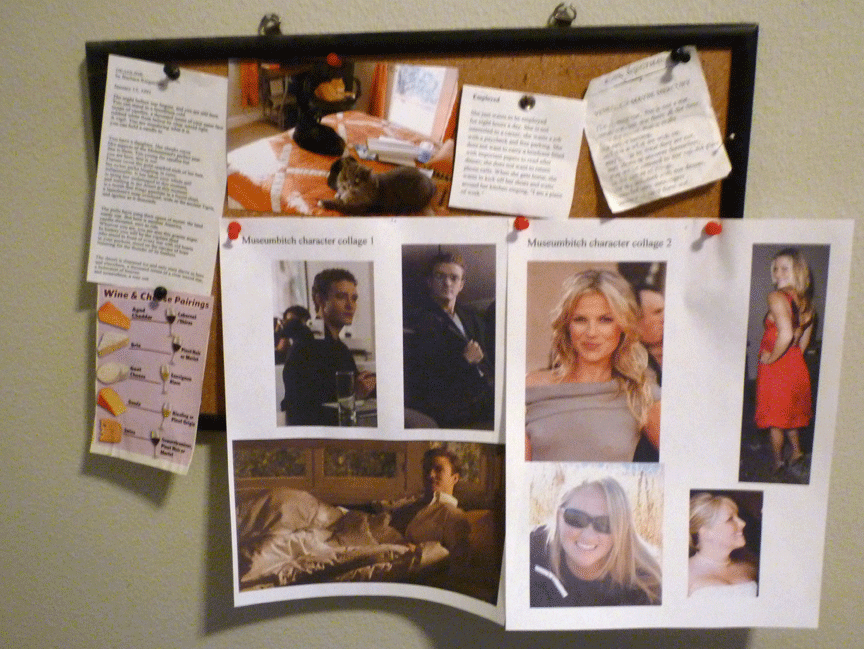
Get crafty. Some authors make collages for books they’re beginning to write. It’s a practice I’ve long admired in theory, but have never pursued due to inherent laziness and a general lack of craftiness. Even so, I like the idea of having something visual to start my wheels turning, so I recently spent an hour browsing online for photos that matched my mental picture of my new characters. I printed out the pictures and pinned them on the bulletin board beside my desk. This comes with the added bonus of having them staring disdainfully down at me as I spend an hour dicking around on Damn You Autocorrect instead of working.

10 things no one knows. Sit down with a pen and paper and make a list of ten things about your character that few people know. These things don’t have to appear in the book – in fact, it’s sometimes best if they don’t – but they’re a good way to gain insight into the character’s inner self. Is he secretly afraid of the dark? Does she refuse to eat apricot jelly because it reminds her of that unfortunate incident with the jumper cables and the guy who insisted she call him Marsha? If you’re lucky, you’ll stumble over a few surprises as you go.

What do you do when you’re trying to get to know new characters? Do you prefer to become acquainted gradually as you ease into the story, or do you perform any sort of preliminary groundwork? Please share.

And don’t steal that apricot jelly thing. I think I’m onto something with that one.

Wednesday, February 16, 2011

5 tips for squashing self-doubt demons

I recently invited questions from blog readers. I figured it might be handy on days I’m too lazy to come up with a topic on my own.

Like today.

A great question came in from Malin:

I suspect you're just as human as the rest of us (most of us) and therefore get assailed with doubt. When you've hit the bottom of the well of writing despair, how do you get back on your feet?

First off, I appreciate the vote of confidence in my humanness. There are days I’ve questioned it myself, though it’s less about self-doubt than the fact that I have really freaky toes.

Indeed I do have days when the self-doubt demon creeps up and gives me a big wedgie. It’s something every writer faces, so I've learned a few strategies for coping:

Recognize toxic thoughts. Some writers are prone to telling themselves, “you suck,” or “you’re stupid.” I’m more passive-aggressive with my self-doubt, offering it up as a negative comparison. “I’ll bet that author never backs herself into a corner like this,” I’ll mutter. No matter what form your toxic thoughts take, learning to recognize them is the first step toward squashing them under your heel like a discarded sheep testicle.

Create an “I don’t suck” file. This doesn’t have to be an actual folder on your desktop or in a file cabinet (though if that works for you, go hard). For me, it helps to have a few little treasures to prove to myself that I do not, in fact, suck. Maybe it’s that blog post by my idol Jennifer Crusie reminding me that even after 20 books and countless bestsellers, she still struggles. Maybe it’s that special email from a critique partner, friend, or massage therapist praising your prose, cooking, or supple backside. Whatever it is, keep it handy for occasional ego pick-me-ups.

Take a break. When I feel myself starting to spiral, the best medicine can be a change of scenery. There’s nothing like a yoga class or a walk with the dog to recharge my batteries. Reading a good book is another great option, with the added bonus of stimulating my writer brain. Don’t feel bad about giving yourself a mental health break. It’s part of the necessary care and feeding of an author’s well-being.

Recognize that sometimes you do suck. Hey, I’ll admit it – there are times I say, “I suck,” and I’m right. Besides enjoying the satisfaction of being right, I use it as an opportunity. Maybe I’m just not feeling “on” with my writing, but it’s a great time to tackle the research I’ve been avoiding. It can also be a good chance to edit a critique partner’s manuscript. You can still be productive even if you aren’t feeling like the sharpest meatball in the pot.

Compensate for what sucks. We all have strengths and weakness. My biggest “I suck” moments come during times of frustrating plotting. It’s not my strength, and I’ve come to terms with it (as have my wonderful critique partners, who more than make up for my weakness). Even if I’m not the best plotter in the world, I’m pretty handy with characterization and scene setting. I write a damn fine sex scene, if I do say so myself. I can hold a pen with my toes and write my name. Recognizing specific things I’m good at can help me believe the things I'm not good at don't matter so much.

What are your strategies for dealing with self-doubt demons? Does hiding under the bed work, or are you partial to getting out your feather boa and your “princess” T-shirt? Please share!

Wednesday, February 9, 2011

5 tips to avoid being a media moron

I’ve worked in marketing and communications for over a decade, and as a reporter before that. In my current job, it’s not unusual for journalists to call and interview me.

I’m pretty adept at spouting clever quotes about tourism and recreation, but yesterday’s call threw me for a loop.

“We’re doing a special feature about you that’ll run this Sunday,” the reporter informed me.

“Great!” I chirped. “Is this about the mountain bike race or the brewery tours?”

“Um, no. We’re doing a feature about you.”

Apparently the world of Tawna-the-marketing-geek has collided with the world of Tawna-the-romance-author and I wasn’t entirely ready for it. I’m hoping years of media experience kept me from making a total ass of myself, but I’ll find out for sure on Sunday if I'm quoted saying I like to run around naked with a glove on my head pretending to be a giant squid.

In the interest of helping you prepare for the moment you might be caught off-guard by a reporter, here are a few tips:

Speak slowly, enunciate clearly. This is crucial whether you’re interviewing for radio, TV or print. It’s natural to talk fast when you’re nervous, so make a conscious effort to speak like a kindergarten teacher on valium. Print journalists in particular will appreciate shorter sentences and longer pauses so they can jot your words correctly.

Keep the audience in mind. The reporter who called yesterday works for a mid-sized community newspaper with a readership comprised of a lot of people who may have never read a romance novel. With that in mind, I shared a few facts about the genre and followed up by emailing links to RWA stats and a blog post I wrote in defense of the romance genre. Had I been talking to someone from Romance Times, that wouldn't have been necessary.

Don’t assume anyone will know what the hell you’re talking about. Several times during yesterday’s interview, I caught myself speaking in vague terms about my bumpy road to publication or my blogging role at The Debutante Ball. These are things I’ve talked about so many times here I assume people are sick of them, but I realized quickly it was all new to the reporter. Even if you’re sure the journalist googled your name and gathered preliminary facts, don’t be afraid to reiterate. You’re providing a usable quote in your own words.

Be sensitive to deadlines. Publishing moves at a glacial pace, but news moves fast. Even though I knew the reporter was likely working on a tight deadline, I still cringed when he asked if I could connect him with someone at Sourcebooks within 24 hours for a quote about me. Everyone in my editor’s office is crazy-busy and I don’t like demanding they drop everything on account of me. Nevertheless, I know the publicity will benefit us all, so I bit the bullet and sent the email.

Don’t be a control freak. Plan in advance what major points you want to make and control the message that way. Beyond that, don’t demand a reporter let you read an article before it goes to press. You can ask, certainly, but many reporters will say no. Trust that you’ve done your job conveying your key messages and then trust the reporter to do her job sharing the story in her own words.

Have you ever been caught off-guard by a question from a reporter or anyone else? How did you deal with it? Please share!

I think I have to go lie down now. I just realized it’s possible I really did say the squid thing.

Monday, January 31, 2011

Ten tips for taming a beastly to-do list

I tried so hard to manage my to-do list during a week of visiting writer pals on the other side of the country. Despite my best efforts, I came home to find my to-do list had developed fangs and a fondness for chasing me around the house with its pants down.

Admittedly, life’s gotten crazier in the eleven months since my agent landed me a book deal. Despite her savvy negotiating skills, she failed to grant me six extra hours a day, so I make do with 24 hours and a lot of caffeine.

I won’t claim to be an expert on time management, but I'll share a few tips I’ve learned for taming a to-do list that threatens to bend you over its knee and paddle you with a wooden spoon (unless you like that sort of thing, in which case you should carry on as is).

1) Omit nothing from the list. It might seem silly to include chores like emptying the trash and clipping your toenails on a to-do list with important tasks like submitting copy edits to your publisher. Don’t let silliness stop you. Not only does it ensure you won’t forget anything, it gives you a much-needed sense of accomplishment when you cross off completed items.

Walk me, please!
Dog guilt is a powerful force.

2) Tackle the guilt tasks first. You know what I mean by guilt tasks – the stuff that niggles at your brain and makes you feel like a lousy human because you haven’t done it. Maybe it’s clearing the clutter off your desk, calling your brother, or taking the dog for a walk. Tackling a guilt task seldom requires as much energy as you lose by having it hanging over your head. Get it done, cross it off, and move on.

3) Be smart with high-priority tasks. The most important thing on my weekend list was inputting my critique partners’ feedback into my current manuscript. Even so, I waited until the second day of operations to take a stab at it. When it comes to writing, I need my brain to be clear and creative. Those adjectives don’t describe my mindset when I’m cowering under my bed as the to-do list growls and calls me a pansy. Putting off the big tasks isn’t lazy – it’s strategic.

4) Do double-duty. Skim your list for things you can do simultaneously. Can you fold laundry and chat on the phone with your beta reader? Scrub the toilet while brainstorming a sex scene? Turn your to-do list into a blog post? (Um, yeah…)

5) Ditch the distractions. I’ve learned to switch off email alerts and Twitter notifications when I’m neck-deep in my to-do list. I’m easily distracted as it is, so I really don’t need…hey, look – a squirrel!

6) Add stuff just to cross it off. Yes, I have performed tasks not on my to-do list and written them in afterward just for the satisfaction of crossing something off. Surely I’m not alone in this?

7) Neuter your next list. One thing that killed me this time was watching my number of unread emails hit triple digits and keep climbing. Though plenty were trash, it still took time to make the assessment and hit delete. Determined to make things more manageable next time, I went in and changed some Facebook and Twitter settings to help reduce incoming messages in the future.

8) Save communication for when you’ve made a dent in the list. I get snarly when I’m stressed, and that’s hardly the right frame of mind for emailing my editor or calling my mom. Unless there’s someone you want to snarl at, save communication for when you’re feeling more upbeat about what you’ve accomplished.

9) Timing is everything. Hitting the grocery store at noon on a Sunday is a good way to ensure you’ll spend an hour in line pondering what sort of prison sentence you'd get if a cop opened your trunk and found the decomposing bodies of a slow cashier and the woman behind you who cursed at her kids. Can you save shopping for evening? Skim your list and make note of time-sensitive tasks. Calling the insurance company probably has to happen during normal business hours, but visiting the adult video store to grab an extra pair of pink fur handcuffs can wait until midnight.

10) Don’t forget the downtime. It's OK to recharge your batteries by reading a chapter in a good book while having a glass of wine. It's probably not OK to reach the end of the book or the bottom of the bottle before your list is done.

What are your favorite strategies for tackling a to-do list? Please share!

Now that mine is curled up under the desk purring, I need to go kick it. Gotta remind that bitch who's boss.

Wednesday, January 5, 2011

Three annoying things writers do

My favorite thing about the holidays is the excuse to lounge by the fire devouring piles of bad food and good books.

Well, mostly good books. I’ll admit I’ve read a few that came perilously close to being hurled at the wall.

As a reader, I’ve always been aware of my pet peeves in novels. As a writer, I'm hyper-conscious about avoiding them in my own stories.

The Lazy Man’s Adverb

I don’t fault writers for the occasional use of adverbs. Sometimes you just need to toss a little -ly love around. But there’s seldom a good excuse for using them with dialogue tags. Any author worth his salt should be able to show the speaker’s tone with context clues, body language, and the words coming out of the character’s mouth.

Lazy: “I don’t want to suck your toes,” she said angrily.

Not as lazy (but maybe a little oogy): She folded her arms and sneered at him. “There’s no way in hell I’m sucking your filthy toes!”

The Big Mis

Short for “the big misunderstanding,” this is one of those ancient plot devices that never ceases to annoy the ever lovin’ snot out of me. It’s where the story’s conflict centers around something that could be cleared up if the characters just sat their pouty butts down and had a 30-second conversation. Jane sees Herbert in Victoria’s Secret, and rather than saying hello and asking if he’s buying her the latex thong she wants, she assumes he’s a cross-dresser and spends the next 250 pages sulking.

If you catch yourself crafting a Big Mis plot, slam on the brakes. Are there other forms of conflict you can introduce that have a little more substance? If you're committed to your Big Mis plot, what can you do to make it feasible the two characters wouldn't have that conversation? If your solution involves removing their tongues and hands, you might want to rethink the story.

As You Know, Bob

I’ll admit it, critique partner Cynthia Reese taught me this phrase by pointing out my own offense in some long-ago manuscript. As You Know, Bob is a clumsy method of introducing backstory by having one character spontaneously lecture another with information they both already know. The result is a conversation that’s stilted, awkward, and as natural as Chelsea Charms’ sweater potatoes (Er, that’s a fairly benign Wikipedia link. I make no guarantees what you’ll find googling her name on your own).

I’ve gotten better at catching myself when I start an As You Know, Bob info-dump. It helps to seek less sloppy ways to introduce the backstory, like flashback or internal musings. In general though, readers are smarter than we give them credit for. Trust them to piece together smaller clues as you slowly feed out backstory over the course of the story.

Do you have pet peeves as a reader? How do you stop yourself from committing them as a writer? Please share.

And really, please don't blame me for the brain damage you incur googling that name. I did warn you.