Showing posts with label Writing process. Show all posts

Monday, November 10, 2014

The magical secret to writing productivity

In the years since my romantic comedies started hitting bookstore shelves, I’ve had a lot of people ask my secret.

When I confessed my preferred sex lube or the location of each tattoo on my body, they realized they needed to ask more specifically about my writing secrets. Do I follow a strict schedule? Use special software? Sacrifice virgins by throwing them into an active volcano?

The answer is yes, no, and where the hell am I going to find virgins?

Bindi, the magical plot dog.
But I do have a secret tool that makes me a stronger, more competent writer, and I'm going to share it with you now: I have a magical plot dog.

I know, I know....some of you are skeptical such a beast exists, but I can prove it's true.

The way my aforementioned writing schedule works, I have a couple full days each week devoted strictly to writing. I have specific word count goals for those days, and I can get pretty testy if lunchtime rolls around and I'm nowhere near the mid-point on the day's goal. So testy, in fact, that I've been known to turn to my dog, Bindi, with an apology.

"I know I said we'd go for a w-a-l-k at lunch, but I'm stuck on a sticky plot point and I'm way behind and I've gotta meet this deadline," I'll tell her. "Can we skip it today?"

And my dog will look at me, shake her head, and reply. "You idiot. First of all, I learned to spell walk about five years ago. And second of all, don't you know that taking me for a walk is exactly what you need to get unstuck right now?"

The thing is, she's right. She can spell walk, though she can't actually talk. Well, not unless I've had too many glasses of wine.

But she also has a point about the writing. Just last week, I was tangled up in a plot snarl I thought I might never escape. I'm on deadline with a book that absolutely, positively must be finished by the Monday before Thanksgiving or my editor will cut off my thumbs and sew them to my forehead. Despite what you might imagine, that sort of stress is not conducive to good writing.

When lunchtime rolled around with no solution in in sight, I did something dumb. I didn't skip the walk – hey, I'm not that dumb – but I did decide to multi-task by calling my mom for a quick chat. And as much as I enjoyed our visit, I came back to my writing desk, sat down, and stared at the screen.

Nothing happened.

I turned to my magical plot dog. "What the hell? I still don't know how to write this scene."

Bindi sighed and shook her head. "You're a moron."

"Oh yeah?" I fumed. "Well you lick your butt."

"You're just jealous."

Again, she probably had a point. Not about the butt-licking, but the fact that I should know better by now. A walk with the magical plot dog is a sacred thing. You can't spend the time chatting with a friend or fiddling with your phone. You have to let your mind wander freely while the fresh air and nature have their way with your fumbling author brain.

There's real science behind this concept. According to a study titled Creativity in the Wild: Improving Creative Reasoning through Immersion in Natural Settings, "Attention Restoration Theory (ART) suggests that exposure to nature can restore prefrontal cortex-mediated executive processes.... Consistent with ART, research indicates that exposure to natural settings seems to replenish some, lower-level modules of the executive attentional system."

Or you can just say you've got a magical plot dog. Whatever.

I shut down my laptop that evening with no solution to the plot snarl and a word count that was lower than what I'd hoped for. The next morning, I got up early to walk the dog. I left my phone at home, and by the time I reached the end of my street, I'd figured out the whole damn scene.

For the record, the dog might not be a mandatory part of the process. If you don't have your own canine companion, it's possible a mere walk around the block could have the same effect. Just a few minutes of fresh air and escape from the tethers of technology can work wonders on your brain. It's the solitude and the change of scenery that makes the magic happen.

Just don't tell my magical plot dog, okay? She'll get pissed. 

Monday, January 27, 2014

How squeezing my thighs, tightening my buns, and getting sweaty makes me a better author

Like everyone else on the planet, I made a new year's resolution that involved exercise. The fact that I made the resolution while devouring a platter of bacon-wrapped water chestnuts and guzzling my fourth glass of red wine means I'm a bit fuzzy on the details of my plan, but that hasn't stopped me from pursuing it.

Here's the thing I've learned about exercise in nearly 40 years on this planet: I suck at it.

Yoga on a standup paddleboard with my dog.
Three forms of fitness in one (plus it was book
research for Eat, Play, Lust.)
Don't get me wrong, I'm a fairly active person. I walk my dog every day, and I love hiking, biking, snowshoeing, and standup paddleboarding as forms of entertainment. I tend to lose interest when something seems like exercise instead of entertainment.

But with a wedding and a 40th birthday on the horizon this year, now seems like a good time to get more serious about fitness.

My current plan looks like something devised by a gym teacher with severe ADD.

Monday is the yoga class I've attended religiously for almost six years. It is the only thing in my exercise routine I am remotely good at.

Tuesday I tell myself I'll ride the stationary bike in my office before dinner. Then I get hungry and decide that if I'm extra-vigorous in chopping vegetables and tenderizing chicken, that counts as a form of physical fitness.

Wednesday is my Barre class, a female-focused mix of pilates, ballet, and weight lifting that's a helluva lot harder than it looks. It holds my attention because the instructor says things like, "Feel that deep in your booty!" or "Everyone grab your balls now!" and I get an extra ab workout by trying (and failing) to stifle my laughter.

Thursday is my Zumba class, which I love because I get to pretend I have mad-sexy stripper moves until I catch sight of myself in the mirror and realize I look like a drunk homeless person caught in a lawn sprinkler.

Bending my elbow counts as exercise, right?
Friday through Sunday I make an effort to drag my gentleman friend snowshoeing or hiking two or three times. We generally make it out of the house once, but I'm pretty sure we get fitness credit for finding alternate ways to work up a sweat.

That's my routine in a nutshell. Besides appealing to my short attention span, there's something about it that resonates with my author self.

The yoga forces me to slow the hell down, breathe, focus, and strengthen my core. It reminds me of those times I find myself anchored to my desk by writer's block and a deadline, convinced I can't possibly spare 30 minutes to walk the dog. The second I leash the beast and set foot outside, the fog in my head clears and I untangle the plot knot I spent all morning chewing at.

The flexibility I allow myself on Tuesdays reminds me that I function best when I don't try to force things. If I have energy to burn, I peddle. If I'm hungry, I make food. As an author, I've learned that if a scene isn't flowing, it's OK to turn my attention to a different scene, or to use my time editing previous chapters or doing research.

Wednesday's Barre class reminds me of the value of laughter, and that sometimes the simplest phrases and tiniest sprinklings of emotion can be the most powerful.

Thursday's Zumba class reminds me to be humble. After nearly a year of doing it, I am, without question, the least coordinated student in class. My classmates sometimes glance at me as though uncertain if they're witnessing a seizure that warrants medical attention. At times I become so baffled by the dance steps that I settle for jumping up and down and waving my arms to keep my heart-rate elevated. But I do it with a smile on my face, and I keep coming back because I know it's good for me to do something so far outside my comfort zone. It reminds me as an author to push myself beyond my perceived limits, and not to hold myself back because I'm afraid of looking like an idiot.

Sometimes, I get the best results by embracing my inner idiot.

Are you with me in setting goals related to writing or fitness this year? How's it going for you? Please share in the comments!

Oh, and if you'd like to learn from my moments of idiocy as a writer, it's not too late to sign up for the South Coast Writers' Conference in Gold Beach, Oregon February 14-15 where I'll be teaching two 90-minute workshops titled, "The top mistakes new authors make (and how to avoid them!)"

Here's the summary (and here's a link to learn more and to register):

The top mistakes new authors make (and how to avoid them!) by Tawna Fenske
It's easy to screw up when you’re getting started as an author. Just ask Tawna Fenske—she’s done it plenty! She's also learned a few things from years of judging contests, critiquing manuscripts, building a career in marketing & PR, and stumbling a few times in her own journey as a published author of romantic comedy. From writing craft to social media, learn the top landmines for newbie writers—and how you can leap gracefully over them.

Monday, August 5, 2013

Who's got your back when you get lost?

Yesterday, my gentleman friend and I set out for a hike. Our chosen quest promised beautiful wildflowers and mountain views on a moderately difficult 6.6 mile loop.

Both seasoned hikers, we packed plenty of water and snacks and studied the map and some directions from a hiking website. Things went well for the first couple miles. My gentleman friend (a freelance photographer on the side) paused often to snap pictures.

Maybe it was the frequent stops.

Maybe I was overly distracted by the views on our frequent stops.
I never tire of this view.

Whatever the reason, we took a wrong turn. Two mountain peaks marked the path along our journey, both about 5,500 feet in elevation. The one we intended to climb boasted well-marked trails, gradual ascents, and a lovely viewing platform at the top.

The other had long stretches with no trails and steep expanses of treacherously loose soil and gravel.

Guess which one we picked?

The climb up was difficult, but manageable. The climb down was downright dangerous. Then the real fun began.

"Where's the trail?" I panted as we stumbled down the side of a cliff.

"It should be over there." He paused. "I think."

I frowned. "Is that the tree where we stopped for a snack?"

"No, that's down there."

Onward we staggered, our water supply dwindling and our sense of direction becoming more twisted. Even the dog looked nervous. The later it got, the more I fretted.

I'm a worrier by nature, and it took a lot for me not to panic. My gentleman friend – admittedly as lost as I was – kept his cool. He led the way along dry creek beds aimed in the general direction we knew we should be headed. He pulled out his iPhone and used the compass to reorient us. He stayed calm even as I heard my own voice rising in fear. When I suggested we were veering too far from a plateau we'd pinpointed as a landmark, he didn't pooh-pooh my proposal go bushwhacking through the forest in hopes of discovering a clearing.

Eventually, we found our way back to the trail. We were a little battered and scraped up, and our water supply was perilously low. But we were safe. More importantly, we were still relatively jolly, never once bitching at each other or turning surly.

It called to mind my novella that's scheduled for release August 26 (though pre-order links are slated to go up this week, so watch for it here).

I wrote Eat, Play, Lust in the early summer of 2012 during what was arguably one of the lowest points in my writing career. The novel I'd written as the third in my romantic comedy contract with Sourcebooks was deemed excellent, but "not the right next book for your career." My editor and I were struggling to see eye-to-eye on what the right next book would be, and I'll admit it – I was on the brink of throwing in the towel. I was frustrated, disheartened, and ready to be done with the whole thing.

It's about as lost as I've ever felt along my publishing journey.

My amazing agent – who always seems to know exactly what to say – talked me off the ledge.

"You need to take a break and write something fun," she said. "Something to remind you why you got into writing in the first place."

"Like porn?"

"Maybe not porn. How about a novella for the Flirt line at Entangled Publishing?" she suggested, explaining that she'd already talked with an editor about me. "It's only 10,000 to 15,000 words. You can do that."

Compared to my normal 80,000-90,000-word novels, it did sound manageable. Before I knew it, I was off and running with a story about a yoga instructor with secret cravings and a hot gourmet chef with a habit of putting his foot in his mouth. The story flowed easily, and I finished in record time. More importantly, I found myself in love with the writing process again.

In other words, it was exactly what I needed when I was lost.

After that, I got back on my horse and wrote a new book for my Sourcebooks contract (now titled Frisky Business, and slated for release May 2014). And the novella with Entangled led to a separate three-book deal with them, with full-length novels now scheduled for release November 2013, March 2014, and July 2014.

All of it can be traced back to that one simple move from my agent. Instead of getting annoyed with me or allowing me to flail or rage or panic when I felt lost, she channeled all those emotions into something productive.

Suffice it to say, I'm a big believer in surrounding yourself with the right people in times of trouble. It's paid off for me more than once.

As my gentleman friend and I stumbled back to the car yesterday afternoon, we rehashed our hiking adventure.

"Do you think it was some sort of relationship test?" I asked.

"How do you mean?"

"Like to see if we got snarky with each other or started blaming one another or stomping off in opposite directions."

He laughed. "How do you think we did?"

"Pretty damn well."

"We should probably make out to celebrate," he suggested. "And then go get french fries."

Got your own story of getting back on track after stumbling around lost? Did someone have your back, or did you find your own way? Please share!

And please let me know if you'd be willing to take a turn rubbing Bengay on my legs. I'm getting too old for this.

Monday, April 15, 2013

Comparison is the thief of joy

Every now and then, someone will ask how long it takes me to write a book. It's one of the few questions I hate answering, ranking right up there with, "does this skirt make my butt look big?" and "did you drink all that wine?"

(For the record, I do not bristle at the question that annoys the crap out of most romance authors, which is, "how do you research your sex scenes?")


One reason I'm not a reason I'm not a fan of inquiries about the speed of my writing is that it can vary wildly. Once upon a time, I could write a full-length, 85,000-word novel in about three months with a couple extra weeks tacked on for critique partner feedback and revisions. That was before the pressure of promotional responsibilities, conflicting editorial demands, and life-changes like divorce and young kids in the house. Those things slowed my pace considerably, turning novel-writing into something chopped up into random spurts over a 12 or 16-month period. Sometimes longer.

I'd reached a point where I assumed that slower pace of fits and starts was the new normal for me, so when my agent landed me a new contract in March and asked how long I needed to write a shorter 55,000-word novel, I asked for roughly five months. I'd just gotten started when she came back and said, "could you do it in six weeks?"

Like an idiot, I replied, "Um, sure?"

This coincided with my longtime critique partner accepting a similarly insane deadline, so we agreed to help one another with moral support, speedy feedback, and the occasional encouraging butt-pat.

The biggest challenge was not that butt-patting is difficult when you live 2,638 miles apart. It's that it took me awhile to recall how differently we approach writing. She writes best in quick bursts of 1,000 words on her lunch hour or 2,500 words after her daughter has gone to bed, then sends me scenes to critique.

For the first week or so, I'd grimace when I saw a text message from her declaring she'd written another 1,300 words while waiting for a doctor's appointment. You suck, I'd tell myself. The only words you wrote were Facebook posts about about your boobs falling out of your dress and how much you admire your gentleman friend's butt.

For the record, he does have a great butt.

I'd head home from the day job pledging to write 2,000 words after dinner, only to find myself cleaning the keyboard with a Q-tip while my computer screen remained blank. Some author you are, I'd mutter to myself.

It took me a good week to pull my head out of my butt and remember how I write best. Long, productive stretches of 5,000 to 10,000 words in a day, followed by three or four days of doing nothing   drinking wine   groping my gentleman friend   serious contemplation regarding the direction of the story. That is a more natural pace for me, and it's served me well in the past.

As it turns out, it works fine for a crazy deadline, too. I'm on track to finish the whole book in roughly five weeks, thanks mostly to excellent wine   the ease of writing blowjob scenes  several good days of super-productive writing.

After one such day, I made the mistake of posting my daily word count on Facebook and Twitter. I was pleased with my spurt of 9,000 words in 8 hours, and felt like sharing.

I regretted it almost instantly when I saw other writers lamenting their own daily production. I couldn't do that many words in a week, someone shared. I only wrote 500 words today, someone tweeted with a frowny-face.

By sheer coincidence, a non-author friend posted the following quote in her Facebook feed that same day:

"Comparison is the thief of joy."

It's attributed to Theodore Roosevelt, and the instant I saw it, I wished Facebook had a stronger option than, "like" (which is not to be confused with my usual wish that Facebook offered a "lust" option. See aforementioned comment about my gentleman friend's butt).

It is a great reminder to all of us, whether you're a writer or a teacher or a firefighter or a nipple-clamp tester. Your skills, your talents, your accomplishments, are your own. Someone else's skills, talents, and accomplishments do not diminish or detract from yours. Keep your eyes on your own test paper and your head in your own game.

Is this something that comes naturally for you, or do you find yourself playing comparison roulette pretty regularly? How do you feel about that? Please share!

Oh, and to answer those earlier questions, of course not, yes, and very, very thoroughly. You're welcome.

Monday, November 26, 2012

When the end isn't the end

Last week, I had the giddy pleasure of typing "the end" on my current manuscript.

Well, that's not exactly what I typed.

This particular ending was a long time coming, and I'm too exhausted now to point out that I just wrote "coming."

I haven't addressed this on the blog yet, but those of you paying close attention may have noticed the third book in my romantic comedy contract hasn't hit shelves yet. Though my publisher had initially slated the release for August 2012 and I completed the manuscript in plenty of time, they suggested it wasn't the right third book for my career. I was given the option to release it anyway, or to start from scratch with a brand new book and a different release date.

My gut and my brain had differing opinions about the best course of action, and they wrestled long and hard in a pit of cherry Jello while wearing sequined g-strings and nipple tassels.

Which is how I ended up writing a new manuscript from scratch, and how I ended up sitting at my desk last week staring at those words through a blur of happy/sad tears.

Once upon a time, I thought a book deal might magically transform me into the sort of writer who'd reach the final line of a manuscript, type "the end," and immediately hand a spotless draft over to my gleeful editor. This fantasy may have also involved several male strippers and a wine dispenser mounted beside my desk, but let's not dwell.

The biggest lesson I've learned since I first accepted this three-book deal in February 2010 is that my fantasy couldn't have been more off-base if I'd thrown in a gang of monkeys clanging celebratory cymbals.

Which, come to think of it, would be pretty cool.

But that isn't reality, and I know now that typing "the end" is only the beginning. I still have an absurd amount of editing to do before I'd even consider letting anyone outside a mental institution have a look at this manuscript. After that, I'll hand it off to my three critique partners who will lovingly tear it to shreds. Once I've implemented their changes, the manuscript will go to my three longtime beta readers, who will point out all the ways my heroine is unsympathetic, my hero is a sniveling weasel, and the fact that my unclear pronoun usage makes it sound like the heroine is licking her own neck. After their changes are made, the manuscript goes to my agent for another round of feedback and polishing before she submits it to my editor.

And after all that, I know it's entirely possible my editor will say, "meh...it's not the right book for your career now."

I don't know what's going to happen, but I do know I can't let myself dwell on that.

I can choose to panic over the flogging my draft will take in the coming weeks, and the fact that it might be all for naught. Or I can choose to take this one step at a time, slow and steady, and to allow myself to celebrate milestones like typing "the end" without rolling my eyes and muttering, "far from it."

For the writers among you, how far is "the end" from "THE END?" For non-writers, what are some of the biggest lessons you've learned along the way in your chosen career path. Please share!

I have to see a man about a monkey.

Thursday, October 25, 2012

The moments that leave you panting

Tuesday afternoon, my gentleman friend came home to find me in a disheveled state. My hair was tousled, my clothes rumpled, my cheeks flushed, and my pulse racing.

No, he didn't catch me doing something illicit. He needed to come home at lunch for that.

But he did discover me in the midst of one of the most breathtakingly giddy parts of my writing process. It generally occurs around the 70,000-word mark when I know I've hit the home-stretch and all the loose threads finally start coming together.

(Let's all pause here and giggle about "coming together" being an integral part of concluding a romance novel).

According to my contract, my romantic comedy titles should be around 80,000-90,000 words. I tend to fall a little short of that on a first draft, and add at least 5,000 words once my critique partners and beta readers finish beating me up.

That means I have roughly 10,000 words left to write. More importantly, the plot holes that have been gaping at me for months look less like craters and more like shallow crevices that are a true pleasure to fill.

(Who wants to make the crevice-filling joke?)

In all seriousness . . . oh, who am I kidding? I write romantic comedy, why would I be serious?

But in reality, this home-stretch of writing is one of the rare and precious times I don't feel like a complete disaster as an author. Writers often divide themselves into two categories – the "plotters," who carefully plan out their plot points prior to starting a book, and the "pantsters" who fly by the seat of their pants with no plan at all.

I am a pantster. I am the worst kind of pantster in that I honestly have no earthly idea who my characters are or what they'll be doing for 85,000 words when I begin a book. I could feed you some line about how this free-spirited approach lets my creativity flow more fluidly, but that's a lie. The fact is, I'm a pantster because I'm too damn lazy to plot a book beforehand.

Which means I spend an awful lot of time fretting that I've just written myself into a corner. If you saw an early draft of any of my books, you'd notice at least a hundred instances of "XXXXXX" where I've marked things I need to return to because I have no idea how to complete the thought.

But honestly, that feeling of cluelessness is worth it so I can enjoy the rush that comes when things finally, finally start to gel. When I can go back and begin lacing in red herrings and character traits and details I omitted during my first stumbling trek through the story.

Few things are more exhilarating than seeing the light at the end of the tunnel and knowing I might get there walking upright instead of crawling on all-fours through a pile of broken glass.

(Anyone want to take the all-fours joke?)

Years ago when I first discovered the thrill of this stage in the writing process, I dubbed it, "the audible clicking of puzzle pieces." There's this moment where I truly believe I can hear those crooked jigsaw parts falling into place, and it's the best sound in the whole wide world.

If you're a writer, do you have a favorite stage in the process? For the non-writers among you, can you relate to the giddy feeling of hitting a turning point in your life or your career? Please share!

I'll be fiddling with my puzzle pieces and giggling like a giddy kid.

Monday, October 22, 2012

Body language sounds filthy if you say it right

Though I make it a point to keep politics out of my social media activity, I'm passionate about the subject (and not in a "presidential kneepads" sorta way).

Since my gentleman friend shares my political passion, we were disappointed to realize the 2012 U.S. vice presidential debate was scheduled in the middle of our road trip to Seattle two weeks ago. Attempting to view a live, televised program while driving slick mountain roads seemed unwise, so we opted for finding a radio broadcast of the debate.

The aforementioned mountain pass made for spotty radio reception, and the debate broadcast was punctuated by loud bursts of static and the occasional evangelical sermon. But we made the best of it, and the two of us enjoyed a rousing post-debate discussion of how things had gone for our preferred candidate.

It wasn't until we arrived at our destination and reconnected with modern technology that we got any sense of what the rest of the world was saying about the debate. Regardless of political persuasion, most seemed to agree that body language set the tone for the exchange. There was eye-rolling, smirking, head-shaking, wild gesturing, and possibly a wedgie issued by one candidate to the other.

We missed all of it. As a result, we had a very different perspective on the debate.

Regardless of whether that's a good or bad thing, it got me thinking about writing. Every year, I volunteer to judge a writing contest through my local RWA chapter. In this year's batch of entries, I came across one that was enchantingly well-written and clever. The dialogue in particular was fast-paced and witty, and moved the story along at a delightfully quick pace.

But that was also a bit of a drawback. The exchanges of dialogue were so fast and snappy, there were few words devoted to body language. There was very little scene-setting, and not enough context clues to inform the reader where the characters were sitting, how they were speaking to one another, and how they were impacted by each other's words.

Is she shouting or whispering? 

Is he surprised by what she's saying, or did he already know?

Is she sitting back in her chair, or perched nervously on the edge?

Is the room dim, or well-lit?

Is he hearing what she's saying, or distracted by her hair or her eyes or bad breath or a scar on her face or the button that's come undone on her blouse?

These are the kinds of comments I made throughout the manuscript. Though judging is always anonymous, the contest coordinator forwarded me a lovely thank you note last week from the author of the entry. The writer was grateful for the feedback, and expressed amazement what a difference the added detail would make in overall character development and scene-setting.

This did not prompt me to give myself a smug pat on the back or smirk over how I never make such a mistake in my own writing. On the contrary, it's easy for me to spot because it's something I fall prey to constantly as an author.

It's easy to get caught up in the quick pace of a scene and forget the need to show your reader what's happening. I'm not talking about injecting huge blocks of copy that slow the pace of the writing. Just a few small details giving someone's tone of voice or facial expression can make a huge difference in how the reader experiences a scene.

If you're a writer, how do you remember to show (rather than tell) the body language and interplay between your characters? Or for the non-writers in the group, what sort of difference does it make being able to see a conversation or debate, as opposed to just hearing the words? Please share!

And lest you think I forgot Friday's book giveaway contest, congratulations to C.L. who offered up this terrific idea for a Halloween costume:

A friend of mine created the best Halloween costume ever (IMHO) and one I think you'll appreciate. She was a "One-Night Stand." She wore a lampshade on her head and built a "table" out of cardboard which encircled her waist. The table had champagne glasses (plastic), condoms, handcuffs, Cosmo magazines and a lipstick tube glued to it.

Love it! If I didn't already have my ninja costume prepared, I'd totally steal this. C.L., shoot me an email to tawnafenske at yahoo dot com letting me know your snail mail address and whether you'd prefer a signed copy ofBelieve it or Not or a signed copy of Making Waves.

And thanks to everyone for playing!


Monday, September 24, 2012

Why I love to suck

Saturday marked the second stop on the Crazy 8s Author Tour in Cannon Beach, Oregon. The next time I think it's wise to commit to two consecutive weekends of book tour driving at cities 400 miles apart, will someone please punch me in the crotch?

Now that we've got that out of the way, I'll say I've very much enjoyed being part of this group tour. As the lone romance author in a group of 28 writers ranging from poets to award-winning literary novelists, I sometimes feel like the chimpanzee crashing a party of swans.

This was apparent Saturday when two authors preceding me devoted their five minutes to discussing cancer, child abuse, and historical massacres. I kicked off my five minutes by squealing – literally squealing – about being introduced by Barbara Roberts, Oregon's first and only female governor and my longtime political idol. Then I launched into my five minute talk dispelling myths about the romance genre, a speech I begin by calling audience members perverts, sexual deviants, and lonely spinsters living in a fantasy world.

I capped it all off by handing my penis pen to a respected poet and asking him to sign a copy of his latest book.

But speaking of sucking (we were, weren't we?) I listened raptly to every word my fellow authors uttered during their five-minute talks. In her talk about the challenges of the writing process, author Ruth Tenzer Feldman said something so wonderful I snatched my penis pen back from the poet and scribbled the quote on the back of my own speech:

"Some of the words are no better than guano, but they serve to enrich the words that come after."

She was discussing the importance of continuing to write, even when it's rough going or the words flow slower than frozen KY Jelly. It's one of the toughest things for new writers to wrap their brains around. Why on earth would you keep writing when you know for certain you're producing absolute drivel?

I love Ruth's take on it – the notion that the crap fertilizes whatever crops you're planting after that. Though I love poop humor as much as the next person, I tend to think of my own lousy writing more like a skeleton. It's not too pretty to look at on its own, but it needs to be there so I can start adding layers of guts and skin and hair and sex organs.

I've seen other authors describe this as, "embracing your suckage" or "giving yourself permission to suck." Whatever you call it, it's an important part of the process whether you're a poet or a governor or a romance author prone to inappropriate public behavior.

How do you allow yourself to suck, either as a writer or in another professional capacity? Please share!

And if you're in Oregon, please mark your calendar for Friday, September 28 at 6:30 when the Crazy 8s Author Tour will make its way to Paulina Springs Books in Redmond.

Thursday, July 5, 2012

Push it real good

Raise your hand if you're a child of the '80s and the title of this post has the Salt-N-Pepa tune humming through your brain right now.
OK, I'm putting my hand down now because that makes it kinda hard to type. And typing is what I wanted to talk about today.

Well, not just typing, though sometimes writing a novel does feel like an exercise in typing random, disconnected words with only a dim hope you're forming coherent sentences.

One of the most common questions I field when I run out of things to discuss at cocktail parties and confess I'm a published author is, "how long does it take you to write a book?"

It's a question I hate for several reasons.

My cocky answer is "about three months," which is technically true. I wrote Making Waves in that amount of time, and Believe it or Not took just a week or two more than that. Factor in another couple weeks for revisions from critique partners and beta readers, and a few more for back-and-forth edits with my publisher once both novels sold as part of my three-book deal. Still, it's true I completed pretty solid drafts of two novels in 12-14 weeks apiece.

But the reason I say that's cocky is the same reason I hate the question – who the hell can live up to that?

Not most writers, and I'm sorry to say, not me.

Because while I can claim I did it in the past, I'm not so sure I can do it now. The last novel I completed took over a year, and it still has some issues. Admittedly, that year was filled with a lot of life drama like divorce and the chaotic publicity of an impending book release, but it's still clear to me I'm slower than I used to be.

That's hard to swallow (snicker).

A headline caught my eye the other day when I was trolling the internet to procrastinate doing real work conducting important online research.  The headline was 4 myths about your ideal weight, and I clicked on it for the same reason I'd click on a headline about lesbian Eskimo porn (morbid curiosity, general perversion, boredom...take your pick).

One part of the article jumped out at me:

That seems like sound advice whether you're discussing weight or writing. People change, lifestyles change, brain/body chemistry changes. You'll go nuts if you spend your life trying to live up to some impossible standard set by your younger self or by someone else.

And yet...part of me still wants to try.

Not the weight thing, since I was living in Venezuela with an intestinal parasite after college graduation, and my freakishly low weight and equally freakish boobs made me look like a toothpick spearing a pair of olives. I'm quite fine looking the way I look now with fifteen years and 20 extra pounds on my frame, thankyouverymuch.

But part of me wants to push it (and push it real good) on the writing front. Part of me wants to see if I still have it in me to write at my old pace.

I sat down a few weeks ago to map out my word count goals for a new novel. It's something I used to do back in my speedy heyday as a newer writer, so I thought I should revisit the habit. I determined the date I needed to complete the novel, and marked 85,000 words on that day to remind myself what my final goal will be.

Then I worked backward from there, marking each Monday (the day I consider the end of my writing week) with the word count I want to achieve by the time I switch off my computer that day.

At the end of the exercise, the pace I'd set for myself was 7,000 words a week. I stared at the numbers for awhile, trying to figure out if it was a realistic goal or an are-you-out-of-your-mind-idiot?! goal.

Then I decided to stop thinking about it and just give it a shot. That was two weeks ago. So far, I've managed to meet my goal both weeks. I may have done it by the skin of my teeth, and I can assure you many of the words I've written would make you cover your eyes in horror and rock back and forth humming Warrant's "She's My Cherry Pie" until the memory of those words disappears from your brain.

But I can't tell you how good it feels to switch off the computer at the end of the day and realize I've met my goal.

Can I keep it up? (snicker). Time will tell. I have my doubts, since the next few months of my life will include a fairly aggressive book tour schedule, some speaking engagements, my 20-year high school reunion, and a complete household move for myself, my gentleman friend, and our assorted pets and kids. Oh, and did I mention we still have no idea when or where we're moving?

But still, I want to try. There's a satisfying balance in learning to celebrate when you meet a seemingly unachievable goal, and learning to cut yourself some slack when you don't. I'm still figuring out that balance.

And there's something rewarding in making a conscious decision to replace, "I can't possibly," with "what the hell, I'll give it a shot."

For what it's worth though, pushing it real good feels damn nice sometimes. Just like the song says.

What's your take on this? Do you tend to set stretch goals and forgive yourself if you don't quite meet them, or do you prefer to keep goals more achievable to ensure the satisfaction of meeting them? Please share!

Oh, and I can promise you'll have that song stuck in your head all day. You're welcome.


Tuesday, April 3, 2012

Real authors probably have a better system for this

A new romantic comedy idea sunk its teeth into my brain last week and began gnawing like a feral hamster on crack.

A smart author would probably devote time to charting a detailed plot and analyzing the characters' goals, motivations, and desires. At the very least, she'd put some solid thought into her hero and heroine's names.

I opted to leave that to the housemates. I found one sipping coffee in the kitchen, and though I wasn't certain he was awake, I decided to pick his brain.

"I'm starting a new book this morning," I informed him. "Name my hero and heroine."

He blinked at me. "Johnny Appleseed. Allie Alligator. Donald–"

"Allie, that's good. That'll work. I've never written an Allie before."

"Especially not with the last name Alligator."

"Right," I agreed. "I might have to change that. OK, now you have to name the hero."

He stared at me blankly for a minute, then looked down at his coffee.

"Hold that thought," I told him. "I have to refill the dog's kibble. You keep thinking."

"Kibble's a good name," he mused as he took a sip of something he probably wished was a lot stronger than Starbucks.

"I know!" I announced. "The hero comes from a big military family. How about a famous military name? Weren't you a history major? Here's a great chance to use that degree!"

He didn't look entirely enthusiastic about the opportunity, but began rattling off names anyway. "Custer. Patton."

"Too redneck. Too gay."

He frowned. "Ulysses?"

"As in Ulysses S. Grant?" I tried to remember eighth grade history class and whether Ulysses S. Grant had a history of beastiality. "Grant's good. I don't think I've written a Grant."

I thought about it for a second as I scooped kibble into the dog's dish. By the time I set the bowl back on the floor, my mind was made up. "Allie and Grant. I like it. Those are my characters' names. Thank you."

He nodded. "I still like Kibble better."

"I know you do."

So there you have it – the new characters I'll be getting to know shortly. I hope I didn't spoil anyone's notions about the hard work and creativity that goes into naming romantic comedy protagonists.

If you're a writer, how much thought do you give to your characters' names? For the readers among you, how much of a difference do names make in your perception of a story? Please share!

I'll be hard at work crafting the fate of Allie Kibble and Grant Patton.

Monday, January 16, 2012

The importance of sucking for awhile

I was making breakfast Saturday morning when one of the housemates stumbled blearily into the kitchen. I’ve learned to get out of the way fast and not make conversation until he’s downed at least six gallons of coffee.

“Morning,” I said at last.

“Morning,” he mumbled. “Got big plans today?”

“Writing. I’m working on a new book, so that’s going to occupy a lot of my time for awhile.”

“Mmmph,” he said into his coffee. “How many pages do you think you’ll write?”

I shrugged and stuffed a piece of bread into the toaster. “I’m aiming for 25, but we’ll see.”

“That’s all? Huh.”

I stared at him. “What do you mean that’s all?”

“I dunno. I just would have figured someone who writes as much as you would be faster than that.”

Two things kept me from beating him over the head with the toaster.

The first is that non-writers just don’t understand that creating a brand new book from scratch involves more than repeatedly typing the phrase, “he plunged his pork sword into the dewy cleft of her love wallet.” You’ve got characters to name, backstories to develop, emotional baggage to unpack, and clever dialogue to finesse.

Sometimes, my editor even expects me to come up with a plot.

All that to say, it takes a bit longer to write 25 pages than it does to read them.

But probably the biggest reason I didn’t brain my housemate with the toaster is that I was totally lying. There’s no way in hell I was going to write 25 pages over the weekend, and I knew it. Maybe later, maybe once I hit my stride in this middle of the book.

But now – when I’m in the ugly, early stages of a new story – I’m lucky to crank out four or five pages a day. And those four or five pages will be some of the most abysmal, unfunny, uncreative examples of fiction you might ever lay eyes on.

People often ask me to name the best part of being a published author. I usually make a smartass joke about my private jet or the sleepovers with George Clooney. Want to know the truth?

The best part about being published and about having written for as long as I have is that I know sucking is part of the process. I can spend a weekend slowly oozing out horrible drivel, and while I may be disgusted with the drivel, I understand it’s necessary to do that before I reach the point where I stop sucking and start writing decent prose.

It takes a crazy amount of patience to hang in there and keep going when you’re writing at the pace of a slug crawling through tar, and every other word you place on the page feels like the wrong one. I’ve seen plenty of writers get discouraged and give up before they ever know that glorious moment when it stops feeling like you’re polishing a turd and begins to feel like you might have a decent novel on your hands.

The trick to writing isn’t hammering out a lot of brilliant prose at a speedy pace. The trick is knowing that if you keep going, you eventually do stop sucking.

I didn’t say any of this to my housemate, of course. By then, he’d fallen asleep leaning against the refrigerator, and the dog was lapping up the puddle of coffee at his feet.

Have you learned the importance of sucking in writing or any other aspect of your life? Please share!

I’ve got some sucking to do. Wait, what?

Monday, June 20, 2011

I have no nuts or bolts

Over the weekend, I made a startling discovery:

I am not a machine.

You would think this might have dawned on me at least once in 36 years. I inspect my parts routinely, and should have noticed there were no wires or bolts or screws.

OK, there have been screws. Maybe that’s what threw me.

Nevertheless, my new epiphany came as a big surprise. I had my weekend all plotted out. I would get home from the day job on Friday and work until 11 p.m. on the large-scale edits for the second book in my contract. On Saturday, I’d get up at 6 and work straight through on those edits until at least 11 p.m.

And if I finished round one by noon on Sunday, I could reward myself by spending a few hours with friends before diving back in and editing all evening and all day Monday.

The first sign that my plan might be overly ambitious came late Friday evening when I started to peter out around 9:30 p.m. It had been a long work week, and my attention span just wasn’t what it needed to be. I kept cranking slowly, but wasn’t as productive as I’d hoped to be.

On Saturday morning, I got up early and got busy with the manuscript. Though I moved more slowly than I would have liked, I was doing pretty well until I hit a section of the manuscript where my editor had requested some particularly big edits.

A machine could have done it.

But me? Well, I considered lying down on the floor, kicking my feet, and screaming, “I don’t wanna!”

I refrained from doing this, mostly because the floor was filthy. Instead, I leashed up the dog and took her for a long walk. By the time I got home, I had reached a point where I could grudgingly muscle through the scene.

Then came another one. A scene requiring even bigger edits that triggered another “don’t wanna” response. I tried hard to stay on task. I stared blankly at the screen and willed the words to come.

But I couldn’t seem to force myself to slash ruthlessly like I needed to, nor could I spark any brilliant ideas for replacing whatever I might slash.

So I stared at the screen some more, and that’s when the anxiety kicked in.

You’re never going to figure this out. Do you even want to? Maybe slashing the scene is a bad idea. Or maybe it’s a good idea, but you’ll do it so poorly that your editor will call you up and say, “um, that three book contract? We’re taking it back because you suck.”

Oh, and while you’re sitting here getting nothing done, your lawn needs mowed, your floors need swept, the cats need shots, you need to go grocery shopping, and oh, by the way, you leave for a week-long RWA conference in New York in one week and you have absolutely NOTHING TO WEAR.

A machine could have handled all that. A machine would have powered through and put words on the page and groceries in the fridge and a whole bunch of designer dresses in the closet with just a few clicks of some flashy buttons.

I got up and found my car keys. Then I drove to the store and bought a few groceries, tried on some shoes, and came home feeling…well, a little better.

And that’s where it’s frustrating. No matter how much you might want to, a writer can’t force machinelike productivity. Even if you’re careful and give your brain a break and do all the right things to relax and battle anxiety, you still can’t force it if it won’t come.

I’ll pause here to let you snicker at that last line.

I’d love to be able offer a bunch of wise tips for forcing productivity, but you know what? I can’t.

And one thing that makes me feel better about the fact that I can’t is this blog post by genius author Neil Gaiman. (Scroll down to the part that begins “Hi, Neil,” and take it from there.)

I bookmarked that post over a year ago to remind myself that even authors in the big leagues deal with these issues. This part, in particular, is something I’ve considered tattooing on my arm:

You don't choose what will work. You simply do the best you can each time. And you try to do what you can to increase the likelihood that good art will be created.

And sometimes, and it's as true of authors as it is of readers, you have a life. People in your world get sick or die. You fall in love, or out of love. You move house. Your aunt comes to stay. You agreed to give a talk half-way around the world five years ago, and suddenly you realise that that talk is due now. Your last book comes out and the critics vociferously hated it and now you simply don't feel like writing another. Your cat learns to levitate and the matter must be properly documented and investigated. There are deer in the apple orchard. A thunderstorm fries your hard disk and fries the backup drive as well...

And life is a good thing for a writer. It's where we get our raw material, for a start. We quite like to stop and watch it.

Amen, brother Neil. Amen.

Do you struggle with expecting machinelike productivity from yourself and getting frustrated when it doesn’t happen? How do you push through? Please share!

I’m thinking about the levitating cat thing now. I really need to check on that.


Thursday, May 19, 2011

Getting myself in the mood

For the last couple months, I’ve received a certain type of message three or four times a week.

It’s usually from a long-lost college pal or a Facebook friend or a regular blog reader who happened to be spelunking the caves of Slovenia when I announced my divorce.

I’m so sorry, the message will start.

I didn’t hear about it until just now.

How are you doing?

There’s usually a paragraph or two of wonderful, heartfelt sentiment – a personal experience with divorce, a virtual butt pat, a reminder that things will get better.

I appreciate the messages more than you can imagine, and I’m touched each time I open one.

I don’t mean I have someone under my desk waiting to grope me while I read my email, though that is on my personal fantasy list.

No, I mean I’m emotionally moved by the arrival of one of these notes. They mean a lot to me.

And yet, they’re always a little jarring.

The truth is, I’m doing great. Ridiculously, joyfully great.

I won’t lie, things were bumpy there at first. I’ll also admit there are days I’d rather stick my hand in a blender and hit pulse than deal with the details of deciding who gets the sofa or whether the dog counts as an asset or a liability.

But for the most part, I feel stupidly happy 98% of the time.

I’ve also grown a little protective of that feeling. I want to nurture it, coddle it, make sweet-sweet love to it in a room filled with sage scented candles and Barry White playing on the iPod.

A co-worker once described me as the least moody person she’s ever met. Years later, I still consider that one of the best compliments I’ve ever gotten. More than anything, it’s due to momentum. I make up my mind to be happy, and if I put my head down and keep plowing forward, I pretty much stay that way.

I think that’s one reason I’ve been procrastinating this round of edits on my third contracted novel. For those playing along at home, this is the romantic comedy I was writing while my marriage was falling apart like a cheap sex toy. Given those circumstances, there was no way the story wouldn’t end up with a more melancholy tone than the first two.

My three critique partners and three beta readers did a fabulous job of kicking my ass and whipping the story into shape so it might make readers want to laugh instead of drown themselves in the toilet. By the time it got to my amazing agent, she assured me she would feel more than confident sending it to my editor as-is.

And yet…and yet….something was still “off.”

She knew it, I knew it, and we spent a long time on the phone trying to figure it out.

And now I’ve spent a month just marinating on those notes.

I say “marinating” because it sounds a lot less lazy than “procrastinating,” but that’s certainly a part of it. The truth is, I’m a little afraid to dive back into that story. I was in such a dark place when I wrote it, and I worry that diving back in will put me there again.

On the other hand, isn’t this the best time to do it?

Let’s all pause and snicker and point out to ourselves that it’s always a good time to do it.

Seriously though, the story needs an injection of joy and humor and confidence and flirtation. In my new-and-improved state of mind, shouldn’t I be able to bring those things to the manuscript instead of fearing the manuscript will drag me down like some medieval sea creature with a taste for virgin flesh?

One way or another, I'll find out this weekend. I've carved out ample time to sit my butt in the chair with my hands on the keyboard and the manuscript spread open before me like a willing hussy. I'm determined to conquer her and she may be determined to conquer me, but somewhere in the middle, we'll probably meet up and ravage each other to the point of blissful exhaustion.

What impact does your mood have on your writing? Are there times you just can’t bring yourself to write the sort of scene or story you need to be writing? A happy day when you need to craft a dark and dreary death scene, or a gloomy funk while you’re writing about a wedding?

Please share!

And for the record, I don’t own any sage scented candles or Barry White music. Perhaps I should remedy that?

Tuesday, May 10, 2011

What the hell is Semach?

If given a choice between leaving my house without clothing or without some sort of list, I’d be naked before I even got in the car.

I’m incapable of running any errand without a list to guide me. Sometimes it’s a collection of stopping points scrawled on the palm of my hand, and other times it’s a grocery list on a piece of scratch paper.

I know, I know…my iPhone surely has a way to streamline this process, but old habits die hard.

Yesterday afternoon, I scribbled a note that was half grocery list, half recipe. I wanted to make beer cheese soup and needed a few items from Trader Joes.

I grabbed the first few things on the list and then stood there on the wine aisle squinting at my own handwriting.

Semach? What the hell is Semach?
I retraced my steps through the store, hoping something might jog my memory.

No luck.

I stared at the list some more, thinking the scratched-out word or the surrounding items might provide a clue.

Nope, nothing.

I whipped out my iPhone and tweeted about it, hoping one of my Twitter followers might have an idea.

“Samiches?” someone suggested.

“Eeeeew,” tweeted someone with either a filthier mind than I have or a genuine distaste for Semach.

Dejected, I finished the rest of my shopping and headed to the cash register.

“Did you find everything you needed?” asked the friendly cashier.

“Actually, no,” I said. “Do you have any idea what Semach might be?”

“Semach?”

The volume of his voice and the fact that it sounded like he’d just shouted “semen!” at a paying customer caused several people to turn and stare.

I thrust my scratch paper at him. “It’s on my list and I can’t read my own writing. What do you think it says?”

He frowned at it. “That says Semach, all right.”

“Thanks.” I took the paper back and watched as he continued ringing up my purchases.

All of a sudden, it dawned on me.

“Spinach!” I yelled as he grabbed a bag of it from my cart.

He looked at my spinach. “Yes. This is spinach.”

“No, no! Spinach is Semach. See?”

He looked at the list and shook his head. “Whatever you say.”

Satisfied the mystery was solved, I bagged up my groceries and headed home to make a meal that, as it turned out, included neither spinach nor Semach.

Incidentally, this is why I’ve never followed that common author habit of keeping a notepad on my nightstand and writing down brilliant ideas as they come to me in the middle of the night. If I can’t read things I’ve written in broad daylight with a clear head, I suspect any notes taken in a dark room with a sleep-addled brain would drive me to the brink of insanity the following morning.

Are you as neurotic about lists and notes as I am? Do you ever have trouble reading your own writing? Have you ever jotted anything brilliant in the middle of the night and later ended up writing about it? Please share!

I have a Semach salad to make. What sort of dressing do you think that calls for?

Thursday, April 28, 2011

Do you do it for love or for money?

Life's been a bit chaotic lately, as you might have guessed. One result of the divorce and my intent to hold on to this house without resorting to prostitution is that I've rented a room to a 20-year-old college kid.

It's not as inconvenient as you might imagine. The house is quite large, and most of the time I don't even know my young tenant is here. He stays in his room listening to music and doing whatever it is young males do behind closed doors.

I'd rather not dwell on that.

The other night, I wanted pork chops. Since I love to cook and it's not any tougher to prep a dinner for two people than for one, I invited my young tenant to join me. He seemed downright giddy at the prospect of a home-cooked meal, and chattered amicably with me as I prepared pork chops braised with shallots in a honey balsamic reduction, rosemary garlic mashed potatoes, and roasted asparagus.

Once he stopped being perplexed at the lack of a frozen pizza on the table, he dug right in.

"This is amazing," he gushed between bites. "Why didn't you become a chef?"

It was such a funny, typically 20-year-old question that I almost laughed.

"Because I like to cook," I told him. "If I had to do it for a job, I might not like it anymore."

It was such a foreign concept to him that he stopped chewing and stared at me. "You mean you want a job you don't like?"

"Not exactly. It's just that loving to do something doesn't necessarily mean it's a good career choice."

I refrained from adding that if I set out to pick a career based on what I love most, the prostitution thing might not be such a bad idea after all.

It did get me thinking though. Not about prostitution, but the fine line between loving to do something and making a living at it. In a roundabout way, I've been writing for my supper my whole adult life. The bulk of my career has been in marketing and public relations, so the writing portion of it taps a different part of my mind than romantic comedy does.

Still, there have been times when the day job sucks the creative writing center of my brain to the point that it resembles a deflated udder. To say that makes it tough to come home and crank out chapters in a novel is a bigger understatement than if I told you I have a mild fondness for being groped.

My urge to protect my creative energy is the main reason I avoid accepting freelance writing projects on the side unless I'm bribed with large amounts of free food and cash. I know my well can run dry, so I'd prefer to save the water for a sexy bubble bath rather than a load of laundry.

I didn't say any of this to my young tenant, of course. By then he'd grown bored with the conversation and was busy texting someone with one hand as he shoveled up the last of the mashed potatoes with the other.

"You're a very good cook," he said politely.

"Thank you," I replied. "You're not going to eat the asparagus?"

He frowned. "It's green."

"I can't argue with that."

How do you find the balance between having a job you love and one that pays the bills? If you're a writer, do you ever reach a saturation point where you fear you might kill your own desire to do it?

Speaking of doing it . . . oh, never mind. Writing is pretty much like prostitution anyway, right?

Thursday, April 14, 2011

On hope, bad advice, and positions that cramp your thighs

Yesterday morning, I had a call from one of my critique partners.

“I’m stuck,” she said.

“You’ve got your ankles behind your head again?”

I could almost hear the eye roll. “Do you ever stop being a pervert?”

“Tell me you didn’t just ask that.”

“Right,” she said. “Whatever, I’m stuck on these edits and I just can’t seem to make anything work.”

I felt her pain instantly, which isn’t terribly unlike getting your ankles stuck behind your head. You want to get free, but you can’t find a way to do that, so you’re sitting there with a cramp in your thigh and an overwhelming fear things will never function properly again.

So I offered her the worst advice I could think of.

“You should quit.”

“What?”

“Quit,” I said. “Set the book aside and start a new one. You can always come back to this one later. Or hell, don’t come back to it. You don’t even have to start a new one, right?”

She was quiet for a long time. Such a long time, I started to worry she was really attempting ankle thing.

“I can’t,” she said. “I can’t be that person who starts writing and gives up.”

I should note that this is my critique partner who isn’t published or agented yet. It’s a distinction that’s almost not worth mentioning because she’s an incredible writer – better in tons of ways than I am, and better than plenty of published authors I know.

But publication is her ultimate goal, and she wants it badly.

Badly enough that she won’t quit, not even if she hates her manuscript, or she can’t dig her way out of a plot hole with a backhoe, or she wants to scream from the thigh cramps.

Someone a whole lot wiser than me once said, “the only difference between a published author and an unpublished one is that the published one didn’t give up.”

I believe that with every fiber of my being.

An hour after I hung up the phone with my critique partner, she sent me an email. Her message was so insightful, so lovely, that I asked if I could share it here. She refused, so I beat her with an empty wine bottle until she relented.

Here’s what she wrote:

Why I write
Shared with permission from Linda Brundage
First of all, thank you for letting me be where I was at today. For saying it is “okay” to not keep writing this book. Somehow, it was what I needed, to be free to actually consider it. I suppose it had the reverse effect in that suddenly in my mind I was thinking of all the reasons why I write. All the reasons why I cannot stop. (At least not today.) The most important of all is because I like myself a lot when I am being creative, when I am writing. I love words and the ideas that come from stringing words together. It is a challenging, rewarding and ultimately a magical process. I like the feeling of hope that comes from writing (the idea that yes, I can get published.) Without hope, I am lost.

***

I couldn’t possibly have said it better myself (which is why I’m certain we’ll eventually see her name in a bookstore – not just on a wanted poster in the lobby, but on an actual book).

And even though she and I are at different points in our writing careers, those words apply to me, too. I know I’ll encounter plenty of new stumbling blocks as I go along. Bad reviews, bad sales, bad hair days. The hope that things will get better is precisely what will keep me going.

Well, that and a fervent desire to make obscene hand gestures at anyone who doubted my ability to succeed.

Have you ever considered quitting when it comes to writing or any other pursuit that means something to you? What made you keep going? Please share!

I’ll be limbering up for my next attempt at the ankle thing.

Thursday, April 7, 2011

The wine between my legs

I can be a bit of a wine snob.

I’m also a cheapskate, which you’d think wouldn’t mesh with the wine thing. In truth, it just means I’m skilled at finding bargains on good stuff.

When it comes to red wine, I’m a big believer in decanting – pouring wine from its bottle into a receptacle that allows it to breathe. For older wines, it’s a good way to separate out sediment. For younger wines, the act of mixing the wine with oxygen brings out its best characteristics.

I see the non-wine drinkers among you yawning, so I’ll get on with the story.

If I’m bringing a wine to dinner party and I know it will be served early in the evening, I’m faced with a dilemma. It makes sense to pour the wine in my decanter and drive slowly to my destination with the receptacle anchored between my legs.

But like most states, Oregon has an open container law. I’ve read the law, and I don’t disagree with its intent. I’m as eager as the next person to reduce the number of folks swigging from bottles of Mad Dog as they cruise the streets looking for transvestite hookers.

I also know I’m not going to be drinking straight from my decanter. Aside from the physical impossibility of it, it’s unlikely anyone would be refined enough to bother decanting a wine but gauche enough to guzzle it behind the wheel of a moving vehicle.

Let’s all pause here for a moment while we finish laughing at the fact that I just implied I’m refined.

Nevertheless, the open container issue is something I’ve considered. If a police officer pulls me over, I’m technically in violation of the law. I recognize that, but can’t help but wonder if a cop would be a little understanding. It’s not like I’m slurping it through a twisty straw, and I really can’t throw the decanter in the trunk to roll around with my spare tire. I'm also a stickler for making sure I don't drive home later in the evening if I've had more than a few sips.

In truth, I don’t spend a ton of time worrying about this. I usually just opt for wines that don’t require decanting, or make sure the wine I bring won’t be served until later in the evening. Problem solved.

But I do think about this in the context of writing rules and when it’s OK to break them.

In romance writing, there are plenty of subjects and situations authors have avoided over the years. While the implied rules have loosened and plenty of authors break them, it's still risky.

For instance, in a love story where the hero and heroine will end up pledging eternal devotion to one another, it's tough to include earlier scenes where either character is bumping uglies with a different person. There are plenty of reasons for doing it, but it takes a careful hand and an acceptance of the risk that some readers might lose sympathy or question the central relationship.

But some authors can smash the rules so beautifully you forget they're there at all. I’ve been re-reading Jennifer Crusie’s FAST WOMEN for the millionth time, enjoying the humorous look at divorce and relationships. 

The fact that Crusie can write a funny book about divorce is one of many reasons I worship at her altar. Another reason is that the book includes a glorious scene in which the heroine sleeps with the hero’s best friend, cousin, and business partner (that’s all the same guy – it’s a fling, not a gang-bang).

The scene is there for a lot of good reasons, and it moves the character development in ways that couldn’t have happened without it.

But talk about risky.

I’ve reread the scene a lot, not just because it’s hot, but because it’s a good study in how to get away with something most authors wouldn’t touch with a ten foot pole.

While I don’t know that it’ll help me much if a cop pulls me over with a decanter of wine and a transvestite hooker in my car, I do think it’ll help me the next time I decide to break an implied writing rule.

Are there times you’ve found yourself breaking rules for a good reason? When is it justifiable and when are you just being bratty? Please share!

Thursday, March 3, 2011

4 tricks for getting to know new characters

With my third contracted book off my desk and in my agent’s hands, now seems like a smart time to do nothing but kick back and stare at pictures of shirtless men online.

I never claimed to be smart, which is probably why I’m preparing to start a new book.

I’m a pantster rather than a plotter, which means I typically have little idea where a story is headed when I dive in. One thing I do like to have before I start is a basic understanding of the characters. Who are they? What makes them tick? If we went out for drinks and the waiter said there was only one glass of Stoller 2008 JV Estate Pinot Noir left, who would win in a swordfight for it?

These are crucial things to determine, so here are a few tricks I’ve tried for getting to know new characters.

Job hunt. One of the first things I usually decide is what my characters do for a living. From there, I try to learn as much as I can about those professions. What’s her daily routine like? What schooling would he need to have? Does she go out for martini lunches or huddle in a corner of a dimly lit break room eating a peanut butter sandwich? Understanding what my characters spend most of their time doing is a big part of understanding what they’re like as people.

Roleplay. Sadly, this isn’t as kinky as it sounds. Grab a friend or critique partner, sit down with a cup of coffee, and pretend you’ve just met. Not only have you just met, but you are your character. Ask each other typical “get to know you” questions. Where did you grow up? What’s your family like? Do you prefer boxers or briefs? You won’t always have the answers in mind before you start, but giving fast, gut-level responses to questions like these can help get you into the mindset of an unfamiliar character.

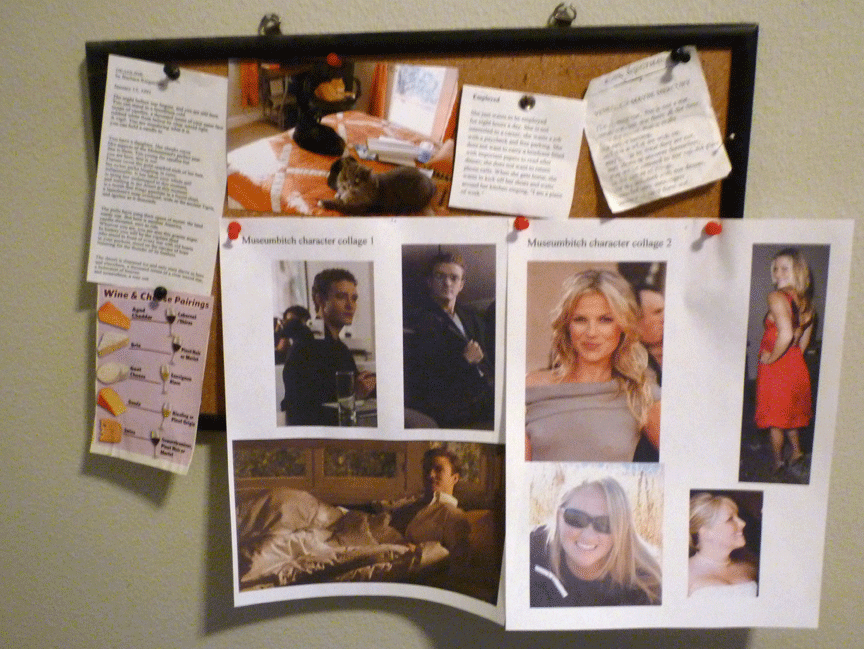
Get crafty. Some authors make collages for books they’re beginning to write. It’s a practice I’ve long admired in theory, but have never pursued due to inherent laziness and a general lack of craftiness. Even so, I like the idea of having something visual to start my wheels turning, so I recently spent an hour browsing online for photos that matched my mental picture of my new characters. I printed out the pictures and pinned them on the bulletin board beside my desk. This comes with the added bonus of having them staring disdainfully down at me as I spend an hour dicking around on Damn You Autocorrect instead of working.

10 things no one knows. Sit down with a pen and paper and make a list of ten things about your character that few people know. These things don’t have to appear in the book – in fact, it’s sometimes best if they don’t – but they’re a good way to gain insight into the character’s inner self. Is he secretly afraid of the dark? Does she refuse to eat apricot jelly because it reminds her of that unfortunate incident with the jumper cables and the guy who insisted she call him Marsha? If you’re lucky, you’ll stumble over a few surprises as you go.

What do you do when you’re trying to get to know new characters? Do you prefer to become acquainted gradually as you ease into the story, or do you perform any sort of preliminary groundwork? Please share.

And don’t steal that apricot jelly thing. I think I’m onto something with that one.

Tuesday, January 18, 2011

Just call me picky word diva

I’m working my way through the copy edits Sourcebooks gave me for MAKING WAVES. It’s a process that’s surprising me in some ways.

When the production editor sent the document last week, she included a note saying I’m not obligated to make any of the edits. “I’ll accept your changes over what the copy editor changed or suggested,” she explained.

I did a quick skim of the manuscript and laughed. The changes seemed tiny. Little bitty switches from one word to another, nothing I minded in the least.

Or did I?

As soon as I sat down and dug in, I found I minded a lot more than I realized.

I’ll give you a couple examples with the caveat that I don’t want to launch a discussion of “right” or “wrong” or “that copy editor couldn’t find her semi-colon with both hands and a flashlight.” I adore the copy editor, whoever he/she is, and think most of the suggestions are spot-on. I plan to accept the vast majority of them and would probably offer a hug and a noogie if we ever met in person.

But a couple stylistic changes rubbed me the wrong way (no small feat considering I’m a fan of most kinds of rubbing). In these examples, the blue text is what I wrote originally. The red is the word added by the copy editor:

He glanced at something in his lap, then punched some numbers on a gadget beside him. Beautiful hands, Juli thought, then she shivered at the memory of those hands all over her body.

Here’s another example:

Behind him, Jake went back to muttering. “Damn woman’s going to ruin us.”

“Probably,” Alex said, and he tried not to look forward to it.

It’s the same sort of addition in both examples, and I’m sure there’s a reason for the suggestion.

But there’s also a reason I wrote the sentence the way I did, which is the same reason I’m not accepting the change. I don't want the he or the she in those spots. I want the words to flow a certain way. I like the brevity of the original with its casual, folksy cadence.

The funny thing is, there was no point in the writing of MAKING WAVES where I made a conscious decision to exclude the she or he in those sentences. I didn’t consult a grammar guide or sit with a quivering finger poised over the keyboard wrestling with this monumental decision.

Yet I find it really does matter to me. As much as I don’t fancy myself a word diva, I probably am. It’s the reason you’ll never, ever catch me blogging if I’ve had anything to drink.

That thud I just heard was probably half of you hitting the floor, but it’s true. I’ve written plenty of words after a glass or twelve of wine, but I’ll never set a blog post to go live until I’ve read it with 110% sober vision. I like making deliberate word choices with anything that will have hundreds of eyes on it. That sort of deliberateness doesn’t always happen with a glass of Chianti beside me.

How choosy are you about word selection? Do you find yourself nit-picking other people’s writing differently than your own? Please share.

And please share your wine, while you're at it. Now that this post is written, I'm free to imbibe.