Showing posts with label RWA. Show all posts

Monday, January 7, 2013

Writing in a bubble makes your hands sticky

I have a love/hate relationship with writers’ groups.

You could broaden that to say I have a love/hate relationship with any in-person human interaction that doesn’t involve naked groping. If more writers’ groups had orgies on their agendas, I’d attend every meeting.

I’m an introvert by nature, so I tend to avoid human interaction like porn stars avoid expired condoms. I wrote romance for many years before my agent commanded me lovingly advised me to join RomanceWriters of America (RWA). There may have been some kicking and screaming involved, and not the fun kind.

As it turned out, I was wrong in my assumption that in-person interaction with other writers would be a painful endeavor. I enjoy the camaraderie and knowledge I gain from the monthly gatherings, and I learn something new at each meeting. Sometimes it’s writing techniques or social media strategies, and other times it’s the latest industry gossip. My little brain soaks it up like a sponge (and not the kind you take your pants off to use).

Unfortunately, a large mountain range separates my city of residence from my closest RWA chapter. Making the seven-hour round-trip journey is tiring in summer months, but downright treacherous in winter months when ice turns the roads into cliffside ice skating rinks.

I haven’t made the trip for months, and could feel myself slinking slowly into my introvert cave and gathering large boulders to block the entrance. When an RWA chapter-mate contacted me last week to say her family was vacationing on my side of the mountains and asked if I’d like to get coffee, I had a mixed reaction. I adore this particular author and love both her industry knowledge and her risqué wit.

But did I really want to change out of my pajamas and leave the house?

I decided I did. When I left three hours later, I slammed my head in the car door repeatedly and asked myself, “why the hell don’t you do that more often?”

There’s something about chatting with other authors that rekindles my passion for writing. Even brief conversations leave me quivering with new knowledge and ideas that empower me for my own career.

While it’s true I interact with other writers in online communities and I adore those relationships like a stripper loves nipple tassels that don't chafe, they're not the same thing.

Let’s face it—most authors (myself included) sugarcoat what they post online about publishing decisions, industry interactions, and dollar figures. Authors who don’t want to burn bridges won’t post on Twitter to lament the challenges of working with a particular editor. You won't see many writers taking to Facebook to detail their sales numbers and royalty figures.

But when you meet in person, people are less censored. And when that happens, you get a genuine sharing of knowledge and information that doesn’t happen in online writer communities.

You also get a different sort of camaraderie than you see online. The butt-pats are real instead of virtual, and that right there is worth changing out of your pajamas.

Do you participate in online groups or in-person meetings for your chosen profession (writing or otherwise)? What sort of interaction do you prefer? Please share.

And let me know if you hear of any of those writers’ groups that get naked and grope each other. I’m asking for a friend.

Friday, September 16, 2011

Shouting from my social media soapbox

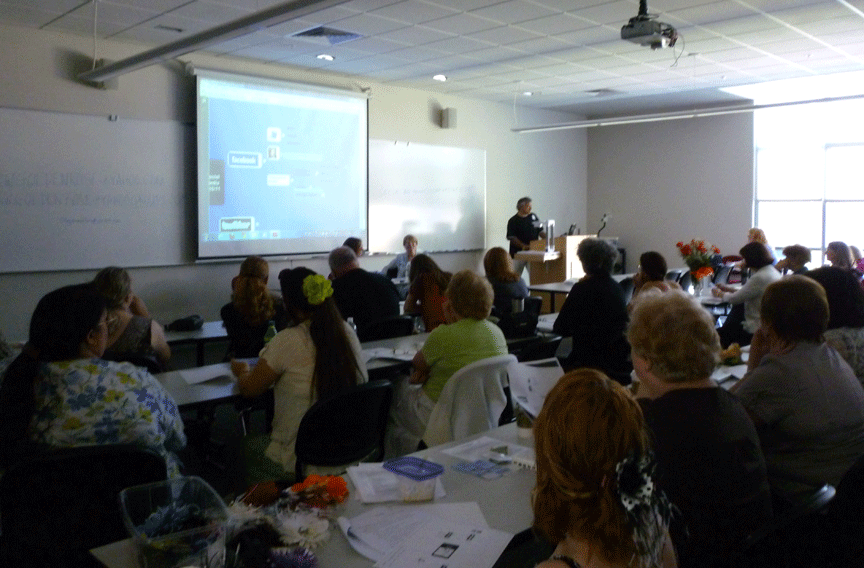
Last Saturday, I went to Portland to be part of a panel presentation on savvy social media for authors.

As a sidenote, it's not wise to drink fourteen gallons of caffeinated iced tea before getting in front of a group for an hour-long presentation, unless the image you're trying to project is that of an incontinent crack addict.

It also might not be wise to sit there with your iPhone posting to Twitter while you're in the middle of the presentation.

Or at least that might be true under normal circumstances. In this instance, the Twitter dialogue that took place turned out to be the perfect illustration of many of the points I hoped to make on the topic of social media, so I'll share it with you here.

Some background, for those who aren't Twitter-savvy: The first tweet in this series is a general message I posted to all my followers just a few minutes before I got up to do the presentation. Malin is a regular blog reader and Twitter pal who lives in Sweden. She replied to my initial tweet with what I thought was an exceptionally keen observation about social media, and the conversation unfolded from there:
A couple things are noteworthy about the exchange.

For one, Malin is exactly right about social media being personal. It's one of the reasons I tweeted what I did. Though I'm not generally nervous about public speaking, I was feeling a little pressure to get up and say something smart. There's always a risk my brain will decide to take a mini-vacation just as I open my mouth to speak or click on my iPhone to tweet. It happens to all of us, and sharing that fear in a public forum gives us all an opportunity to relate to each other.

The second thing that's noteworthy is that I've never met Malin. She lives on the other side of the world, and half the time she's tweeting in Swedish. My book isn't even sold in Sweden, but because Malin follows this blog and pals around with me on Twitter, she ordered Making Waves online. She even emailed me this screen shot a few months ago so I could see what my book looks like on the Swedish site where she bought it:

Now here's the thing: I never asked Malin to buy my book. I never asked her to send me that delightful screen shot. I never asked her to banter with me on Twitter in a way that made me look smarter than I am in front of the assembled group.

She did those things because we've forged a sort of friendship through our months of banter on social media sites. In the spirit of that friendship, you can be damn sure I'll line up to buy Malin's book someday when she achieves her goal of becoming a published author.

It's that sort of friendship – real, genuine, honest-to-goodness human connections – that make social media a valuable tool for authors.

I think about that every time I see an author cramming her tweet stream with messages urging people to buy her book. I think about it whenever I see an author on a message board asking people to visit his blog without bothering to interact with other authors there or considering the fact that at least 90% of them have blogs, too, and that the way to get someone to visit yours is not to beat people over the head without engaging in a real, meaningful way.

Social media isn't about selling. It's not about self-promotion. It's about forging connections and trusting that the rest will happen naturally.

Any thoughts on this subject? Feel free to tell me if you disagree – it's all part of engaging, right?

I'll leave you with a few photos someone was kind enough to snap for me on Saturday. Note the giant iced-tea cup. It was on its third refill, and I was preparing my second potty sprint. I'm not proud.

Monday, February 14, 2011

Questions, answers, and one shriveled brain

I'm peering into my mental gas tank right now, and I've gotta confess, I'm running on fumes.

It's been a crazy week, capped off by 7 hours of round-trip driving and a speaking engagement at the monthly Rose City RWA meeting where I was honored to be part of a panel of authors who are much, much cooler than I am.
(left to right) Cathryn Cade, me!, Kristina McMorris, Delilah Marvelle and Jessa Slade

Those of you who read Friday's blog post will notice I took my speaking coach's advice and wore the glasses.

On Sunday, my local paper ran a wonderful feature story about me and my dual life as a romance author and marketing/PR chick. I tried unsuccessfully to scan it for posting, and also made several attempts to work around the newspaper's insistence you sell a kidney in order to view the article.

I briefly considered calling each of you at home and offering to read it aloud to you, but finally decided to just create a PDF from the online version and post it to Google Docs. You can see that right here. It might look a little fuzzy or small, but click the plus sign off to the right and it should be easier to read.

Though my brain is shriveled and useless at the moment, I'm hopeful it will improve shortly.

In the meantime, I'm feeling inspired by the author panel where audience members peppered all five of us with great questions. I'd like to offer the same opportunity to blog readers. Well, not the exact same opportunity – you're stuck with just me, instead of the other four authors (who, as I mentioned, are much cooler than me).

Is there anything you want to ask me? It can be writing-related or not, I don't care. I haven't decided yet if I'll do a single Q&A blog post or if I'll just use your questions to inspire a whole bunch of future posts. Why don't we see what we get?

And if anyone has a brain to loan me, could you set it on my front porch within the next 24 hours? That would be helpful.

Friday, August 13, 2010

Why authors love stupid questions

I know I’m supposed to repeat the refrain, “there are no stupid questions.”

And while I believe that’s true, there are always questions you feel stupid asking, especially in publishing where learning curves are steep and the rules are printed on tablets hidden somewhere in the New York City sewer system.

Last week, I attended a meeting of the Mid-Willamette Valley Romance Writers of America. Unlike the Rose City RWA group I belong to (which has 150-200 members), the Mid-Willamette group is tiny.

There were only two other people last week, both authors working on their first novels. At first glance, you might assume that I – with three books scheduled for publication starting next August – would be the most knowledgeable about our genre.

You would be wrong.

Like most romance writers, I spent the previous week following news from the national RWA convention, listening to updates about awards and lectures and rubber chicken dinners.

But unlike seemingly every romance writer on the planet, I was clueless about the Golden Hearts and RITA awards. Oh sure, I understood they're the big awards in the genre and we should all be willing to mud wrestle to get one, but what’s the difference between them? How do writers get nominated? Who decides the winners?

When I posed the questions to one of the women at that tiny Mid-Willamette RWA meeting, there was a moment where she just blinked at me.

And then she answered the questions – thoughtfully, knowledgeably, and without a touch of condescension.

Because the fact is, she had attended several conventions and understood that aspect of RWA much better than I did. She had knowledge I didn’t, and she was happy to share it.

I don’t know what was running through her mind, but I can guess. I imagine it felt damn good to help a fellow author.

Why do I think this? Because a few minutes later, the third author spoke up. Brand new to writing, she studied the information on my business card and fired off some questions for me:

You have an agent? How did you meet her? Is she local? How do agents get paid? How do you get an agent? How did you know how to write a query letter?

And you know what went through my mind?

It wasn’t frustration at the volume of questions or a mental eye roll at the notion that authors and agents might connect over cantaloupe on the produce aisle at an Oregon grocery store.

It was, holy crap, I know the answers, this is so cool!

I don’t care how long you’ve run the publishing gauntlet – there will always be things others know that you don’t, and knowledge you have that others want.

And how freakin’ amazing is it that we can gather at meetings and in online communities to share what we know?

It can be scary to ask a question you fear might be stupid, but the fact is, someone will feel good being able to answer it. I’m not suggesting you run out and badger every author with 100 questions before making an attempt to do some research on your own, but don’t be afraid to speak up if there’s something you’re wondering.

I know I’m glad I asked about those awards, and I’m doubly glad the other author was brave enough to ask me her questions.

Oh, and in case you share my previous ignorance, here’s some info about the Golden Heart and RITA awards.

And here’s the gist of what I told the other author about agents:
• Yes, I have an agent. I connected with her by writing a query letter.
• I learned to write a query letter from a variety of online resources, but my favorite is agent Janet Reid’s Query Shark.
• I’ve never met in-person with my agent, the brilliant and talented Michelle Wolfson, but I learned about her and hundreds of other agents through agentquery.
• Reputable agents never charge up-front fees, and only get paid when they sell your work. They earn a commission, typically around 15% (a bargain for the authors, in my opinion – agents work damn hard). There's more great info here about what agents do.

So how do you feel asking or answering so-called stupid questions? Are there any you’ve been afraid to ask? Any you summoned the courage to ask elsewhere and want to share with others? Please discuss in the comments. I’ll do my best to answer when I can, and will try to tackle some of the bigger ones in future blog posts.

Have at it – bring on the stupid questions!

Tuesday, August 10, 2010

Why I'm stroking my husband's...leg

Yesterday, my husband shaved his legs.

No, he didn’t follow up by donning my best negligee and asking me to call him Katie. Believe it or not, there’s a fairly manly reason for it.

If you’re new to this blog, you should know Pythagoras is obsessive about exercise. He starts to twitch if he doesn’t run every day. When he tells me he’s going for a “quick bike ride,” he means he’ll be riding 90 miles straight up the side of a mountain.

This is actually the reason for the leg shaving. It’s a trademark of competitive cyclists. Watch the Tour de France or any high-level cycling event and you won’t see a leg hair anywhere.

Reasons for this vary. Some say it’s for aerodynamics. Others claim it makes road rash easier to treat after crashes. Another theory is that it facilitates post-ride leg massage.

But let’s face it – if it were an issue of aerodynamics or wound cleaning, wouldn’t they shave their arms as well? And while Pythagoras might wish for daily post-ride leg massage, the odds I’ll be providing this are about the same as the odds he’ll learn to rub my shoulders without copping a feel.

Which leaves you with the real reason cyclists shave their legs – because cyclists shave their legs.

Simple enough.

Cyclists have always shaved their legs, so cyclists continue to shave their legs because that’s what they do. It’s how they pick each other out of a lineup.

I thought about this last week when I attended the monthly meeting of the Mid-Willamette Valley Romance Writers of America and realized I am largely ignorant about the habits of romance writers. I didn’t join the group until after I landed my book deal in February, and I’m still trying to learn the ropes.

Is there a secret handshake? A hairstyle I should adopt? A special way I’m supposed to pat my colleagues on the butt at the end of each meeting?

I’m only half joking here, because I really don’t know. While everything I’ve written over the last eight years has had elements of romance, it wasn’t until this book deal came along that I really thought of myself as a romance author. I’m still not sure what that means, so I mostly feel like the weird kid in the back of the room worrying someone will notice she’s not wearing the right socks.

If you’re a romance author, can you clue me in? Are there any habits I should be aware of or secrets I should know? If you don’t write romance, what are the trademarks of authors in your genre? Can I spot a paranormal author by the antennae sprouting from her forehead or a thriller writer by her muscle shirt and big tattoos? Please share in the comments.

I’ll be waiting with my razor at ready, just in case there’s a rule requiring me to shave my pinkie toes.

Friday, May 28, 2010

Defending pink wine and bodice rippers

The other night, I went to a dinner party with a 2004 Jardiniére Rosé Willamette Valley Pinot Noir.

That’s a complicated way of saying I brought a bottle of pink wine. A damn good wine, but pink nonetheless.

There’s a stereotype associated with pink wines, and it’s not a good one. People think of the sickly-sweet rotgut sold in gallon jugs as “white zinfandel” and think pink=cheap. Unless you’re a starving college student, cheap is not a good thing in wine.

I was recently at Firesteed doing research for LET IT BREATHE, and the tasting room associate lamented this as he poured their fabulous 2008 Pinot Noir Rosé.
A most excellent Rosé.
“Wine critics love it, but the public is reluctant,” he explained. “People see pink and turn up their noses.”

It’s not hard for me to draw a parallel between that and the romance genre.

I’ll proudly tell anyone from my grandma to the paperboy that I write romance. Though most are supportive, I’d be delusional if I said I didn’t see the occasional sneer. It’s a look that suggests I’m either a sexual deviant, an inferior writer, or some combination of the two.

My instinct is to stammer something about how I write quirky romantic comedies that are way different from the stereotypical bodice rippers with Fabio on the cover.

And then I get mad at myself, because so damn what if I wrote bodice rippers? Is there something wrong with that?

Statistically speaking, the romance genre generated $1.37 billion in sales in 2008, and remained the largest share of the consumer market at 13.5 percent (thanks RWA for those stats).

And yet, as the creators of Smart Bitches, Trashy Books noted in their hysterical book BEYOND HEAVING BOSOMS, “romance is easily the most well-hidden literary habit in America. Millions of dollars are spent on romance novels, yet few will admit to reading them.”

I’m not sure what’s behind that. Is it the desire to be seen as intellectual who would never read escapist tripe? Is it the fear of being branded a sexual deviant along with the author?

Or is it something else?

As the recipient of a degree in English Lit, I am qualified not only to serve Happy Meals, but to point out that romance is part of nearly every great work of literature. The Illiad, Hamlet, Don Quixote, Anna Karenina…frankly, you’d have a shorter list if you just tallied up the books without romance (and then skipped them entirely, because really, who wants to read anything without nookie in it?)

While most modern romance novels probably won’t find their way into the literary canon anytime soon, that doesn’t make them any less worthy of respect and admiration. The romance genre is popular, it’s enjoyable, and it’s nothing to be ashamed of – for readers or for writers.

So on that note, I lift my glass of pink wine in a toast to everyone who loves romance. Cheers to all of you – the sexual deviants, the good and bad writers, and anyone who just craves a damn good love story.

Monday, April 12, 2010

Feather boas, heaving bosoms, and my first RWA meeting

Well, I survived my very first RWA meeting.

Not only survived, but I had a pretty good time.

Those of you who’ve been reading awhile will be disappointed to know I did not flash my underwear or drop gristle in a stranger’s purse.

In fact, I deliberately avoided a tempting box of Krispy Kreme donuts for fear I might fling one Frisbee-style across the room while bleating like a goat.

What? Don’t pretend you’ve never considered it.

The thing that most impressed me about the group was its diversity. Though I’ve been proudly crafting smut for awhile, I’ve never spent much time around my fellow romance authors.

Even though I know better, a tiny part of my brain still pictured a room full of nubile twenty-somethings tossing their raven locks as their feather boas fluttered in the breeze and they pranced around calling each other “dahling.”

Apparently the retired Air Force master sergeant seated next to me forgot his feather boa. It’s understandable, since he’s 81 years old.

But his respect for the romance genre – as well as for his late wife, who inspired his interest in it – was enough to make me consider the possibility that my preconceived notions about romance authors were a bit off-base.

I met authors who write Christian romance, and authors who write explicit smut. I met authors who are just starting their first books, and one author who’s spent so much time on the New York Times bestseller list they’re considering renaming it for her.

Suffice it to say, I would be hard-pressed to draw you a picture of the “typical” romance author.

And that’s not just because I can’t draw.

If you aren’t already a fan of Smart Bitches, Trashy Books, you must stop what you’re doing right now and visit heir blog. Then order a copy of their divine book, BEYOND HEAVING BOSOMS.

In addition to being the queens of snark, the Smart Bitches are the ultimate advocates of the romance genre. They’re clever, hilarious, and have built an impressive community of like-minded readers devoted to exploring romance novels from all angles (including some that are illegal in most Southern states).

If my first RWA meeting served to break down my preconceived notions about romance authors, the Smart Bitches will break down any you may have about the genre itself.

On that note, check out the contest they’re running. Readers were invited to create a romance novel cover using a photo they provided. As a devout Photoshop nut, I couldn’t resist the urge to play. Can you guess which one is mine?

No, I won’t tell you – it seems unfair somehow. But if you’ve been following this blog awhile, you probably find yourself saying, “I just look for the weirdest one, and that must be Tawna’s, right?”

Probably.

Friday, April 9, 2010

If you are what you wear, I'm in big trouble

Tomorrow I’m traveling to Portland for my first meeting with my new RWA chapter, the Rose City Romance Writers.

Can I confess I’m a little nervous?

Oh, it’s not that I’m afraid of dropping gristle in someone’s purse or shoving a half-cup of butter in my mouth.

They aren’t serving food, which cuts back significantly on my ability to embarrass myself.

I am, however, faced with the age old question that has plagued women since the first cavewoman studied her reflection in a pond trying to decide if the mastodon pelt or the T-rex hide was more flattering to her skin tone:

What do I wear?

In most parts of Oregon, “dressing up” means putting on a clean fleece hoodie. However, having a good friend in the fashion industry has made me dimly aware that there are fashion rules I should attempt to comply with.

Rules that aren’t carved in stone.

Several years ago I worked for a large corporation with a dress code that hadn’t been revised since the Nixon administration. A handful of female employees dared to question the company’s pantyhose requirement, and were quickly slapped down by a posse of matronly executives who considered bare legs just slightly below murder on the scale of mortal sins.

After several attempts to make my point through professional channels, I decided to challenge the hosiery policy by complying with it in theory, but looking as ridiculous as possible in reality.

One day I wore a forest green skirt with neon pink fishnets. Another day I showed up in a pink silk skirt and rainbow striped toe socks.

I looked horrendous. I was so proud. Certainly, I’d proved my point.

Then a co-worker returned from a meeting looking bemused. “I was just talking with one of the executives,” she said, naming the grandfatherly director of one of the company’s most influential departments. “He thought you looked nice today. Said you really brightened things up.”

I stared at her. “He was being funny, right?”

She shook her head. “You know him. He isn’t funny.”

As it turned out, the guy was dead serious. He thought I looked wonderful – bright and cheery, and as far as he was concerned, perfectly fashionable.

Eventually, the hosiery policy was changed – not before I trotted out a few more ridiculous outfits and withstood the threat of firing.

But the lesson I took with me is that fashion is sometimes in the eye of the beholder. What’s ridiculous to one person might be the height of haute couture to another.

If writing is the most subjective business on the planet, fashion must run a not-so-distant second.

On that note, I have to go figure out what to wear tomorrow. Parachute pants, perhaps?

Tuesday, March 16, 2010

Networking tales from the socially challenged

After I joined Romance Writers of America last week, author/blogger Jeffe Kennedy kindly educated me about the different branches of the organization. With one branch, she explained, I’d have access to special meetings and events.

“Meetings?” I asked weakly. “Like – in person?”

It’s not that I’m antisocial. Though I prefer my human interaction to be virtual, my career in marketing & corporate communications forced me to participate in plenty of in-person networking activities over the years.

I just wasn’t very good at it.

One group of local marketing professionals used to hold monthly luncheons. They were well attended, and always provided an excellent opportunity for networking and education.

They were also an excellent opportunity for me to demonstrate why I shouldn’t be allowed out of the house.

The first time I went, I moved through the buffet line chatting amicably with a colleague about a direct mail campaign. Spotting the brownies, I set one on the edge of my plate and reached for the spoon nestled in a giant bowl of whipped cream.

“So we’ll be using radio spots to get the buzz started before the piece drops,” I explained as I spooned a hefty scoop of whipped cream onto my brownie.

The brief look of horror that crossed her face probably should have alerted me to impending danger, but it didn’t. I assumed she was counting calories.

Smug in the knowledge of my remarkably high metabolism, I marched back to our table to continue the conversation.

“So what sort of ROI have you been seeing on your new campaign?” I said as I scooped the whipped cream off my brownie and spooned it in my mouth.

The moment my lips closed around it, I realized my mistake. I had just crammed a half-cup of butter in my pie-hole.

Butter that began melting before I had a chance to decide whether I really felt like swallowing a mouthful of salted fatty-acid emulsifiers. It was instantly liquefied, eliminating most of my options. Could I spit in my water glass?

I saw my colleague scoot back a few inches as she gamely tried to pretend nothing was wrong. “Our preliminary numbers look good,” she said, ignoring the gagging sounds I made. “We’ll be using focus groups next month to fine-tune the message, but we’re seeing a great response.”

I took a deep breath and swallowed the butter. “You don’t say?”

You would think I might have learned my lesson and avoided the luncheons altogether after that. If so, you would have sorely underestimated my desire to humiliate myself with food.

Several months later, I returned to the scene of the crime. This time they provided chicken and a guest speaker discussing the merits of qualitative research.

As I absorbed the presentation, I daintily cut a bite of chicken and began to chew.

And chew. And chew.

I soon realized the piece of gristle wasn’t going anywhere. Having learned from my butter experience that swallowing bad things wasn’t a networking requirement, I reached for my cloth napkin and quietly spit the gristle into the corner.

As the speaker continued, I forgot about the gristle. Several minutes later, I reached for my napkin again.

Everything happened in slow motion. The gristle rolled out of the napkin, tumbled off the table, and bounced into the gaping Coach handbag hanging on the chair of the stranger seated next to me.

I looked up to see if she’d noticed. She was smiling obliviously at the speaker, jotting notes about controlling consumer perception.

I looked back at her handbag. I couldn’t see the gristle anywhere. The bag was a huge tote, packed to overflowing with several electronic devices and something that looked like a pair of gym socks.

I stole another glance at the owner of the purse. She laughed, still focused on the presentation.

I started to reach for her purse.

Suddenly, the woman seated beside gristle-girl looked at me. I saw her eyes narrow as she spotted my hand creeping toward her friend’s purse.

I froze.

Had the speaker paused then, I might have offered an explanation. “I’m not a thief – just someone with abysmally bad table manners.”

Instead, I drew my hand back and pretended to dust some lint off the edge of my sleeve.

Satisfied I wasn’t planning to pilfer her friend’s wallet, the woman turned back to the speaker. I looked down at the handbag again. Was that the gristle stuck in the bristles on her hairbrush? Maybe if I knocked the purse to the ground, I could grab the gristle and run. Or maybe if I pulled the fire alarm –

“Thank you all for coming today,” announced the speaker. “Enjoy the rest of your afternoon.

I sat back in my chair, defeated.

I watched the woman and her friend gather their things and flounce out of the room. I tried not to picture the scene when she eventually discovered the gristle. Would she know what it was? Would she know to blame me?

I never got answers. I also never had those two women sit anywhere near me again.

So you see, I don’t have the world’s best track record when it comes to in-person networking. That doesn’t mean I’m dreading future RWA meetings. Just that I hope they don’t serve browies. Or chicken. Or—