Showing posts with label Rejections and setbacks. Show all posts

Monday, February 4, 2013

Three things I've learned being a judgmental b*tch

I'm armpit deep in a pile of romance novels as a result of volunteering to judge this year's RITAs (the romance novel equivalent of the Academy Awards).

I won't pretend it's a hardship to spend every waking moment reading romance novels. That's pretty close to my description of a perfect job, right behind "adult product tester" and "wine quality assurance manager."

But still, it's time consuming. It's also a good reminder of a few things we writers sometimes forget in our dogged pursuit of agents, book contracts, and joyous reviews from readers who had spontaneous orgasms upon opening our latest masterpiece.


Here are a few things I'm hereby commanding myself to remember:
  1. Amazing books get published every day, some that make me swoon over the quality of prose and storytelling while thinking, "I couldn't ever write like that." That's true, I couldn't. But it's also true no one could ever tell my stories the same way I could. And I couldn't tell your stories the same way you could. The great thing about books is that no two are exactly the same, and thank dawg for that.
  2. Lousy books get published every day. It's true, and as much as we all like to imagine that only quality material rises to the top, that's not always the case. But this fact neither detracts from nor builds my own experience as a writer. Pointing out examples of lousy writing that gets published just makes us look petty and snobbish.
  3. Every published novel I pick up to review for this contest has been rejected or ridiculed by someone at some point. Guaranteed. This business is subjective, and just because one agent, editor, or reader doesn't want what you're writing doesn't mean everyone will feel the same. 
That last point is significant whether you're a writer, an engineer, or a nipple-clamp salesman. Rejection is a fact of life, and there's always something we can take away from the experience. What's your takeaway?

I leave you with this gem I spotted on Facebook this morning. Amen, Mr. Maraboli. Amen.

Monday, November 26, 2012

When the end isn't the end

Last week, I had the giddy pleasure of typing "the end" on my current manuscript.

Well, that's not exactly what I typed.

This particular ending was a long time coming, and I'm too exhausted now to point out that I just wrote "coming."

I haven't addressed this on the blog yet, but those of you paying close attention may have noticed the third book in my romantic comedy contract hasn't hit shelves yet. Though my publisher had initially slated the release for August 2012 and I completed the manuscript in plenty of time, they suggested it wasn't the right third book for my career. I was given the option to release it anyway, or to start from scratch with a brand new book and a different release date.

My gut and my brain had differing opinions about the best course of action, and they wrestled long and hard in a pit of cherry Jello while wearing sequined g-strings and nipple tassels.

Which is how I ended up writing a new manuscript from scratch, and how I ended up sitting at my desk last week staring at those words through a blur of happy/sad tears.

Once upon a time, I thought a book deal might magically transform me into the sort of writer who'd reach the final line of a manuscript, type "the end," and immediately hand a spotless draft over to my gleeful editor. This fantasy may have also involved several male strippers and a wine dispenser mounted beside my desk, but let's not dwell.

The biggest lesson I've learned since I first accepted this three-book deal in February 2010 is that my fantasy couldn't have been more off-base if I'd thrown in a gang of monkeys clanging celebratory cymbals.

Which, come to think of it, would be pretty cool.

But that isn't reality, and I know now that typing "the end" is only the beginning. I still have an absurd amount of editing to do before I'd even consider letting anyone outside a mental institution have a look at this manuscript. After that, I'll hand it off to my three critique partners who will lovingly tear it to shreds. Once I've implemented their changes, the manuscript will go to my three longtime beta readers, who will point out all the ways my heroine is unsympathetic, my hero is a sniveling weasel, and the fact that my unclear pronoun usage makes it sound like the heroine is licking her own neck. After their changes are made, the manuscript goes to my agent for another round of feedback and polishing before she submits it to my editor.

And after all that, I know it's entirely possible my editor will say, "meh...it's not the right book for your career now."

I don't know what's going to happen, but I do know I can't let myself dwell on that.

I can choose to panic over the flogging my draft will take in the coming weeks, and the fact that it might be all for naught. Or I can choose to take this one step at a time, slow and steady, and to allow myself to celebrate milestones like typing "the end" without rolling my eyes and muttering, "far from it."

For the writers among you, how far is "the end" from "THE END?" For non-writers, what are some of the biggest lessons you've learned along the way in your chosen career path. Please share!

I have to see a man about a monkey.

Thursday, September 6, 2012

On struggles, sacrifice, and drinking wine while being groped

I love concerts more than drinking wine  being groped  drinking wine while being groped

I love concerts a lot.

For a pair of tickets to see a performer I really admire, I'd gladly give up drinking wine  being groped  drinking wine while being groped  my morning mug of tea.

Last Saturday I had the pleasure of seeing Brandi Carlile live for the first time. I've attended hundreds of concerts in my 38 years on the planet, so you know it's a big deal when I say this one made my top five list.

Brandi charmed me not only with her passion and musical talent, but with the stories she told between songs. Stories about struggling to make it as an artist. About the roller coaster of creative successes and failures. About what it's like to perform at outdoor venues in the summertime and finally, finally be the one standing onstage when the sun goes down.

I wish I'd written down the precise words she spoke about the things people are willing to give up to chase their dreams, but I was too busy drinking wine  being groped  drinking wine while being groped  enjoying the music.

But it struck a chord with me anyway. And it got me thinking about how many artists have that thread running through their words. Shawn Mullins is another one of my favorite performers, and though he's from the South, I've had the pleasure of seeing him several times in Oregon. He often opens with a song titled, "Twin Rocks, Oregon" about a chance meeting with a transient man offering a unique perspective on life.


The lyrics that always sock me in the gut are these ones:
I told him I, too, had been travelin' around 
Living out of my van from town to town 
Playing for tips and whatever records I could move
I said, "I don't reckon I'll be making it big 

It's hard to get rich off a tour of coffeehouse gigs."
He said, "yeah, but ain't it a blessin' to do what you wanna do?"
I've thought more than once about having those last few words tattooed on my arm, particularly during the post-divorce struggles of this past year.

I make it a policy not to share specifics of money when it comes to my life as an author, but I don't think it will surprise you to learn I don't travel around on book tour in a pink Leer jet with shirtless male flight attendants groping me while I drink wine offering me in-flight magazines. Until last week, I drove a 15-year-old car with a dented bumper and a cracked windshield. Nearly every stitch of clothing I own comes from thrift stores, and my annual expenditure for haircuts & styling is under $100.

In the years before I had a book deal, I worked full-time in marketing & communications earning surprisingly good money. I was laid off just weeks before my agent landed me my three-book romantic comedy deal with Sourcebooks, and when I went job-hunting after that, I opted to find a part-time job that allowed me more time for writing.

The pay cut stung, and it stung a lot harder when I suddenly found myself single with a mortgage to pay. Over and over, I asked myself if I'd be smart to swap those extra writing days for the paycheck of a full-time job.

That might have been the smart thing to do, but it wasn't what I chose. Even though I knew it meant a lot of life changes – taking in housemates to pay the mortgage, eventually selling the house – I was willing to make sacrifices to give myself the time I knew I needed to pursue this writing career as wholeheartedly as I could.

Will that choice pay off?

If you mean will I eventually acquire that pink Leer jet with shirtless male flight attendants groping me while I drink wine offering me in-flight magazines, I can assure you it probably won't.

But that was never the payoff I expected anyway.

The thing I want most from my writing career is to wake up every morning knowing I'm doing what I want to do. Maybe not every moment of the day, and Lord knows there have been moments I wanted to stuff my laptop in the neighbor's septic tank and set fire to it.

But certainly I spend the bulk of my waking hours thinking I'm damn lucky to have the opportunities I've been given as an author. The fact that I've made a few sacrifices to achieve that only serves as a reminder how much I truly want to spend my time doing what I've chosen to do.

What are your thoughts on the subject? What struggles and sacrifices are you willing to endure to reach your goals? Please share.

I'll be over here drinking wine  being groped  drinking wine while being groped  working on my next novel.

Wednesday, March 28, 2012

On success, disappointment, and star-nosed moles

Many moons ago when I was a young and innocent pup, I thought a book deal would mean the end of writing-related disappointments.

My fantasy may have also included confetti and foot rubs from George Clooney, and it’s possible I cleared storage space in my garage for fan mail.

Fast forward a decade or so, I’ve learned some lessons along the way (not the least of which is that you should buy D-batteries in bulk before hosting a Pure Romance party, but I digress).

My road to publication was a bumpy one, and I’d be lying if I claimed everything’s been smooth sailing since then. Some setbacks I can’t really discuss publicly, but others I can share (albeit, with a touch of shame – an unfamiliar emotion for me, but I digress again).

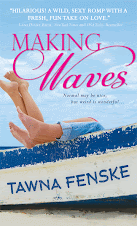
The RITA awards are the Romance Writers of America equivalent of the Oscars. My publisher sent Making Waves for consideration, and though I tried not to think about it, I wanted urgently, desperately to be a finalist. I mentioned it to almost no one, and avoided watching the calendar for the date they pledged to notify contestants.

The date was Monday. Sadly, my name didn’t appear on the list of finalists.

It didn’t crush me. It didn’t ruin my day. It didn’t send me weeping into my closet where I huddled in the dark eating Girl Scout cookies and rocking back and forth humming “I’m a Little Teapot.”

Still, I’ll confess I felt stung for an instant.

Then I got mad at myself for feeling stung, because AREYOUKIDDINGMEBITCH?

Once I stopped slamming my head on my desk, I tallied my good fortune. I have my health. I have amazing friends and family, and the best agent on the planet. I have an incredible gentleman friend who makes me smile for reasons that don’t all involve being naked. I’ve published three books to embarrassingly positive reviews, including a nomination for “Contemporary Romance of the Year” from the RT Book Reviews 2011 Reviewers Choice Awards.

I’m damn lucky, and I know it.

But does that mean I’m not allowed to feel tinges of disappointment over setbacks? I’m not sure.

A critique partner once gave me a terrific piece of advice:

Someone else’s success does not detract from yours.

That’s absolutely correct, and something I remind myself whenever the green-eyed monster appears.

And yet…and yet…sometimes, that’s not entirely true.

There can only be a limited number of RITA finalists, and if every single contender in my category was eaten by a star-nosed mole, I would be the winner. The fact that my competitors all survived mole attacks means they emerged victorious and I….well, I didn’t get eaten by a mole. That’s something.

Hello, I'm a star-nosed mole.
Here’s something else: I told you Monday about the friendly Twitter competition my publisher arranged using the #ebookbracket hashtag and a plea for readers to vote which book will be sale-priced for 99-cents in early April.

For the first round, eight of us were paired off by genre. My competitor in the Contemporary category was an amazing author with USA Today bestseller status, two million books in print in more than 20 countries, three Maggie Award of Excellence finals, a Bookseller’s Best win, and five RITA nominations – one of which she nabbed Monday morning.

In other words, she rocks (and I can attest to that personally since I've read and loved her books).

The #ebookbracket challenge from Sourcebooks.
Please keep voting for Making Waves!

But through some bizarre stroke of good fortune, I managed to land more Twitter votes in our publisher’s #ebookbracket challenge. That sent me through to the final four (which ends March 28 at 4 p.m. CST, and you can vote as many times as you want, so please, pretty please, tweet a vote for Making Waves using the hashtag #ebookbracket and my Twitter handle, @tawnafenske…er, I digress again).

While I doubt my competitor would trade my victory for hers, there’s really no point in comparing. I had a flutter of success, and I’m happy about it. Period.

That stands by itself no matter what other successes or failures might come to any of us. For me, it’s important to celebrate my own victories, while graciously tipping my hat to the ones that go to other people.

Do you pay much attention to the successes and failures of others? How does that impact your overall attitude about yourself? Do you think someone is more or less entitled to feel disappointed, depending on the successes he/she has? Please share!

And please, pretty please, tweet your little hearts out in the #ebookbracket challenge (a link to complete rules can be found here). Thanks a ton for your support so far!

Thursday, February 16, 2012

4 ways to bounce back when your confidence takes a beating

Whether you're a writer, a botanist, or a lag screwer, one thing is certain – there will be times your confidence in your ability to do the job is so shaken, it could double as a dirty martini.

As much as I enjoy that beverage (and not just for the name), finding myself in a confidence-shaken state is no fun at all. In case you've landed there yourself, here are a few tricks I've found for getting the mojo back:

Lick your...wounds
Whether you're hit with a bad review as an author, or a bad case of chlamydia as an escort, chances are you won't feel like getting back in the saddle right away. Don't. You need time to process, to heal, to formulate a plan, and to drink a few medicinal sips of that dirty martini. It's a vital part of the process to make time for these things, so don't feel guilty about it.

Punch something
You can do this literally (though I suggest choosing your pillow over a steel door) or you can do it figuratively (a good bitch session with a pack of girlfriends is priceless). Either way, give yourself a chance to cycle through the emotions of the setback. While I don't advise calling your boss or editor at 3 a.m. to sob that he ruined your life, it can be therapeutic to vent to a pal with a sympathetic ear. If you'd prefer to keep the harsh words to yourself, there are plenty of physical ways to blow off some steam. Hit the batting cages, buy a voodoo doll, or play Whac-A-Mole at your local video arcade (my personal favorite).

Do something you're great at
It's important to start building your confidence up again, which means you shouldn't go near the project that set you back in the first place. Think of a task you know you perform exceptionally well and do it. For some of you, this may mean finding a willing partner and retreating to the privacy of your home. A recent setback for me in the writing realm had me doing the "I suck" tango (I swear that's not a reference to the previous sentence). Instead of continuing to fling myself at the same wall, I switched gears – and genres – and poured my energy into a different project. Making a deliberate choice to focus on a type of writing I feel more skilled at has been slowly rebuilding my confidence, not to mention making me laugh (which is another crucial part of the process).

Find friends to stroke your...ego
Long before I ever had a book deal, I went through a string of bad rejections. Determined to keep moving forward, I wrote a new manuscript. My critique partners and beta readers were aware of the rejections, and though I never asked any of them to go easy on me, something shifted in that next round of feedback. Instead of focusing their criticisms on things that didn't work for them, every single reader went out of her way to flag elements of the story that did work. Not only did it give me a much-needed confidence boost, it helped me pinpoint what I was doing well so I could keep doing more of it.

What are your favorite strategies for rebuilding your confidence after it's been shaken? Please share!

And feel free to belly up to my imaginary bar for that dirty martini. Extra olives?

Friday, October 21, 2011

On having the balls to mark the wood

Moments of supreme clarity sometimes arrive when you’re sopping wet.

At least, that’s how it is for me.

I spent much of last weekend hanging out at Summer Lake Hot Springs. Though the motive for the trip was my speaking engagement at a nearby library charity event, my real reason for going was a fervent desire to soak my bones in the hot springs.

(Insert “bone” joke here. Go ahead, I’ll wait).

The outdoor rock pools were heavenly, but I was particularly charmed by the rustic bathhouse with its large, spring-fed pool. The structure was built in 1928, and a four-inch pipe feeds water from the springs into the indoor pool.

(Anyone want to make the pipe joke?)

The water feels heavenly, and light streaming through the skylights give the place a dreamy, ethereal feel. It’s romantic not only for the steamy heat, but for what adorns the walls of the structure.
Names. Hundreds of them. Joe loves Julie. Raven-n-Mark. Peter & Jenna 4ever. And somewhat curiously, Tooter & Hank.

I swirled around in the water with my gentleman friend, tracing my fingers over the letters.

“Don’t you wonder how many of these people are still together?” I asked. “Like Rod and Tiff – how do you think they’re doing?”

“Or Nick and Kyle,” he added. “I hope those crazy kids made it.”

I sighed. “Once upon a time, all these people were so giddy with love, they carved their names in the wood. Now – how many of them even speak to each other? There’s something sad about it.”

“There’s something hopeful about it,” he countered. “About having the balls to do it in the first place – to make your mark and lay claim to each other knowing it might not last.”

The words socked me in the gut. Not because I’m a romance author. Not even because he had his hands on my bare back when he said it.

But also because he knows. We both know.

Both of us were married before, and both divorced under startlingly similar circumstances. Neither of us wanted or expected our splits, but we both emerged on the other side feeling happy and whole and remarkably stronger.

Under the circumstances, you might expect us to be jaded. We’re cautious, to be sure, but somehow, neither of us lost heart.

I’m sure that eternal optimism is part of what kept me writing romantic comedy even when I wasn’t feeling particularly romantic or comedic. I do believe in forever – even now, knowing what I know about those names on the wall or my own happily ever after that turned out not to be.

It's always true things might not work out the way you hope.

But it's also true they might.

That's enough for me. That's what I choose to focus on, both in my writing career and in my life.

So here’s to anyone who’s had the balls to put yourself out there despite the odds it might not last. Here’s to enduring faith, love, and the hopeful handling of wood.

Wednesday, August 31, 2011

Burning up, and I kinda like it

For the last week, I’ve been walking around with red eyes, a slight headache, and clothing that reeks of smoke.

No, I haven’t been hanging out in a hash bar.

This is Central Oregon in the summertime, where a weird convergence of dry, desert landscape, big trees, and frequent late-summer lightning storms results in an abundance of forest fires each year.

Currently, more than half-a-dozen fires are burning over 60,000 acres. That might sound like a lot, but it’s actually a pretty slow fire season for us.

There are obvious downsides to having everything around you in flames. Aside from the occasional risk of, you know, BURNING TO DEATH, you deal with runny eyes and noses, occasional breathing difficulties, hazy skies, and hair that smells like you’ve been rolling in an ashtray.

But there’s an upside to all the summer forest fires. Every year, I make it a point to pour myself a glass of wine, retreat to my back deck around 8 p.m., and revel in that upside.

Yes, the forest fires make for excellent sunsets. The smoky haze creates an incredible filter for the slowly sinking sun, sending up bursts of technicolor orange, yellow, red, and a whole lot of other colors seldom found in the Crayola box.

Even after a few glasses of sunset-enhancing wine, the metaphor isn’t lost on me. No matter what sort of lousiness life might throw at you, there’s always something positive you can take away from it. Even when everything goes up in smoke, there’s an upside somewhere. Always.

You just have to look for it.

That’s true whether you’re talking about natural disasters, setbacks in your writing career, trauma in your personal life, or walking face-first into a door at work and breaking your nose but being kinda glad you did it because you didn't get stuck in that boring 10:30 meeting.

Hypothetically speaking.

My first book deal that fell through in 2006 when Harlequin canceled the Bombshell line?

I'm so glad now that book never hit shelves. My writing has improved and my voice has changed to the point that I almost don't recognize that story as something I produced.

The unexpected divorce that gobsmacked me earlier this year?

I would never have known how much happier I could be if I hadn't been hit squarely between the eyes by that two-by-four.

Can you think of a time you were surrounded by crummy stuff but saw a silver lining anyway? Is it generally tough or easy for you to do? Please share!

And if you’re having trouble coming up with something, I’d like to humbly invite you to my back deck this evening.

I’ll supply the wine.

Monday, August 22, 2011

The screwy evolution of author fears

It wasn’t long ago I spent an inordinate amount of time hating my mailman.

OK, I didn’t actually hate him. I hated the sight of him.

Those were the days when a lot of agent queries happened via snail. Each time I saw that battered mail truck creeping along my street, I had a sick feeling he was bringing another rejection. While my natural optimism had me picturing sunshine and rainbows and good news most of the time, there were still days I wanted to shoot out the tires of that truck with a dart gun.

Those days passed after I got an agent, but a new set of fears arrived after that. When we began submitting my work to editors, I got nervous each time I saw my agent’s name in my inbox or on my caller ID. It was still a fear of rejection, but a different sort. I fretted that each time an editor said, “no thanks,” it pushed my agent that much closer to wondering what drugs she’d been taking when she signed me, and whether she could acquire enough to endure the misfortune of keeping a dead-weight client around.

After the book deal came through, I began wondering what my next big fear would be. Bad reviews? Poor sales? A disturbing fungus contracted during a book signing at a nudist resort?

I actually hadn’t put words to my current fear until Friday afternoon when I was getting ready for an event at Powell’s Books in Portland, Oregon. I mentioned to my agent that I was nervous, and she asked why.

She probably expected me to express a fear of public speaking or that no one would show up. I probably should have feared those things, given my foot-in-mouth tendencies and the fact that most people have better things to do on a Friday evening than drive to a bookstore to listen to an author yammer.

But what really bothered me was knowing I wouldn’t be able to spend quality time with the people who did show up.

Having survived a similar book signing event before, I already knew the difficulty of trying to connect with everyone. As much as I want to hug all the attendees until their eyes bug out, there just isn’t time (nor does everyone enjoy being mauled by strange authors).

I want to make eye contact with people when I’m reading or answering questions, but I get distracted and end up staring at the weird guy in the back row wearing a fedora and an apron.

I want to chat for hours with everyone who hands me a book to sign, but I can’t seem to pull it off. I’m not saying I’ve got giant lines of people winding halfway down the block, but even a handful of people can get bored and meander away if the author spends too much time gabbing with others about traffic and giant purple vibrators. When I see people leave the line, I panic. Do they hate me? Do they think I’m a snob?

Or more likely, did they mistakenly believe it was the line for free popsicles and now they’re forced to make a hasty exit before things get awkward?

When I was at RWA Nationals, an author pal with a fairly recent book deal was approached by another writer who wanted to go out for drinks. Exhausted and overcommitted, the author politely declined.

“So you think you’re too good to hang out with unpublished authors now?” the other writer snapped.

That story breaks my heart because I know with absolute certainty that’s not how the author was feeling. I know what it’s like to be exhausted to the point of delirium, and I know that’s the state she was in that evening.

But I also know how things can be perceived, and I hate the thought of people perceiving me that way. Am I a snob because I seldom respond to blog comments like I used to? Am I a bitch because I’ve dropped the ball on a handful of interview requests in recent weeks?

Er, don’t answer that. There’s seldom a right answer to a question that begins “am I a bitch?”

I am curious about the subject of fears. What was your biggest fear a few years ago? How has that changed today? How do you expect it to change in the future?

Please share!

I should probably go apologize to the mailman for the dart thing, huh?

Friday, February 4, 2011

Victims aren't sexy

Though I realize the term “wall-banger” sounds decidedly filthy, it’s how avid readers describe a book that frustrates them to the point that they hurl it across the room.

Each reader has something different that might prompt them to chuck paperbacks at the wall. For me, what sets my throwing arm in motion is a character stuck in victim mode.

Everything happens to this character. The character doesn’t actually make anything happen.

I’m not just talking about a string of bad luck, either. Plenty of authors expertly throw all manner of atrocities at their characters, from famine and pestilence to a bad case of jock itch. But how the character responds to these things makes me decide – usually within the first chapter – whether I’m willing to stick with the character through 400 pages, or if I’d prefer to do something more pleasant like unclog the hairball from my sink.

The reason I’m thinking about this isn’t because I’ve had a recent wall-banging experience with a novel. It’s because I feel some obligation to remind authors at all stages in their careers that agents and editors don’t like victims, either. Not just in your manuscripts, but in authors.

Every time I see someone taking to the interwebs to lament a rejection or setback, I cringe. I totally understand the need to share experiences with other writers and to gather support. Believe me, I get it.

But it’s the tone that can be a red flag.

Pop quiz, let’s pretend you’re an agent. You aren’t dumb, so you know an author is querying widely. You know there have been some rejections along the way.

But if you see something like this on a writer’s blog, what are you going to think?

I got three more rejections this week. Obviously they don’t understand my vision. Whatever, I don’t want an agent who isn’t willing to take risks.

I’m not quoting anyone directly there, but I’ve certainly seen similar diatribes. The statement smacks of victimhood. Woe is me. I’ve been wronged.

How likely is it that an agent or editor will want to work with someone who has that attitude?

My amazing agent and I had a pretty bumpy path to this current three-book deal. But no matter how many roadblocks we hit, I made damn sure I never fell into victim mode. Oh, sure – I might have muttered quietly about my own crappy luck and even placed curses on several editors’ genital function. But I didn’t do it publicly, and I sure as hell didn’t mention it to my agent.

The fact that she had the same approach made me admire her all the more. Maybe she screamed at her computer or got out her editor voodoo doll in the privacy of her home. I’d be surprised if she didn’t. But the tone of her interactions with me was always this:

It sucks, but here’s what we’re going to do next.

That approach in the face of setbacks is the #1 thing that kept both of us committed to plodding forward together.

I guess what I’m suggesting is that you pay attention to the tone of your public declarations of rejection. If you do decide to share your setbacks, do it in a way that suggests you’re capable of getting back up and marching forward instead of wallowing in a pool of your own bodily secretions.

What do you guys think? Have you seen the sort of thing I’m describing? Have you done it yourself? Do you disagree about what’s OK to vent in public? Please share, I’m very interested in a discussion.

I’m also very interested in knowing how to repair a paperback-sized hole in my drywall. Hypothetically speaking, of course.

Thursday, October 28, 2010

The rejection sweater – a must-have fashion

Since we talked about cupcakes on the blog yesterday, I figure I might as well keep the topic going to infect you with the same cupcake lust that hit me last week.

Author Karen Amanda Hooper had a hilarious blog post in which she revealed a clever strategy for making rejections sting less. She and her writing pals decided to substitute the word “cupcake” for “rejection.”

I see the appeal. I just got three cupcakes from agents today has a pleasant ring, doesn’t it?

It reminded me of a habit several writing buddies and I adopted back in our earliest years of the submission game. This was before I sold my first book to Harlqeuin/Silhouette’s Bombshell line (which was canceled one month before my debut was scheduled to hit shelves…er, not that I’m bitter).

I had been waiting nearly a year for a response on a requested full manuscript, and the stress had taken a toll. One night, I had a dream I went to a big party attended by several editors. Since things always happen like this in dreams, I spotted the editor who had my submission.

I mustered the courage to approach her. “Have you made a decision yet?”

“Yes, of course,” she replied. “We’ve decided we aren’t interested in your manuscript, but we do have some lovely gifts for you.”

“Gifts?”

“Yes, here. We'd like you to have this apple and this sweater. Enjoy!”

I accepted the two items without question, since in the dream, it seemed perfectly logical to receive fruit and clothing from an editor.

When I told my writing pals about the dream, they were delighted. For the next year, each time on of us received a particularly heartbreaking rejection, the others rallied around her and bought an inexpensive sweater and an apple. We’d have coffee together and wear our rejection sweaters as badges of honor.

Even now – with countless rejections under my belt and a three-book deal to show for my struggles – I’m warmed by the idea of the rejection sweater. I know people say writing is a solitary pursuit, but I’ve never found that to be true. Everywhere I look, I see writers offering each other pats on the back and clever cupcake humor to cushion the blows.

Do you have any strategies for coping with rejection? Any interesting ways you’ve supported fellow authors in the face of a setback? Please share.

I have to go find my sweater.

Tuesday, October 12, 2010

A little rain must fall

For all the non-Oregonians reading, what do you think of when you picture my fair state?

Hats off to those who said “wine,” but I’m guessing at least half of you said “rain.”

(Feel free to insert your own Oregon joke here about how we don’t tan, we rust. Or maybe the one about how our state flower is mildew).

While it’s true spots like Portland and Eugene are supremely soggy, that’s not the case here in the high desert of Central Oregon where it seldom rains. Though Pythagoras and I both grew up in rainy parts of the state, we’ve been on the dry side for 13 years.

That’s just long enough to alter our perception of rain to the point that we briefly considered canceling our hike when we woke Saturday morning to see drizzly conditions. Then we remembered real Oregonians have gills. We scoff at umbrellas. We don’t consider it a true hike unless there’s mud, dammit.

So we set out for a hike around Tumalo Falls. By the time we returned to the car, it looked like we’d both spent the last few hours standing fully clothed beneath the falls.
I posted that picture on Twitter with some silly comment about it looking like I peed my pants in reverse. I didn’t think much of it until an online pal wrote that she was sorry the rain ruined my hike.

That struck me as funny.

Maybe it’s the fact that if Oregonians let rain ruin things, we’d have very little bliss in our lives.

Or maybe it’s that the rain kind of made the hike.

I left my jacket at home, so Pythagoras chivalrously loaned me his. The dog – unaccustomed to soggy soil – kept spinning out and making us laugh. And the smell of the high desert when it rains is the closest thing I can think of to heaven.

I guess I never considered the rain might be a negative.

Admittedly, I’ve always been an optimist. I probably couldn’t have endured such a bumpy journey to publication if that weren’t the case.

Even so, it can be tough to keep a positive attitude when you’re in the trenches gathering rejections or struggling with a book that won’t cooperate. You have it in your mind how things should go, and any deviation from that can send you into a tailspin.

But sometimes what seems like a setback can turn out to be the best thing. There’s no doubt I was crushed years ago when Harlequin/Silhouette canceled the Bombshell line a month before my debut was scheduled for publication, but I look back now and breathe a sigh of relief. That’s not the sort of book I wanted to write in the long-term, but it took a major shakeup to prompt me to realize I should take a different path.

While you probably won’t always feel like dancing for joy when the downpour hits, there’s almost always something to be gained from it.

Are you an optimist, or do setbacks tend to hit you pretty hard? Can you recall anything that’s happened to you that seemed heartbreaking at the time, but turned out to be the best thing for you?

Please share in the comments. I’m still trying to get the rainwater out of my underwear.

Friday, September 17, 2010

On phallic squash and rejections

Last year, I had my first garden.

Peppers flourished with wild abandon. Tomatoes ripened faster than I could make salsa. Summer squash grew to gargantuan proportions, prompting many phallic thoughts not only for me, but for everyone who stopped by and received one as a gift.

If you have phallic thoughts looking at this year’s squash crop, I feel very sad for you. This is my most impressive specimen:

Hardly in the same ballpark as the ones that took both arms to carry just 12 months ago.

The funny thing is, I changed nothing in my gardening process. I used the same fertilizer, bought seedlings from the same store, even planted within a couple days of last year’s start date.

But the weather hasn’t been kind this year. Neither have the aphids or those nasty little spiky weeds that make me want to throw a hoe through the fence. I’ve done everything I can, but my garden just isn’t flourishing this year.

I couldn’t help but think of this when I read Victoria Strauss’s excellent blog post at Writer Beware titled Getting published is not a crap shoot.

I agree with her wholeheartedly, and think every author should read it. Here’s an excerpt:

There’s no question that good books fail to find publication –for a whole range of reasons, including what a publisher is already publishing, sales or marketing concerns, poor publisher/agent targeting on the writer's part, or sometimes simply because the writer gave up too soon. But far more often, rejection is based on quality and marketability, or the lack thereof.

Like I said, I agree with her. I really do.

And yet the last line of that paragraph makes me sad. I’ve stood in the shoes of every author who ever stared at a rejection letter and wondered, “is it the writing or is it something else?”

And the problem is, you often can’t know.

During the (sometimes brutal) two-year stretch leading up to my three-book deal, I had the benefit of an amazing agent who was able to procure detailed explanations from editors rejecting us. It was staggering how often the decision came down to something that had nothing to do with the writing itself – an editor who just bought a book in the same vein, or a marketing team that feared the book might be a tough sell with older readers.

I’m not saying I didn’t learn and grow from those experiences, but I also didn’t take them too personally. I recognized that sometimes it is a crap shoot.

It's important to strike a balance between embracing failures as an opportunity to learn and improve, and recognizing that sometimes there isn’t much to learn. Sometimes you’ve mastered everything within your control – the weeds, the typos, the watering schedule, the plot holes – and your lack of success can’t be traced to anything you have the ability to fix.

But the great thing? There’s always spring. Always. You can look ahead and see sunshine and honeybees and pound your chest and shout, “oh weather gods, you may have beaten me this year, but next year I shall have squash that put porn stars to shame!”

Not that I’ve done that.

Why are the neighbors staring at me?

Psst...don't forget to stop by and visit me at The Debutante Ball today!

Friday, August 20, 2010

Sometimes, love just ain't enough

Last week, I invited readers to ask questions.

I answered most in the comments, but one caught my eye from blog reader Alexa. She asked:

If you believe in your book, but you've gotten a lot of rejections, at what point do you say, "It's not them, it's me" and revise or scrap the manuscript?

I told her I needed to mull it over, and that’s what I’ve been doing. Mulling. Did you know mulling involves copious amounts of Sauvignon Blanc?

After a full week of careful contemplation, here’s my answer:

It depends.

Don’t you hate that? And don’t you hate that I feel compelled to constantly remind you “every author’s journey is different, and you can’t judge yourself by someone else’s experience.”

Now that we got that out of the way, I’ll tell you my experience. And I’ll tell you the two things that can help you figure out the answer to that question for yourself.

In the last eight years, I’ve written nine full manuscripts and six partials. With every single one, I believed I had a shot at publication.

But the first thing that helps me determine if I’m right or I’m delusional is perspective – that is, input from people who are not emotionally tied to the story.

I get that from my two critique partners (writers themselves) and three beta readers (masters at spotting “issues”).

When I finished writing MAKING WAVES two years ago, I thought it was pretty solid. Then I handed it off to those guys.

They trashed it.

I thought my heroine was quirky. They thought she was immature and weird.

When I reread it, I had to admit they had a point. I revised the hell out of the story, adding scenes, tweaking descriptions, and working to make the heroine more sympathetic. The book eventually sold as part of my three-book deal with Sourcebooks, and it’s scheduled as my debut next August.

But that’s only half the story

Because recently, I opened MAKING WAVES for the first time in over a year. It’s due on my editor’s desk soon, and I wanted to do some final polishing.

And that’s when I got the second thing on my list – perspective. (For a writer, I suck at coming up with new words.)

But now I’m talking about the perspective you get when you take a break from your own work. When you set it aside, ignore it for awhile, and write a new manuscript or two.

This time around, I realized I hadn’t gone far enough rehabbing my heroine. Despite my critique partners’ feedback that first time, deep down I thought, “they just don’t get her.”

But with two years of distance between my brain and the original writing, I was able to separate myself from what I meant to write and what I actually wrote. I made new tweaks, added 5,000 words to the story, and am preparing to send it to my editor.

I’m sure she’ll have changes of her own. It’s possible she’ll insist my heroine would be more compelling with a third arm (in which case I will politely ask if she prefers it to protrude from her forehead or her stomach).

Does that answer your question? Not totally, right? Because it comes from the obnoxious, happily-ever-after perspective of an author who sold the novel.

So let me confess something:

While I adore MAKING WAVES with every fiber of my being, and I’m thrilled it’s being published, it’s not my favorite book I’ve written.

That honor belongs to a book I wrote in 2006 – the one that originally snagged offers of representation from four agents. Two of those agents shopped it to editors, and maybe a dozen of those editors professed to love it.

But the book never sold.

Was it me? Was it them? Was it aliens?

I honestly don’t know.

I still believe in that book. So does my brilliant and talented agent, Michelle Wolfson.

But we’ve both come to accept that the time isn't right for it.

You can work hard to get the perspective of others and the perspective of distance. That’s a crucial part of figuring out if your manuscript has problems.

But sadly, that’s not always enough.

And as gut-wrenching as it is, a smart writer learns how to move on, write something new, and set the beloved project on the back burner with the heat on low.

Have I depressed you all now? I feel like I should tell a penis joke to lighten the mood. Anyone know a good one?

Tuesday, August 17, 2010

Ask & I’ll give it up: my agent query stats

Last week, I mentioned a personal rule from my 2006 agent hunt, which was to send out two new queries for every rejection I received.

Some of you asked for details. How many queries did I send? How many rejections did I get? How many requests for fulls & partials? How many foot massages did I offer before finally landing the amazing Michelle Wolfson (who subsequently landed me a three-book deal)?

Fortunately, I saved all my original notes from my query days. It took awhile to compile statistics, and before I share, here’s some background:
  • I sent my first queries in late summer 2006 and my last mid-December 2006. Snail mail was common, and accounted for nearly 50% of my queries. Things have changed since then. Nearly everything is electronic now, and the only piece of printed correspondence I’ve swapped with my agent in 2.5 years is a contract.
  • Because I had already sold a book to Harlequin/Silhouette when the line collapsed and left me orphaned, I was considered “published” by two or three agents I queried. In a couple cases, this resulted in phone calls or an expedited query process, but in most cases, I was part of the regular slush pile.
  • As a result of the whole sold-a-book-that-never-got-published thing, several agents asked to see the orphaned novel (the rights were reverted to me). Since I knew I wanted to go a different direction with my career, I was more intent on querying a new book I’d written in a different genre. Know what’s interesting? Neither of those novels – not the one that originally sold to Harlequin/Silhouette, and not the one that snagged offers of representation from four agents – has sold today. I don’t say that to be discouraging. I say it to point out the publishing industry is fickle. Just because agents or editors love a book doesn’t mean it’s destined to land on bookshelves. This is one reason it’s crucial to find an agent who is passionate about your whole career – not just one book.

So without further ado, here are my stats from 2006:

Number of queries
71

Rejections of initial query
28

Zero response to initial query
16

Partials requested & rejected
2

Fulls requested & rejected
6

Fulls/partials requested, then zero agent response
2

Agents who quit or closed to queries
3

Agents who referred me to other agents
4

Agents who offered representation
4

Fulls/partials requested after I had already signed with another agent
4

Agents who requested full, then bowed out when I issued a deadline upon receiving other offers
1

Bizarre photocopied full request w/ no agent name, no mention of my name or my book, and no email address given for follow-up questions
1

Some random, interesting tidbits:
  • Of the 4 referrals I received from agents saying, “I’m not the right agent for this, but try my colleague so-and-so,” two resulted in offers of representation from so-and-so.
  • Prior to querying, I made a chart of agents and their requirements using agentquery. Then I cross-referenced it with info gathered from the agents’ own websites. If they differed, I trusted what was listed on the agent sites.
  • One of the agents who requested a full and ultimately rejected it contacted me out of the blue two years later to wish me well and say she always wonders if I’m “the one who got away.” (Totally made my day).
  • I did not, in fact, provide foot massages to any prospective agents (though I have a standing offer to Michelle to let my dog lick her feet if she so desires).
A few lessons learned:
  • No matter how polished your query is or how much homework you’ve done, you will screw something up. I guarantee it. Consider this when you send your initial queries. Do you want to contact your “dream agent” with a query you’ll kick yourself about in a month, or do you want to save him/her for when you’ve learned a few things by trial & error? I got a whole lot more requests in my third month of querying than I did in my first because my query got better. I thank my lucky stars Michelle Wolfson was in the last batch of agents I queried because she didn’t get to see what an idiot I could be (I saved the idiot thing for later in our relationship).
  • As I’ve shared before, I initially signed with another agent and then left amicably after a year upon realizing it just wasn’t the right fit. This happens, and it’s no one’s fault. Lucky for me, I knew Michelle was the right agent for me, and she was still willing to take me on a year after she made that initial offer.
So there you have it. All the numbers you ever wanted and some you probably didn’t. Feel free to hit me with questions in the comments. If something requires a long explanation, I may devote future blog posts to the topic.

Ready? Set? Go!

And happy querying to all!

Friday, July 30, 2010

I spit on the birthday curse

I looked at the calendar yesterday, and was horrified to realize my 36th birthday is in two weeks.

I know what you’re thinking – don’t worry, Tawna, you don’t look a day over 35. With a good skincare regimen and a supportive bra, you’ll stay youthful and vigorous for at least another two months.

But it’s really not aging I’m worried about. It’s the fact that my birthday is cursed.

You heard me right. My birthday is cursed, and I am deeply superstitious about this.

Don’t believe me? Consider the evidence.

Here’s how my 32nd birthday unfolded:
  1. My cat died.
  2. My editor at Harlequin/Silhouette called to tell me the Bombshell line – which was scheduled to publish my debut novel in February 2007 – was being cancelled a month before said debut.
  3. My longtime employer threatened to fire me if I refused to comply with the company’s hosiery policy (I did. They didn’t. Long story).
A few years passed, and I began to forget my birthday curse. When my 35th birthday rolled by without incident, I thought I was home free.

But the birthday demons were just toying with me. Exactly one week after my birthday, the following things occurred in a single day:

  1. A doctor’s appointment revealed that a nerve surgery in my elbow had failed.
  2. Our elderly dog was incapacitated by a severe vestibular disorder and couldn’t walk.
  3. Our younger dog collapsed suddenly from an undetected, bleeding tumor and had to be put to sleep.
  4. My agent called to tell me a book deal we thought was an absolute certainty was not going to happen.
So now you see why I’m only half kidding when I talk about the birthday curse.

I’m not saying all writing-related superstitions are bad. Back when I was querying agents, there was a funny little “blessing” Pythagoras would perform over every snail-mail query I sent. It was a sweet way to involve him in a challenging process, and it lent a teamwork vibe to an otherwise solitary pursuit.

But my fear of the birthday curse – well, there’s nothing fun about that.

Which is why I’m determined not to let it worry me this year. Deep down, the intelligent part of me knows that good things and bad things happen every single day. Much as I might occasionally believe the world revolves around me, I know the date of my birth does not control the flow of luck in the universe. Assigning so much significance to a single date just ensures I’ll spend the next few weeks braced for bad things to happen, and is that really a healthy way to write?

So this year, I spit on the birthday curse. I kick it in the nuts and give it a wedgie before ducking behind Pythagoras and cackling like a fiend.

Are you superstitious when it comes to writing? Do you have rituals you perform when sending queries or contest entries? Please share in the comments (unless it involves human sacrifice, in which case you should probably share with the police).

Friday, July 9, 2010

On writer guilt

Several days ago, I saw something on Twitter that broke my heart. It was from an author whose book deal had recently fallen through, and here’s what it said:

I feel like I owe an apology to everyone who congratulated me, like the engagement fell through and I got all these gifts I didn't deserve.

You can read the whole story on her blog.

I know it doesn’t help much to say I’ve been there before, but I have. I sold my first book in May 2006 to Harelquin/Silhouette’s Bombshell line of women’s action-adventure novels. Fifteen months later, I got the “un-call” from my editor saying they were canceling the line a month before my scheduled debut. Though I got to keep my advance, I was out on my butt with one formerly contracted novel, two follow-ups that never made it to contract, and a whole lot of guilt.

The guilt was the worst part.

Even now – after three years and a new three-book deal – it still hits me sometimes.

All those people you told, the voice in my head whispers. They thought you’d have a book out by now. They’re wondering if you lied. They’re wondering if you suck. They’re wondering if you slept with all the editors and weren’t particularly good at it.

When people say writing is a solitary profession, I always laugh. I don’t know any writers who work without an army of people behind them – spouses, partners, children, friends, family, agents, editors, bikini waxers, and hoards of acquaintances who cheer your successes and mourn your failures.

When things go wrong, it doesn’t matter what stage you’re at in your writing career – you can’t help but feel you’ve disappointed them all.

I’ve blogged before about deciding who to tell about your writing.

But that’s really only half the equation. Unless you write in a bubble (which tends to get your keyboard sudsy) there will be others riding along in your writing journey. How do you not feel responsible for letting them down if things don’t go the way you hope?

I don’t have an answer.

Writing is emotionally draining whether you write gut-wrenching literary fiction or nut-busting thrillers. Not just the writing process, but the expectations we pile on ourselves. There’s no way to alleviate that – though I suppose sex, drugs, and insanity sufficed for Hunter S. Thompson.

But wouldn’t it be easier if we all learned to be a bit more forgiving of ourselves? To accept that no matter how hard you work at it, there’s only so much you can do to control your own writing success. The rest is just dumb luck and the very subjective opinions in an ever-shifting publishing world.

I can’t promise not to care what people think. No author pursuing publication can promise that, or we’d all be content to scribble our thoughts on the back of a tampon box and stuff it in the medicine cabinet.

What I can promise – what we all should promise – is to cut ourselves some slack. To recognize that there will be ups and downs and times where you want to kick someone in the nuts and run away laughing. No amount of guilt we pile on ourselves will change that.

But if we all make a conscious effort to give ourselves a break, it’ll go a long way toward reducing the number of authors feeling lousy over things they can’t control.

So how about it? Are you a guilt-ridden writer? Want to join me in throwing off the hair shirt?

Leave it over there by the bar, and pull up a stool. I’m buying.

Friday, June 11, 2010

The number you don't want to know

It sucks when they come in waves like this.

No, for once I’m not making a dirty joke. I’m talking about rejections, and the fact that two author pals just got hit with them. The sort of rejections that take the wind out of your sails and the gin out of the cupboard because you’re hoping a stiff one (nope, still not dirty) might take the sting out.

But the gin doesn’t help, because let’s face it – rejection sucks. Even the positive rejections, the ones cushioned by praise and flattery and “almost there” cheerleading.

I hate the idea of standing here with an amazing agent and a recent book deal trying to say something wise and comforting. Frankly, I might’ve thrown rocks at someone like that a year ago. Or four years ago. Or six years ago.

And that’s when I start thinking about the numbers. About the fact that somewhere in the great unknown is a list of every author and the number of books he or she must write before getting a big break. For some, it’s one. For others, it’s 20.

When I first started writing fiction in 2002, I heard the average is seven. Six books that don’t sell. I remember hearing that and laughing. That won’t be me. That could never be me.

I was wrong.

The counting gets tricky since my sixth and eighth full manuscripts sold as part of my three-book deal, but that doesn’t count partials, and then there’s the mess with my third manuscript selling and getting canceled (go here if you don’t know the story).

But my point is, this: I am eternally grateful I didn’t know my number beforehand. If someone had offered me a crystal ball and given me a peek, you can bet your sweet assignat I would have looked.

And that would have changed everything. Maybe I would have been discouraged by all the dead book corpses. Maybe those earlier stories would have been infused with the hopelessness of knowing they would never be published. Maybe I would’ve missed the important lessons I learned in writing them.

I honestly don’t know.

I know rejection is hard on everyone (nope, still not dirty). But the thing you have to cling to is the belief that THIS BOOK MIGHT BE THE ONE.

Maybe it won’t be, but that’s not the point. Hope should be the thing driving you every time you open a new Word document and type “once upon a time.”

Not knowing how many tries it will take allows you to get everything you possibly can from the experience of writing each book. It lets you savor that thrill, to truly keep your eye on the ball in front of you.

And for every writer, that is the only ball that matters.

(OK, I kinda meant the last one).

Tuesday, May 18, 2010

When life hands you lemons, add them to your vodka

Yesterday sucked donkeys.

There were a variety of reasons, but suffice it to say I found myself staring at the seven remote controls on the coffee table wondering which could fast-forward through my crappy morning.

But I write humor. On this blog, in my manuscript, in my tweets – I’m here to be funny. If I stopped making you laugh, you’d stop reading and I’d have to resort to telling knock-knock jokes to the cat and gauging his reaction by how enthusiastically he licked his butt.

The great thing about writing romantic comedy is that it’s easy for me to brand myself with tweets and blog posts that reflect the same humor I use in my books. I’ve talked to several authors who write more serious novels and find it tough to draw people in. I’m lucky to have cheap laughs as my lure.

So what happens if I’m not feeling funny?

Behold, I give you Tawna’s tips for writers (or anyone else) having a donkey-sucking day:

DO switch up the music you’re listening to
. If you’re on the tenth replay of Pink Floyd’s “On the Turning Away,” it’s possible you’re contributing to your downward spiral. Switch to something you can dance to. Bonus points if you actually dance. Triple bonus points if you do it in your underwear.

DO interact with someone who makes you laugh. Turn to Twitter for a quick pick-me-up, or swap an email with an old pal.

DO interact with someone in-person. This is different than the last one because real face-to-face contact forces you to be animated and engaged. I work from home, so I have to get creative with this. It’s possible my vet wondered why I pleaded for a last-minute appointment yesterday, or why I hugged her when I left.

DO try to accomplish something. Even something small like doing the dishes or organizing a messy drawer will give you a sense of achievement to ensure the day wasn’t a total waste of lipstick.

DO take a walk. Fresh air does great things for your mind.

DO keep your troubles in perspective. Years ago, I worked in marketing for a large medical center. My computer crashed one afternoon, losing two weeks of work. When I griped about it to one of the nurses, he nodded supportively. “It’s been a bad day for me, too,” he agreed. “My patient died.” Suddenly, my woes didn’t seem so terrible.

DON'T wallow. It can be exhausting trying to pull yourself out of your rut, and the urge to lie down in the mud and smear it all over yourself can be overwhelming. Don’t do it. Get up, wipe off the slime, and get moving.

DON'T drink. I know, I know…I love wine as much as the next person. But alcohol is a depressant, and it’s like pouring kerosene on the flames when you’re already feeling down. Better solution? Ben & Jerry’s Cherry Garcia frozen yogurt straight from the carton.

How about you? What are your bad day pick-me-ups? Please share in the comments. I’ll be over here making damn sure today is better than yesterday.

Friday, May 14, 2010

You're tougher than you think you are

Earlier this week, I was doing what critique partner Cynthia Reese refers to as “butterfly blogging” – flitting from one delightful blog to the other, sucking up delicious droplets of nectar.

Wait, why does that sound sweet when she says it but dirty when I do?

Anyway, I stumbled across a post from an aspiring author who had just received a rejection.

On one hand, I felt like weeping for her.

The other hand wanted to smack her on the ass and say, “you go, girl!” because it was clear she was already starting to pick herself up and stumble back onto the battlefield.

If you’ve read my blog for awhile, you know my journey to publication was a bumpy one.

Every time my agent would call with bad news – or before that, when agents were the ones rejecting me – there was this moment where I’d just sit there. And wait.

Was I going to cry? Was I going to scream? Was I going to throw my computer off the balcony and go be a pirate instead of a writer?

And though I might have wanted to do all of those things at one time or another, I never screamed, I rarely cried, and sadly enough, I never got to be a pirate.

I was always fascinated by my own capacity for recovering from those crushing rejections. Each time, I’d think to myself I’m not sure I can take another one.

And every single time, I could.

There are a lot of skills you have to develop as a writer. You fine-tune your plotting and characterization. You get the hang of pacing. You learn to write good query letters.

But there’s nothing that really teaches you how to get back up and keep going when everything in you is screaming enough already!

It’s just something you learn to do – to look down at yourself and see the bullet holes and recognize them for what they are.

They’re not life-threatening. They’re a sign of courage. Of your ability to persevere.

And the fact that you’re probably a lot tougher than you think you are.

Thursday, May 6, 2010

To tell or not to tell? Er, what was the question?

Yesterday, I got my hair trimmed.

I went to the same hairdresser who gave me the purple stripe ten weeks ago to commemorate my three-book deal.

She’s trimmed my hair every ten weeks for the last decade, which means we have one of those relationships that falls somewhere between “friend” and “I’m embarrassed to admit I still don’t remember your husband’s name.”

After the preliminary chit-chat about my hair, we settled in for the usual questioning that occurs between two people who see each other five times a year.

“So where can I buy your books now?” she asked, scissors neatly snipping my split-ends.

“Well, you’ll be able to buy them anywhere,” I replied. “Barnes & Noble, or probably most of the indy bookstores in town, but not until August 2011.”

She frowned at me in the mirror. “But you got a book deal, right?”

“Right.”

“And I can’t get the books until this summer?”

“Er, next summer, actually,” I admitted, keeping one eye on the scissors poised dangerously above my left ear. “August 2011. It’s a pretty slow process.”

As she continued to snip, I explained once more how everything in publishing moves at the speed of a slug on Valium.

The thing is, she knows this. She’s watched me struggle for eight years, so she’s aware that the path between “I wrote a book!” and “I have a book deal!” can be a long and treacherous one.

But I don’t blame her a bit for not remembering the details or for not being an expert on publishing. Hell, sometimes I wish I could forget.

And sometimes, I wish I’d never told her I’m a writer. Not until the day I was able to walk in and announce, “I have a book deal, I must have a purple stripe!”

I know I’ve said we’re ALL real authors – everyone who’s ever attempted to craft a book. And while I believe that with every fiber of my being, deciding whether to tell anyone is another matter.

Do you tell your close friends and family? I think so – you’re going to need their support.

But what about the casual acquaintances you see a few times a year? Your mechanic? Your babysitter? Your hairdresser?

I don’t know about you, but I spend a long time in that chair every ten weeks, and discussing how to get cat puke out of carpet can only carry the conversation so far.

Writing is such an all-consuming process that it’s nearly impossible to resist the urge to tell everyone who asks what you’re doing.

But it can feel like a little twist of the knife each time you encounter a well-meaning acquaintance you haven’t seen for months, and you’re forced to rehash your rejections. “Nope, not yet," you’ll say with forced cheer. “I know we had great feedback from that editor last fall, but it just didn’t happen.”

Deciding what to tell and to whom you tell it is a choice each writer must make at some point. As someone who’s been down that road, I can only say that I wish I’d spared myself some awkward cocktail party conversations.

How about you? Who knows you’re a writer? Who doesn’t? Do you exercise caution when details with people who wield sharp objects for a living, or is your hairdresser on a first name basis with your main character?